Technology
·
Performance And Abstraction
·
why some pages load instantly and…
Hard
5 min
Why Does This Page Take Forever to Load?
Every webpage is a chain of requests, and one slow link breaks the whole thing
Share
You click a link. Nothing. You stare at a spinner for four seconds. Then the page appears. Meanwhile, the site next to it loaded before your finger left the trackpad. Both are 'just websites.' So why the difference?
Software hides enormous complexity behind simple surfaces. You type a URL and see a page — but between those two events, your computer and several servers are having a rapid-fire conversation you never see. Performance and abstraction is the study of what's happening in that gap: why it sometimes takes milliseconds and sometimes takes an eternity. This lesson is about one specific culprit — the chain of fetches — and why a single slow link in that chain costs you seconds.
When you request a webpage, your browser doesn't get one thing. It gets a list of things to go get. The HTML file arrives first — but HTML is basically a shopping list. It says: now fetch this stylesheet, and this font, and this JavaScript file, and this image, and this ad script, and this analytics tracker. Each of those items might live on a different server. Each requires its own round-trip across the internet. A modern webpage routinely makes 50 to 100 separate requests before it looks finished.
Make your call
You visit a news site. The text appears almost immediately, but the page keeps jumping around for three more seconds as things load in. What's most likely causing the delay?
A
Your internet connection is too slow to handle the text
B
Third-party scripts — ads, trackers, comment widgets — are each making their own separate fetches
C
The server is building the page fresh for every visitor
So why do some pages feel instant? Because smart engineers break the chain. The main tricks: caching (storing files on your device so the browser never has to ask for them again), CDNs (content delivery networks that put copies of files on servers physically close to you — a request to a data center 20 miles away is dramatically faster than one to a server 5,000 miles away), and bundling (combining 30 JavaScript files into one, so there's one fetch instead of 30). A page that loads in 400 milliseconds has usually had all three applied aggressively.
Key Insight
The slowest fetch in the chain sets the floor. It doesn't matter if 49 of your 50 requests finish in 100ms — if one third-party ad script takes 4 seconds, your page takes 4 seconds. This is why a single slow dependency can make an otherwise fast site feel broken.
Remember the spinner from the opening? Now you know what it's hiding. The browser has everything it needs to show you something — but it's waiting on a script or a font or a tracking pixel that hasn't come back yet. Some browsers are smart enough to show the page anyway and fill in the missing pieces later. Others block rendering entirely until the chain is complete. That design choice — block or don't block — is often the difference between a page that feels alive and one that feels stuck. The chain of fetches is invisible to you. But it's the entire reason some pages feel fast and others feel like they're loading over dial-up.
Related threads
Technology
·
Your Apps Are All Living a Lie
·
every app thinks it has the whole…
Your Apps Are All Living a Lie
Technology
·
How Ctrl+Z Remembers Everything You Did
·
how undo remembers everything (command…
How Ctrl+Z Remembers Everything You Did
Technology
·
How Does the Algorithm Know You So Well?
·
the recommendation that knew you'd like…
How Does the Algorithm Know You So Well?
Sources
Images from Wikimedia Commons. Attribution required by license.
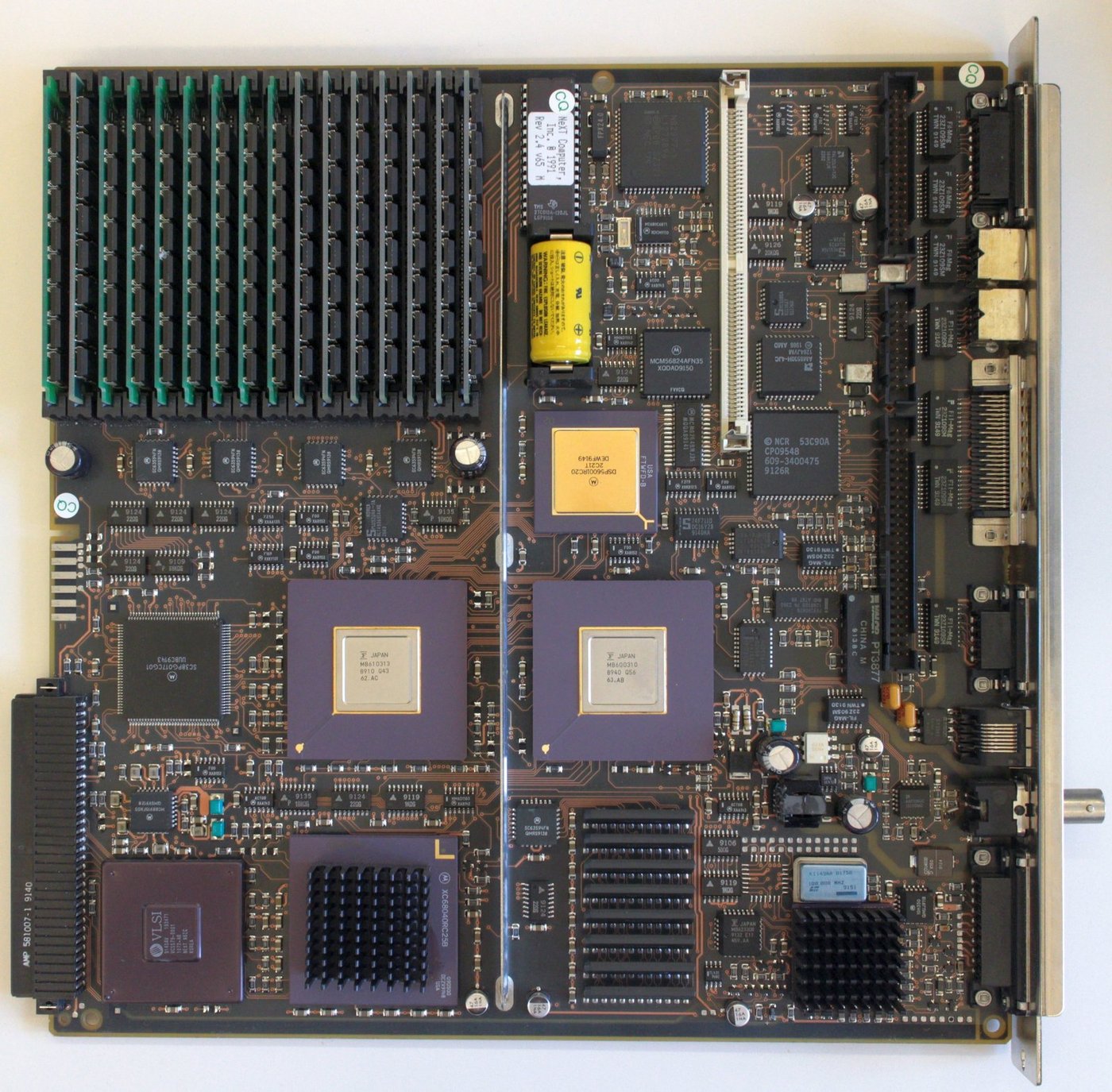
NeXTcube motherboard (1990) with Motorola 68040 microprocessor at 25 MHz and Motorola digital signal processor 56001 at 25 MHz. The descriptions of the integrated circuits as provided in the annotations to the image are partly from https://github.com/jsdf/previous/blob/master/src/ioMemTabNEXT.c. More details on the chips and also connectors can be found in the hardware manual on p. 21The British computer scientist en:Tim Berners-Lee used this model to develop all components of the World Wide Web at the research center CERN in Geneva about 1990. On it, he designed HTTP, HTML, the first web browser named worldwideweb, and the first web server.
Autopilot · CC BY-SA 4.0
* This NeXT workstation (a NeXTcube, monitor Cern 57503) was used by Tim Berners-Lee as the first Web server on the World Wide Web. It is shown here as displayed in 2005 at Microcosm, the public science museum at CERN where Berners-Lee was working in 1991 when he invented the Web.
The document resting on the keyboard is a copy of "CERN DD/OC March 1989 Information Management: A Proposal. Abstract" which was Berners-Lee's original proposal for the World Wide Web. (Further text visible: "...distributed hypertext systems, Hypertext, computer conferencing, document retrieval, information management. Project, IBM Group talk, VAX/Notes, CERNDOC, UUCP News, Hierarchical systems".)
The partly peeled off label on the cube itself has the following text: "This machine is a server. DO NOT POWER IT DOWN!!" The labels on top of the server and on the keyboard read "PROPRIETE CERN" (French for "Cern property").
Just below the keyboard (not shown) is a label which reads: "At the end of the 80s, Tim Berners-Lee (TBL) invented the World Wide Web using this Next computer as the first Web server."
The book is the enyclopedia in many parts of Robert Kemp Philp, ed.: "Enquire Within upon Everything", London 1856 and later editions, which TBL describes on page one of his book "Weaving the Web. The Original Design and Ultimate Destiny of the World Wide Web as "a musty old book of Victorian advice I noticed as a child in my parents' house outside London". (Text that is almost legible in the high resolution picture: 750. Diuretics, 756. Diaphoretics, 761. Expectorants, 765. Ginger).
Text at the beginning of Tim Berners-Lee: Weaving the Web, Chapter 1 Enquire Within upon Everything:
"When I first began tinkering with a software program that eventually gave rise to the idea of the World Wide Web, I named it Enquire, short for Enquire Within upon Everything, a musty old book of Victorian advice I noticed as a child in my parents' house outside London. With its title suggestive of magic, the book served as a portal to a world of information, everything from how to remove clothing stains to tips on investing money. Not a perfect analogy for the Web, but a primitive starting point.
What that first bit of Enquire code led me to was something much larger, a vision encompassing the decentralized, organic growth of ideas, technology and society. The vision I have for the Web is about anything being potentially connected with anything..."
This is a new upload by Coolcaesar of the original JPEG file on en:September 22, en:2008 directly to Commons in response to continued vandalism of the original.
User:Coolcaesar at en.wikipedia · CC BY-SA 3.0
Quiz yourself