Technology
·
Devices And Physics
·
etching wires smaller than a virus…
Medium
6 min
How Do You Draw a Wire Thinner Than a Virus?
The trick that puts billions of transistors on a fingernail
Share
The chip in your phone contains about 16 billion transistors. Each one is roughly 3 nanometers wide — about 30 times smaller than a coronavirus. Nobody carves them by hand. They're printed with light.
Your phone, laptop, and every smart device you own runs on silicon chips — wafers of material packed with microscopic switches called transistors. The more transistors you can fit, the faster and more power-efficient the chip. The question that drove 60 years of engineering: how do you keep making them smaller? The answer turned out to be light — used in a process called photolithography, which is exactly what it sounds like: writing with light.
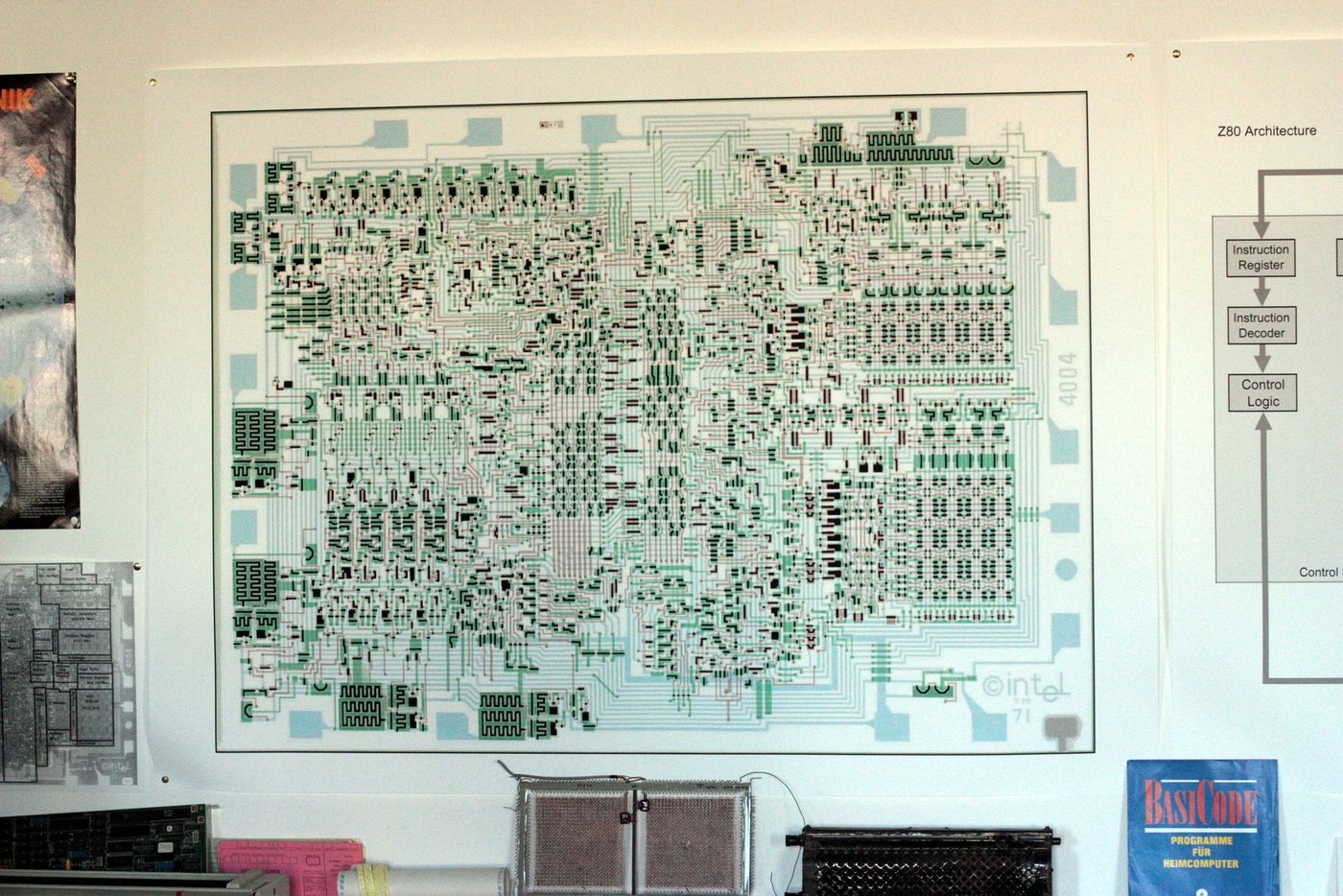
The basic idea is closer to photography than to carving. You coat a silicon wafer with a light-sensitive chemical called a photoresist. Then you shine light through a stencil — called a mask — that has the circuit pattern on it. Wherever the light hits, the photoresist changes chemically. You wash away the exposed parts, then etch the exposed silicon underneath with acid or plasma. What's left behind is a precise pattern of material: wires, gates, connections. Repeat this dozens of times, layer by layer, and you've built a processor.
Make your call
The smallest feature you can print is limited by the wavelength of the light you use. If you want to print features smaller than the light's wavelength, what do you think happens?
A
The pattern blurs — light diffracts around edges and you lose resolution
B
The photoresist compensates by becoming more sensitive
C
Shorter wavelengths are physically impossible to generate
Early chipmakers used visible light — wavelengths around 400–700 nanometers. That was fine when transistors were measured in microns. But as features shrank below 100nm, visible light became useless: you can't focus a feature smaller than the wave printing it, for the same reason you can't write fine calligraphy with a mop. The industry moved to deep ultraviolet (DUV) light at 193nm. Then they hit that wall too. Today's leading-edge chips use extreme ultraviolet (EUV) light at 13.5nm — generated by firing a laser at a tin droplet 50,000 times per second, vaporizing it into plasma that emits the right wavelength. The machines that do this, made almost exclusively by a Dutch company called ASML, cost around $200 million each and weigh as much as a loaded Boeing 737.
Key Insight
A single EUV machine contains more than 100,000 precision parts, must be transported in multiple cargo planes, and requires mirrors so smooth that if you scaled one up to the size of Germany, the tallest bump would be 1 millimeter high. This is the most precise manufacturing process in human history — and it runs 24 hours a day in factories producing chips by the millions.
The 3-nanometer features on a modern chip aren't just small in an impressive way — they're small in a physics-bending way. At that scale, quantum effects start leaking in. Electrons tunnel through barriers they classically shouldn't be able to cross. Managing this is part of why chip design has become as much quantum physics as electrical engineering. The transistors themselves have changed shape — from flat switches to three-dimensional fins (FinFETs) and now gate-all-around structures — specifically to keep quantum leakage under control. The wire isn't just getting smaller. The whole geometry of the switch has had to evolve to survive at that size. That 16-billion-transistor count in your phone isn't the ceiling. It's just where the physics stood when the factory last updated its masks.
Related threads
Technology
·
Your Screen Is Lying to You Beautifully
·
a real-looking photo out of tiny…
Your Screen Is Lying to You Beautifully
Technology
·
How One Cable Carries a Thousand Conversations
·
one cable, two conversations…
How One Cable Carries a Thousand Conversations
Technology
·
Your Phone Listens All Night Without Dying
·
the ear that's always listening, barely…
Your Phone Listens All Night Without Dying
Sources
Images from Wikimedia Commons. Attribution required by license.
Intel 4004 Chip Layout
Wolfgang Stief from Tittmoning, Germany · CC0
Intel 4004 Chip Layout
Wolfgang Stief from Tittmoning, Germany · CC0
Quiz yourself