Technology
·
Data And Storage
·
how a movie fits in your pocket (compression
Medium
5 min
How a Two-Hour Movie Fits on Your Phone
How compression exploits your own predictability to shrink a movie
Share
A two-hour movie, uncompressed, would take up roughly 100 gigabytes. Your phone holds it in under 2. Nothing was deleted. Nothing was lost. So where did the other 98 gigs go?
Every file on your phone — a photo, a song, a video — is just a long string of numbers. The question of data storage is really a question of how many numbers you need, and whether you can get away with fewer. Compression is the art of finding shortcuts in that string: patterns you can describe in fewer numbers than it takes to write them out in full. The two ideas that make it possible are redundancy and entropy — and once you see them, you'll notice them everywhere.
Redundancy is repetition. Think about a video of someone sitting at a desk talking. The background — the wall, the bookshelf, the lamp — doesn't move. Frame after frame, those pixels are identical. A naive video file would write out every single pixel for every single frame: 30 frames per second, 2 million pixels per frame, 7,200 seconds of movie. That's the 100-gigabyte number. A smarter file says: here's frame one in full. For frame two, I'll only describe what changed. If 95% of the frame is a static background, you only need to store the 5% that moved. The rest is just 'same as before.'
Make your call
Here's the question that breaks most people's intuition: if you took a video of a snowstorm — every pixel shifting every frame — would it compress as well as the desk video?
A
Yes — a snowstorm has repeating patterns, so it compresses fine
B
No — constant motion means almost nothing stays the same between frames
C
It depends on the resolution, not the content
Entropy, in information theory, is a measure of surprise. A signal where the next value is totally unpredictable has high entropy — there are no shortcuts, no patterns, nothing to summarize. A signal where the next value is almost always the same as the last has low entropy — you can describe it in very few numbers. The desk video has low entropy (boring background, predictable pixels). The snowstorm has high entropy (chaotic, unpredictable). Compression works by finding and eliminating low-entropy regions. High-entropy content — a snowstorm, a jazz improvisation, a static-filled radio signal — resists compression almost completely. That's not a bug in the algorithm. It's a mathematical ceiling: Claude Shannon (1916–2001, United States), the mathematician who invented information theory, proved in 1948 that you cannot compress a signal below its entropy. You can approach the limit, but you can't beat it.
Key Insight
This is why a ZIP file of a ZIP file is barely smaller than the original. The first compression already squeezed out all the redundancy. What's left is high-entropy data that looks random — and random data, by definition, cannot be compressed further.
Modern video compression — the format your streaming app uses — layers multiple tricks on top of this principle. It throws away information your eyes won't notice anyway: fine color detail in dark regions, high-frequency textures in your peripheral vision, subtle differences between nearly identical shades. This is lossy compression, meaning the file you play back isn't a perfect reconstruction of the original — it's a reconstruction good enough that you can't tell the difference. The 2-gigabyte movie on your phone is the result of a codec (a compression algorithm) making thousands of these judgment calls per second, betting that your visual system won't catch what it left out. Most of the time, it wins that bet. The 98 gigabytes didn't disappear — they were judged unnecessary and discarded. Your brain fills in the rest.
Related threads
Technology
·
Why a Damaged QR Code Still Works
·
a QR code survives a coffee stain…
Why a Damaged QR Code Still Works
Technology
·
Every File Has a Secret Fingerprint
·
any file, one fingerprint…
Every File Has a Secret Fingerprint
Technology
·
The Database That Never Forgets a Power Cut
·
the database that survives a power cut…
The Database That Never Forgets a Power Cut
Sources
Images from Wikimedia Commons. Attribution required by license.
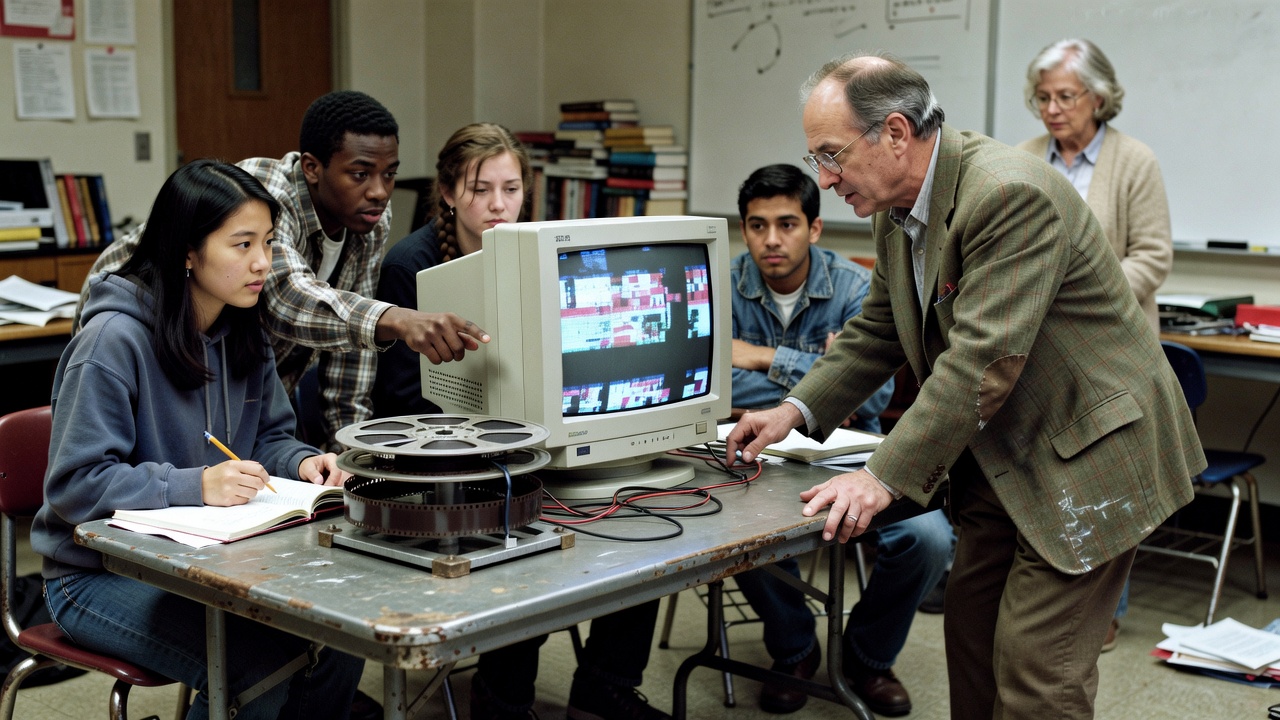
film reel digital compression
Generated by Grok Imagine (xAI), prompt: Generate a single 16:9 horizontal image for an educational lesson.
Lesson title: "How a Two-Hour Movie Fits on Your Phone" · How compression exploits your own predictability to shrink a movie
Domain: …
Claude Shannon information theory
Generated by Grok Imagine (xAI), prompt: Generate a single 4:3 horizontal image for an educational lesson.
Lesson title: "How a Two-Hour Movie Fits on Your Phone" · How compression exploits your own predictability to shrink a movie
Domain: t…
Quiz yourself