Technology
·
Networks
·
one tower, a million phones (frequency…
Medium
5 min
How One Cell Tower Serves a Million Phones
Why your city doesn't run out of signal even when everyone calls at once
Share
A stadium just filled with 80,000 people, and every single one of them is posting a video at the same time. There are only a handful of cell towers nearby. How does anyone get through?
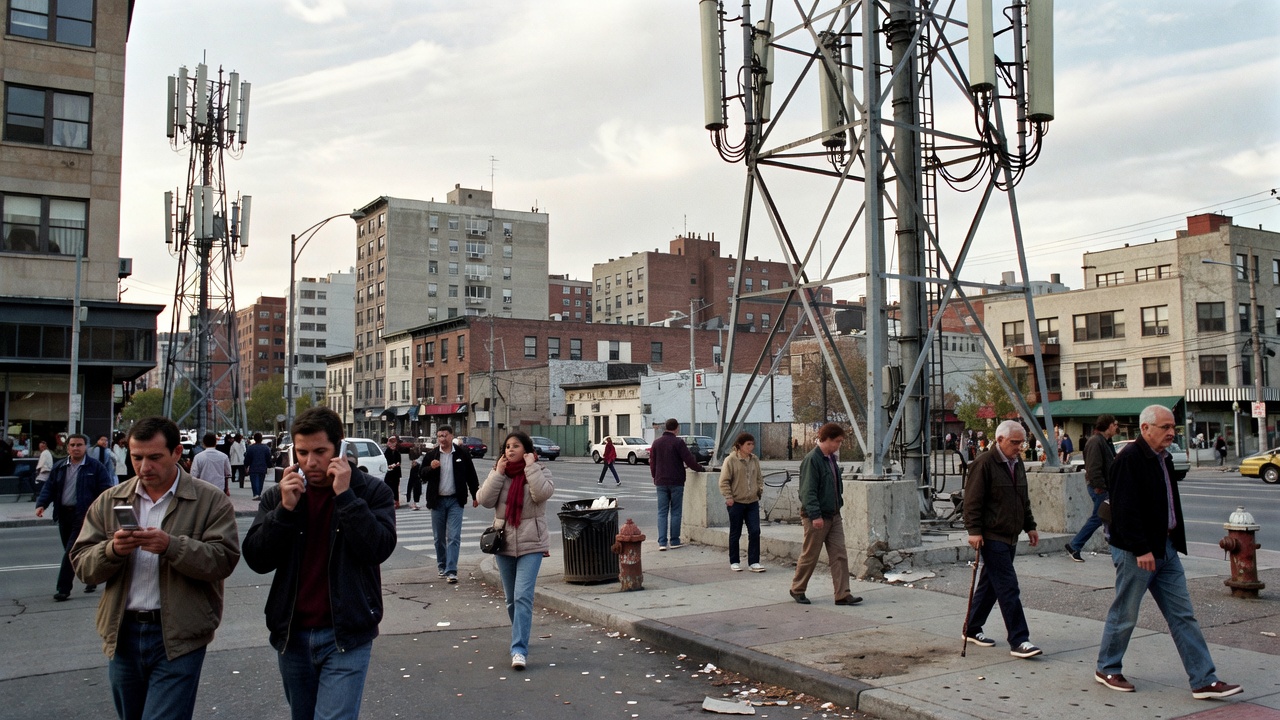
A single cell tower in a dense city serves tens of thousands of phones at once — and somehow your call doesn't collide with theirs. The basic idea is simple: your phone sends a signal to the nearest tower, the tower connects to the internet or phone network, and information flows back and forth. What's not simple is how one city with thousands of towers handles millions of simultaneous conversations without everything colliding into noise. That's the problem frequency reuse solves.
Radio signals travel on frequencies — think of them like lanes on a highway. If two cars try to use the same lane at the same time in the same place, they crash. Two phones transmitting on the same frequency in the same area produce the same result: garbled, unusable signal. Early radio engineers thought this meant you could only have as many simultaneous conversations as you had distinct frequencies. And since the usable radio spectrum is finite — there's only so much of it, and governments carve it up carefully — that seemed like a hard ceiling on how many people could be on the phone at once.
Make your call
So here's the question engineers faced in the 1970s: you have a limited number of radio frequencies and a city full of people who all want to make calls. What's the best way to let more people use the same frequencies without their signals crashing into each other?
A
Assign each person a unique frequency so no two calls ever overlap
B
Reuse the same frequencies in different geographic zones, keeping zones far enough apart that signals don't reach each other
C
Compress multiple calls onto a single frequency using software
Bell Labs engineers figured this out in 1947, though it took decades to actually build. The insight: radio signals weaken with distance. If you divide a city into small zones — cells — and assign each cell a set of frequencies, then use the same frequencies again in a cell far enough away, the two signals never interfere. They've faded to nothing long before they reach each other. A city that could support maybe a few hundred simultaneous calls on a single set of frequencies can now support tens of thousands, by reusing those same frequencies over and over across the map. That's why the technology is called cellular — the geography is the trick.
Key Insight
The spectrum didn't get bigger. The cells did — by getting smaller. More cells in the same area means more frequency reuse, which means more capacity. When a network gets congested, the answer isn't more spectrum. It's smaller cells.
That's exactly what happened when smartphones arrived and data usage exploded. Networks responded by shrinking cells dramatically. Today, dense urban areas are blanketed with 'small cells' — low-power transmitters mounted on lampposts, building facades, and bus shelters, each covering just a few hundred meters. A single city block might have three or four of them. Each one reuses the same frequencies as cells across town, multiplying capacity without any new spectrum. The stadium full of 80,000 people posting simultaneously? The network planned for it by pre-loading that venue with small cells so the frequencies get reused dozens of times within the same physical space. The capacity was built into the geography long before the game started.
Related threads
Technology
·
Your Phone Knew Before You Looked
·
a notification reaches your phone…
Your Phone Knew Before You Looked
Technology
·
Why Bluetooth Is Slow and WiFi Is Fast
·
Bluetooth is slow and WiFi is fast for…
Why Bluetooth Is Slow and WiFi Is Fast
Technology
·
Your Phone Knows Exactly Where You Are
·
how your phone knows where you are…
Your Phone Knows Exactly Where You Are
Sources
Images from Wikimedia Commons. Attribution required by license.
cell tower urban network
Generated by Grok Imagine (xAI), prompt: Generate a single 16:9 horizontal image for an educational lesson.
Lesson title: "How One Cell Tower Serves a Million Phones" · Why your city doesn't run out of signal even when everyone calls at once…
radio frequency spectrum diagram
Generated by Grok Imagine (xAI), prompt: Generate a single 4:3 horizontal image for an educational lesson.
Lesson title: "How One Cell Tower Serves a Million Phones" · Why your city doesn't run out of signal even when everyone calls at once
…
cellular network hexagonal cell map
Generated by Grok Imagine (xAI), prompt: Generate a single 4:3 horizontal image for an educational lesson.
Lesson title: "How One Cell Tower Serves a Million Phones" · Why your city doesn't run out of signal even when everyone calls at once
…
Quiz yourself