Technology
·
Journey Of A Message
·
part 1
Medium
5 min
Part 1 of 3
Your Message Doesn't Travel in One Piece
How a single text gets shredded, scattered, and reassembled before you read it
Share
You hit send. A message leaves your phone. Half a second later, someone on the other side of the planet reads it. What actually happened in that half second — and why does it arrive in one piece when it traveled in thousands?
The internet is not a tube. That's the first thing to understand. When you send a message, it doesn't slide through a dedicated pipe from your device to theirs the way water moves through a hose. Instead, it gets cut up — shredded into small chunks called packets — and each chunk finds its own way to the destination, potentially taking a completely different route. This is packet switching, and it's the foundational trick that makes the modern internet possible.
Before packet switching existed, phone networks worked on something called circuit switching. You'd call someone, and the network would reserve a dedicated electrical path between you and them for the entire call. That path was yours alone — even during silences, even if you put the phone down to make a sandwich. The circuit sat there, idle, blocking other traffic. It worked fine for voice calls. It would have been catastrophically wasteful for data. Imagine reserving a highway lane just for your car, even when you're parked.
Paul Baran (1926–2011, United States) — engineer at RAND Corporation who first proposed distributed packet-switching networks in the 1960s — came up with the core insight: instead of reserving a line, break the message into pieces and let each piece route around whatever's in its way. The network becomes resilient. One router goes down? The packets reroute. Traffic jam on one path? Packets take another. No single point of failure can stop the message.
Make your call
You send a video file to a friend. It gets cut into thousands of packets, each taking a different route across the internet. What do you think happens when they arrive?
A
They arrive in order, because routers coordinate the sequence
B
They arrive out of order, and your device reassembles them
C
They arrive out of order, and the last packet triggers a re-send of any missing ones
Each packet carries three things: a chunk of the actual data, a header with the destination address and sequence number, and a small checksum so the receiving device can verify nothing got corrupted in transit. When all the packets arrive — in whatever order, via whatever routes — your device sorts them by sequence number, checks the checksums, and reconstructs the original. If a packet is missing or damaged, it asks for just that one to be resent. Not the whole message. Just the missing piece. This is why a slow internet connection doesn't always mean a broken download — it might just mean one packet is taking the scenic route.
Key Insight
Right now, those packets are passing through routers you don't own, run by companies you've never heard of, in countries you've never visited. Each router reads the destination address on the packet's header — just like a postal worker reading an envelope — and forwards it to the next hop. Dozens of strangers' machines are handling your message before it reaches its destination. Which raises an obvious question: if anyone on the path can read the address on the envelope... what's stopping them from reading what's inside?
Related threads
Technology
·
Your Message Is Sealed Before It Leaves Your Phone
·
part 2
Your Message Is Sealed Before It Leaves Your Phone
Technology
·
The Video That Didn't Come From the Source
·
part 3
The Video That Didn't Come From the Source
Sources
Images from Wikimedia Commons. Attribution required by license.
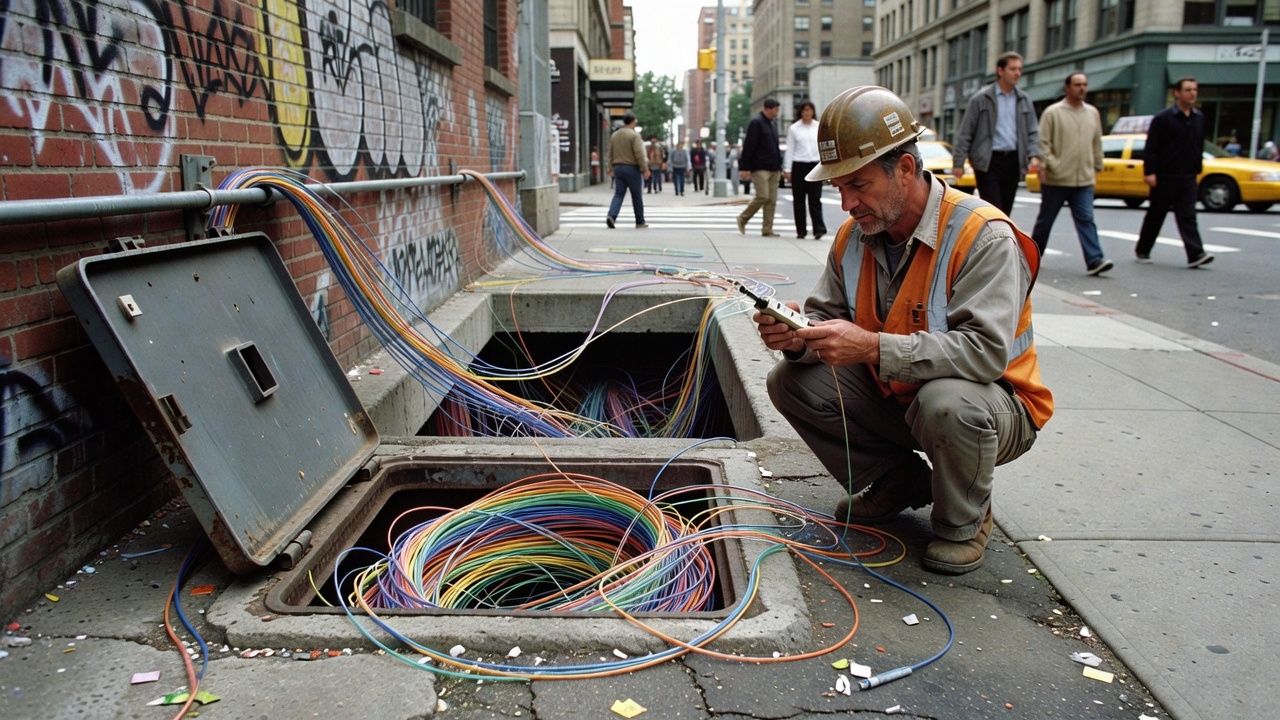
fiber optic network cables
Generated by Grok Imagine (xAI), prompt: Generate a single 16:9 horizontal image for an educational lesson.
Lesson title: "Your Message Doesn't Travel in One Piece" · How a single text gets shredded, scattered, and reassembled before you rea…
Telephone operators - New Quotation Room - New York Stock Exchange
Library of Congress · Public Domain via Library of Congress
Quiz yourself