Science
·
Science Is Messier Than You Think
Easy
5 min
Science Is Messier Than You Think
The real process behind discoveries looks nothing like what you learned in school
Share
The scientist who discovered that stomach ulcers are caused by bacteria had to drink a beaker full of the stuff to get anyone to believe him. The scientific method, as it turns out, is less 'orderly steps' and more 'controlled chaos with occasional self-experimentation.'
You were probably taught the scientific method as a neat five-step checklist. Question → Hypothesis → Experiment → Results → Conclusion. Clean. Linear. Tidy. Real science looks nothing like that. Real science looks like a group chat where everyone is arguing, half the results are confusing, someone keeps changing the question, and occasionally one person turns out to be completely right for the wrong reasons. The checklist isn't wrong — it's just a map, and maps leave out all the terrain that makes travel interesting.
Analogy
Think about how you actually figure out why your phone battery is dying so fast. You don't write a formal hypothesis and design a controlled experiment. You check what's running in the background. You turn off location services. You charge it differently. You notice it dies faster when you're on cellular. You form a guess, test it casually, revise the guess, test again. That back-and-forth — observe, guess, poke at it, update your thinking — is closer to how science actually works than any textbook flowchart. Scientists just do that with more rigor, more documentation, and way more arguing about the results.
Here's what the process actually looks like. A scientist notices something weird — an anomaly, a pattern, a result that doesn't fit. They form a hypothesis: a specific, testable explanation for what might be going on. The word 'testable' is doing a lot of work here. A hypothesis isn't just a guess. It has to make a prediction you can actually check. 'Stress causes ulcers' is a hypothesis. 'Bad vibes cause ulcers' is not — you can't design an experiment around bad vibes. Then they run experiments, collect data, and see if reality cooperates. Usually, it doesn't. Usually, the results are messy, partial, or just confusing.
Key Insight
The most important word in science isn't 'proven.' It's 'falsifiable.' A good scientific claim is one that COULD be proven wrong if the evidence went the other way. If no possible result could ever change your mind, you're not doing science — you're doing something else.
Make your call
Barry Marshall couldn't convince anyone that bacteria caused ulcers. What do you think finally changed the medical establishment's mind?
A
He published a landmark meta-analysis combining dozens of patient studies
B
He drank the bacteria himself, got sick, then cured himself with antibiotics
C
A pharmaceutical company funded a large controlled trial that confirmed his results
Example
Back to Barry Marshall, the ulcer guy. In the 1980s, the medical consensus was firm: ulcers are caused by stress and stomach acid. Marshall and his colleague Robin Warren found bacteria living in ulcer patients' stomachs and suspected the bacteria were the actual cause. Nobody believed them. The idea that bacteria could survive in stomach acid seemed absurd. So in 1984, Marshall drank a petri dish full of the bacteria, developed gastritis within days, treated it with antibiotics, and recovered. It was reckless, dramatic, and it worked. He won the Nobel Prize in 2005. The point isn't that you should drink bacteria. The point is that overturning scientific consensus requires extraordinary evidence — and sometimes the system resists even that for years.
This is where replication comes in — and it's the part of science that almost nobody talks about but that matters enormously. One experiment proving something means very little. Science builds confidence through repetition: other researchers, in other labs, with different equipment, getting the same results. When that happens, you start to trust the finding. When it doesn't — when other labs can't reproduce the result — that's a red flag. In the last decade, psychology and medicine have been rocked by a 'replication crisis,' where huge numbers of famous studies turned out to be impossible to reproduce. That's not science failing. That's science working — catching its own mistakes, slowly and painfully, the way it's supposed to.
Key Insight
Science doesn't give you Truth with a capital T. It gives you the best current explanation that survives the most rigorous attempts to destroy it. That's actually more valuable — because it updates when better evidence shows up.
So next time someone says 'scientists used to think X, so why should I trust them now?' — that's actually the wrong takeaway. Scientists used to think ulcers were caused by stress — until one researcher drank a beaker of bacteria and proved them wrong. Then the evidence was too hard to ignore. They updated. That's not a bug in the system. That's the whole point of the system. The goal was never to be right the first time. The goal is to be less wrong over time.
Sources
Images from Wikimedia Commons. Attribution required by license.
scientist lab experiment
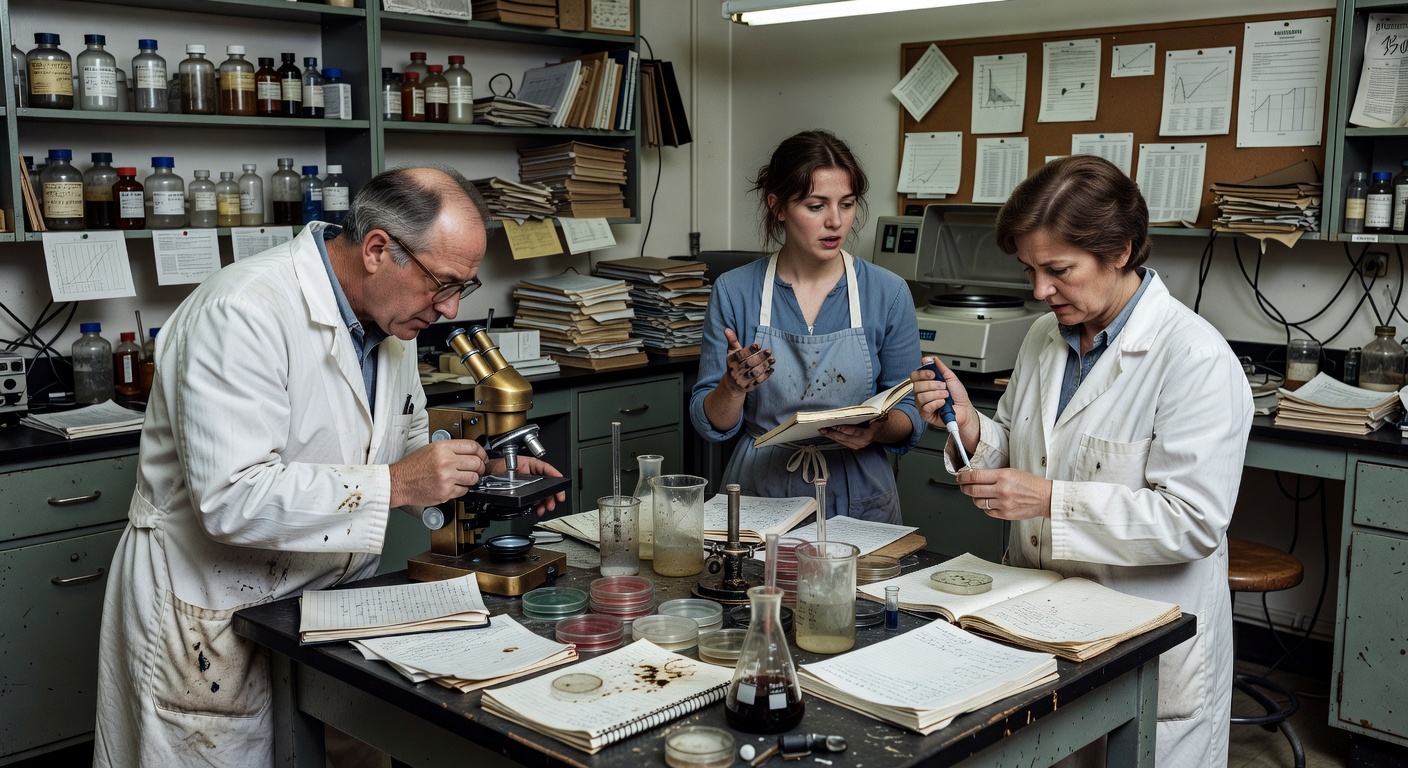
Generated by Grok Imagine (xAI), prompt: Generate a single 16:9 horizontal image for an educational lesson.
Lesson title: "Science Is Messier Than You Think" · The real process behind discoveries looks nothing like what you learned in school…
These bacteria were cultured from a urine sample from a woman who thought she had a urinary tract infection. I'm definitely not seeing any Escherichia Coli in this sample, which is supposedly the most common agent by far in such infections; that, being Gram-negative would have stained pink. Perhaps the cocci might be Staphylococcus saprophyticus, that supposedly being a distant second most common cause of such infections. I don't know what the bacilli might be, I have no information about any form of those that are common in this sort of infection. But then, I'm strictly an amateur at this sort of thing.
Surely it is a symptom that one's hobby is making one weird; when one's first reaction, on hearing from one's wife that she thinks she might have a urinary tract infection, is to want a sample to examine under one's microscope.
I didn't actually see much on directly examining the sample provided by my wife, so I put a bit of it in a Petri dish to see what I could culture out. This was much slower to grow than other bactiera I have cultured in this manner. After ten days, using Micrology Laboratories' Easygel medium at room temperature, I had grown barely enough for one slide.
This picture was taking using a 100× oil-immersion objective, together with a 15× eyepiece that contains the numbered scale that appears in this image. The numbered ticks on the scale are eleven (11) microns apart, the smaller unnumbered ticks being 1.1 microns apart. And of course, this sample was Gram-stained.
Bob Blaylock · CC BY-SA 3.0
Quiz yourself