Science
·
The Invisible River Running Through Everything
Medium
7 min
The Invisible River Running Through Everything
How a stampede of tiny particles becomes the force running through every circuit you use
Share
Right now, billions of electrons are moving through the walls of the room you're in. They're not going anywhere useful on their own — but the second you flip a switch, they form a river so precise it can power a city or kill a person. Same particles. Completely different outcome. The difference is control.
Every atom has a nucleus surrounded by electrons — tiny negatively charged particles orbiting at the edges. In most materials, those electrons are locked in place, bound tightly to their atoms. But in metals like copper, the outermost electrons are barely holding on. They wander freely between atoms like people milling around a crowded room with no fixed seat.
Those free electrons are the entire story of electricity. Everything else — circuits, voltage, watts — is just describing what happens when you get those electrons to move in the same direction at the same time.
Here's where three terms you've heard your whole life finally make sense together:
Voltage is the pressure — how hard the battery is pushing electrons. Higher voltage means more urgency, more force behind the flow. A 9V battery pushes harder than a 1.5V AA.
Current is the flow rate — how many electrons actually move past a point per second. Measured in amps.
Resistance is the friction — how hard the wire (or whatever the electrons are moving through) fights back. Thin wire, bad conductors, and components all add resistance.
They're locked together by one of physics' most useful relationships: Voltage = Current × Resistance. Crank up the voltage with the same resistance, and more current flows. Add more resistance with the same voltage, and less current gets through. It's not complicated — it's just pressure, flow, and friction.
Key Insight
Resistance isn't the enemy — it's the point. When electrons have to fight through a thin tungsten filament in a light bulb, all that friction turns into heat and light. Your phone charger, your toaster, your speaker — they all work by turning electrical resistance into something useful. Electricity without resistance would just be wire getting hot for no reason.
Example
Imagine you're plugging in your laptop. Here's what's actually happening:
The outlet in your wall is connected to a power grid where generators are constantly pushing electrons back and forth (that's AC — alternating current — but ignore that for now). The moment you plug in, you complete a circuit — a closed loop that electrons can travel around. No loop, no flow. That's why pulling the plug stops everything instantly: you broke the loop.
Your charger brick isn't just a plug — it's a transformer that converts the high-voltage power from the wall into the lower, steadier voltage your laptop battery needs. Inside that brick, resistance, magnetism, and clever engineering are all working together. The whole thing runs on the same three concepts: voltage, current, resistance.
Make your call
Flip a light switch and the bulb lights up almost instantly. But if electrons themselves are the current, how fast are they actually moving through the wire?
A
Close to the speed of light — electrons are nearly massless, so they travel almost instantly
B
A few centimeters per hour — but a pressure wave travels at nearly the speed of light
C
Around the speed of sound — fast, but measurably slower over long distances
Now it gets interesting — electricity doesn't actually travel slow. The electrons themselves barely move (a few centimeters per hour, honestly). What travels at nearly the speed of light is the signal — the push. It's like a tube packed with marbles. Push one marble in one end and a marble pops out the other end instantly, even though no individual marble traveled the whole length.
So when you flip a light switch and the bulb lights up 'instantly,' you're not waiting for electrons to race across the room. You're feeling the pressure wave arrive — which is basically instantaneous.
Key Insight
A circuit has to be a complete loop. Always. Electrons need somewhere to go AND somewhere to come back from. Open the loop anywhere — cut the wire, flip the switch, pull the plug — and the current stops. This is why a bird can sit on a power line without dying: it's touching one wire. The moment it touches two wires (completing a circuit through its body), it becomes the path electrons take. That's a very bad day for the bird. Same particles, same wire — the difference, as always, is control.
Sources
Images from Wikimedia Commons. Attribution required by license.
electric lightning bolt city
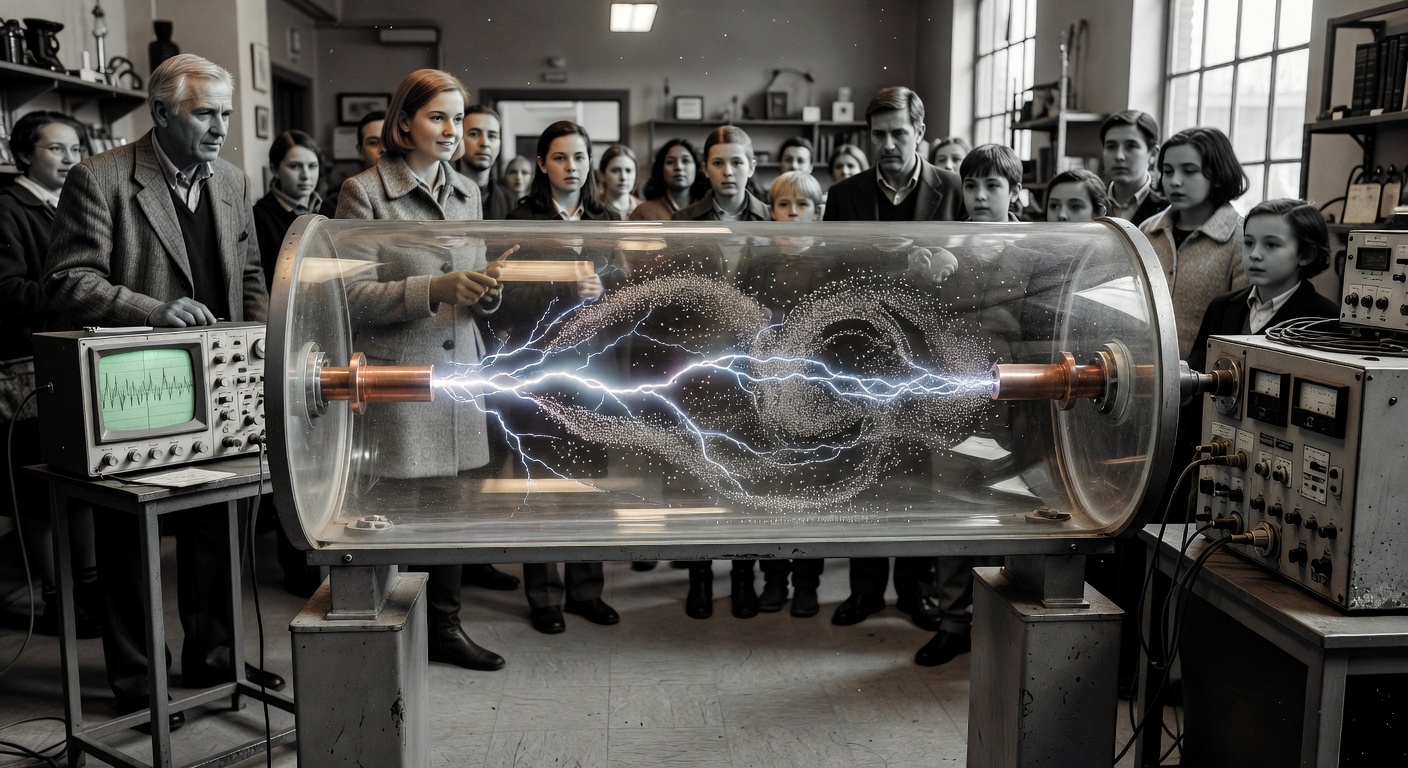
Generated by Grok Imagine (xAI), prompt: Generate a single 16:9 horizontal image for an educational lesson.
Lesson title: "The Invisible River Running Through Everything" · How a stampede of tiny particles becomes the force running through e…
copper wire electrons microscope
Generated by Grok Imagine (xAI), prompt: Generate a single 4:3 horizontal image for an educational lesson.
Lesson title: "The Invisible River Running Through Everything" · How a stampede of tiny particles becomes the force running through ev…
"Franklin & Kite" Engine Panel Painting — ca 1835
Gift of CIGNA Museum and Art Collection via Smithsonian Open Access (CC0)
Quiz yourself