Science
·
Why You Can't Unscramble an Egg
Medium
7 min
Why You Can't Unscramble an Egg
The hidden law that gives time its direction — and why the universe is slowly falling apart
Share
You've never seen a broken coffee mug leap off the floor and reassemble itself. But the laws of physics technically allow it. So why doesn't it happen? The answer explains why time only moves forward — and why everything, eventually, falls apart.
Here's something nobody told you in school: the basic laws of physics are reversible. If you filmed two billiard balls colliding and played the video backward, it would look completely normal. No law of physics gets violated. But film a coffee mug shattering on the floor and play it backward? It looks insane. Something is different about the mug — and that difference is entropy.
Entropy is a measure of disorder — or more precisely, the number of ways a system's parts can be arranged. A whole mug has basically one arrangement that counts as 'whole mug.' A shattered mug has millions of arrangements that count as 'shattered.' When the mug falls, it's not that something pushes it toward disorder. It's that disorder has so many more possible states that landing there is almost mathematically inevitable. Order is rare. Chaos is the default.
Analogy
Think about your phone's camera roll after a night out. Photos, memes, screenshots, blurry videos — all mixed together in a chaotic pile. Now imagine trying to get them back into perfect chronological order with every file neatly named. The messy state happened on its own. The organized state requires deliberate effort. That's entropy in action. The universe is constantly moving from your organized camera roll toward your chaotic one — and it takes real energy to fight that direction.
Make your call
Back to that shattered coffee mug from the hook: why doesn't it ever leap off the floor and reassemble itself? Physics says the particles *could* reverse — so what's actually stopping them?
A
Energy is lost when the mug shatters, so there's not enough left to reverse the process
B
The shattered state has so many more possible arrangements than the whole mug that reassembly is effectively impossible
C
A law of physics specifically forbids matter from moving backward in time
Key Insight
The Second Law of Thermodynamics: In any closed system, entropy always increases over time. Order breaks down. Heat spreads out. Things fall apart. This isn't pessimism — it's physics. And it's the reason time has a direction at all.
Heat is entropy's partner in crime. Heat is just atoms moving around — the faster they move, the hotter something is. When you put a hot cup of coffee in a cold room, the fast-moving coffee molecules crash into slower air molecules and transfer energy. The coffee cools. The room warms, barely. That heat spreads out and never spontaneously concentrates back into your cup. Why? Because there are astronomically more ways for heat to be spread out evenly than for it to be clumped in one spot. Entropy wins, every time.
Here's the catch — and the answer to why that mug stays shattered. This is why time feels like it moves in one direction. The laws of physics don't actually care which way time flows — except for entropy. The 'arrow of time' is just entropy increasing. The past is the low-entropy state. The future is the high-entropy state. You remember the past and not the future because your memories are physical records — ordered patterns in your brain — that formed when entropy was lower. You are, in a very real sense, a creature of increasing disorder.
Key Insight
Life itself is a temporary rebellion against entropy. Every living thing takes in energy — from food, from sunlight — and uses it to maintain order inside itself. But it always exports more disorder to the surroundings than it creates internally. You're not cheating entropy. You're just moving it around. The universe's total entropy bill always goes up.
Zoom out far enough and this gets genuinely unsettling. The universe started in an extraordinarily low-entropy state — the Big Bang was a single, impossibly ordered point. Everything since has been entropy increasing: stars forming and exploding, galaxies spreading, energy dispersing. Eventually — in trillions of years — all the useful energy will be spread out perfectly evenly, no temperature differences anywhere, no way to do work. Physicists call this the Heat Death of the universe. The final, maximum-entropy state. Nothing happens after that. Nothing can.
Sources
Images from Wikimedia Commons. Attribution required by license.
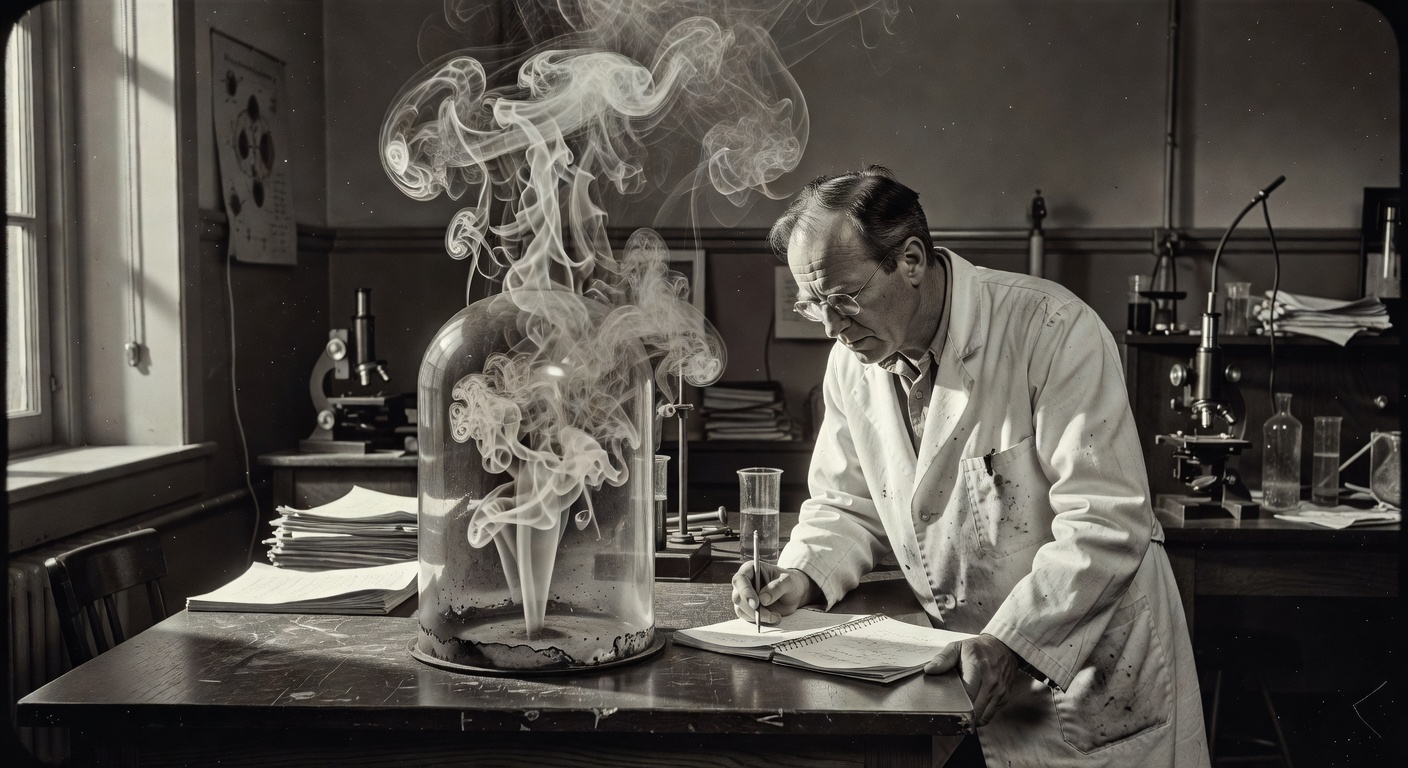
smoke dispersing air
Generated by Grok Imagine (xAI), prompt: Generate a single 16:9 horizontal image for an educational lesson.
Lesson title: "Why You Can't Unscramble an Egg" · The hidden law that gives time its direction
Alice Muth (1887-1952) in The Commercial Appeal of Memphis, Tennessee on October 4, 1946, part 1
Ida Clemens for text and Charles Nicholas for the image · Public domain
Quiz yourself