Science
·
Why Water Is Weirder Than You Think
Easy
5 min
Why Water Is Weirder Than You Think
The molecule whose strange chemistry makes life possible
Share
You drink it every day without thinking twice. But water is one of the strangest substances in the universe — it defies the rules that govern almost every other molecule. And without those weird rule-breaking properties, life on Earth simply wouldn't exist.
Here's something that should bother you: by all the rules of chemistry, water should be a gas at room temperature. Its molecular cousins — hydrogen sulfide, hydrogen selenide — are all gases. Water is tiny and lightweight. It should float away like steam the moment it forms. And yet, here it is. Liquid. Filling oceans. Keeping you alive. Something about water is deeply, fundamentally different.
That something is the shape of the molecule. A water molecule is two hydrogen atoms bonded to one oxygen atom — H₂O, you've known that since middle school. But the shape matters more than the formula. The oxygen pulls the shared electrons toward itself so aggressively that one side of the molecule ends up slightly negative, and the hydrogen side ends up slightly positive. The whole molecule becomes a tiny magnet with two poles. Chemists call this being 'polar.' You can call it the reason water is weird.
Make your call
Water is tiny and lightweight — by chemistry's rules, it should be a gas at room temperature, just like its molecular cousins. So what actually keeps it liquid?
A
Water molecules are heavy enough that gravity holds them together in liquid form
B
The lopsided shape of the molecule creates tiny magnetic attractions that lock molecules together
C
Oxygen is so reactive that it chemically bonds water molecules into a continuous liquid network
Analogy
Think about how magnets work in your earbuds case — the positive end of one magnet snaps toward the negative end of another. Water molecules do the exact same thing. The slightly positive hydrogen on one water molecule gets attracted to the slightly negative oxygen on another. These tiny magnetic handshakes are called hydrogen bonds. They're weak individually — but water molecules are constantly forming thousands of them at once. It's like a mosh pit where everyone is grabbing everyone else. That collective grip is why water stays liquid when it 'should' be a gas, why it takes forever to boil, and why it stores heat so well.
Key Insight
Water's polarity is the master key. It's the reason water dissolves almost everything, sticks to itself, and refuses to boil at a 'normal' temperature. One lopsided molecule explains most of what makes life possible.
Now here's where the 'universal solvent' thing comes in. When you drop salt into water, the salt crystals — which are sodium and chloride ions held together by electrical attraction — get ambushed. The negative end of water molecules swarms around the positive sodium ions. The positive end swarms around the negative chloride ions. Water essentially pries the crystal apart ion by ion and surrounds each piece, keeping them dissolved and separated. This is called solvation, and water does it to almost everything: sugars, proteins, minerals, DNA. Your blood, your cells, your neurons — they all work because water is constantly dissolving and transporting the right molecules to the right places.
Example
Your morning coffee is a chemistry demo. The bitter compounds in coffee grounds — caffeine, chlorogenic acids — are polar molecules. Water's polarity grabs them and pulls them out of the grounds into your cup. Oil, on the other hand, is nonpolar. Its electrons are spread out evenly, so water has nothing to latch onto. That's why oil and water don't mix, and why your salad dressing separates every time. The universal solvent has limits — it only dissolves things it can magnetically grab.
And here's the bonus weird thing: ice floats. That sounds obvious until you realize it shouldn't happen. Almost every substance is denser as a solid than as a liquid — solid iron sinks in liquid iron, solid wax sinks in liquid wax. But when water freezes, its hydrogen bonds lock into a rigid crystal structure that's actually more spread out than liquid water. Ice is less dense than liquid water, so it floats. That one quirk is why fish survived ice ages — the floating ice insulated the liquid water below, keeping it from freezing solid all the way down. Life hid under the ice sheet and waited.
Key Insight
If ice sank like every other solid, lakes and oceans would freeze from the bottom up. There would be no liquid refuge. Complex life probably never gets started. The fact that you exist might come down to water being too weird to follow the rules — which is exactly what makes it the strangest, most life-sustaining substance in the universe.
Related threads
Science
·
You're Mostly Empty Space
You're Mostly Empty Space
Sources
Images from Wikimedia Commons. Attribution required by license.
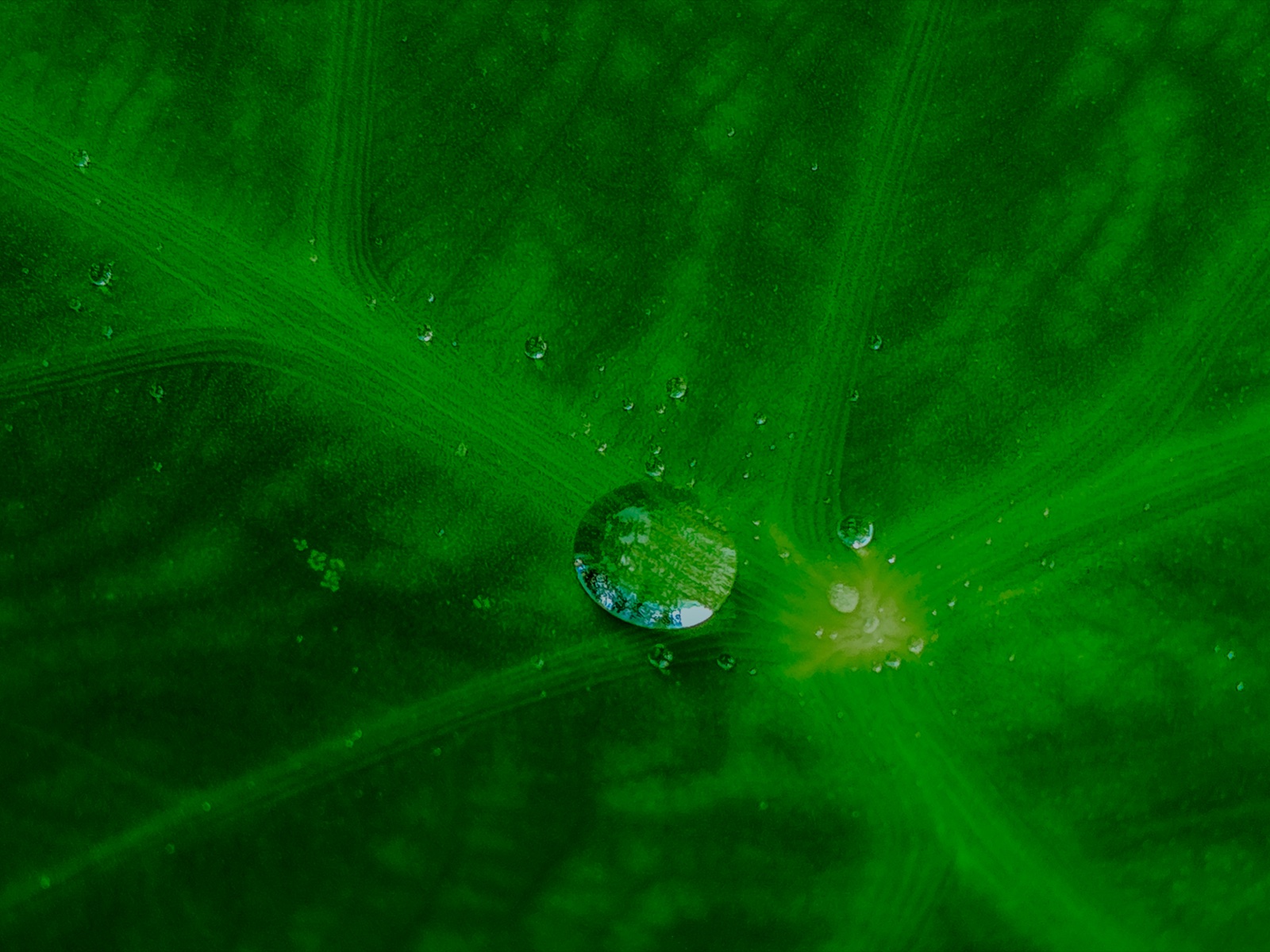
A macro photograph showing a single water droplet resting on a vibrant green leaf. The droplet reflects the surroundings like a miniature lens, while the leaf’s visible veins and textures create an intricate natural pattern.
Navaneethpp · CC BY-SA 4.0
A Waterdrop detaching from a water tap on 21 January 2006
Roger McLassus · CC BY-SA 3.0
Wilson Bentley Photomicrograph of Tabular Snowflake No. 349 — 1890
SIA via Smithsonian Open Access (CC0)
Quiz yourself