Science
·
Why Does Anything Change Into Anything Else?
Medium
6 min
Why Does Anything Change Into Anything Else?
Fire, rust, and digestion all come down to atoms breaking apart and bonding back together differently.
Share
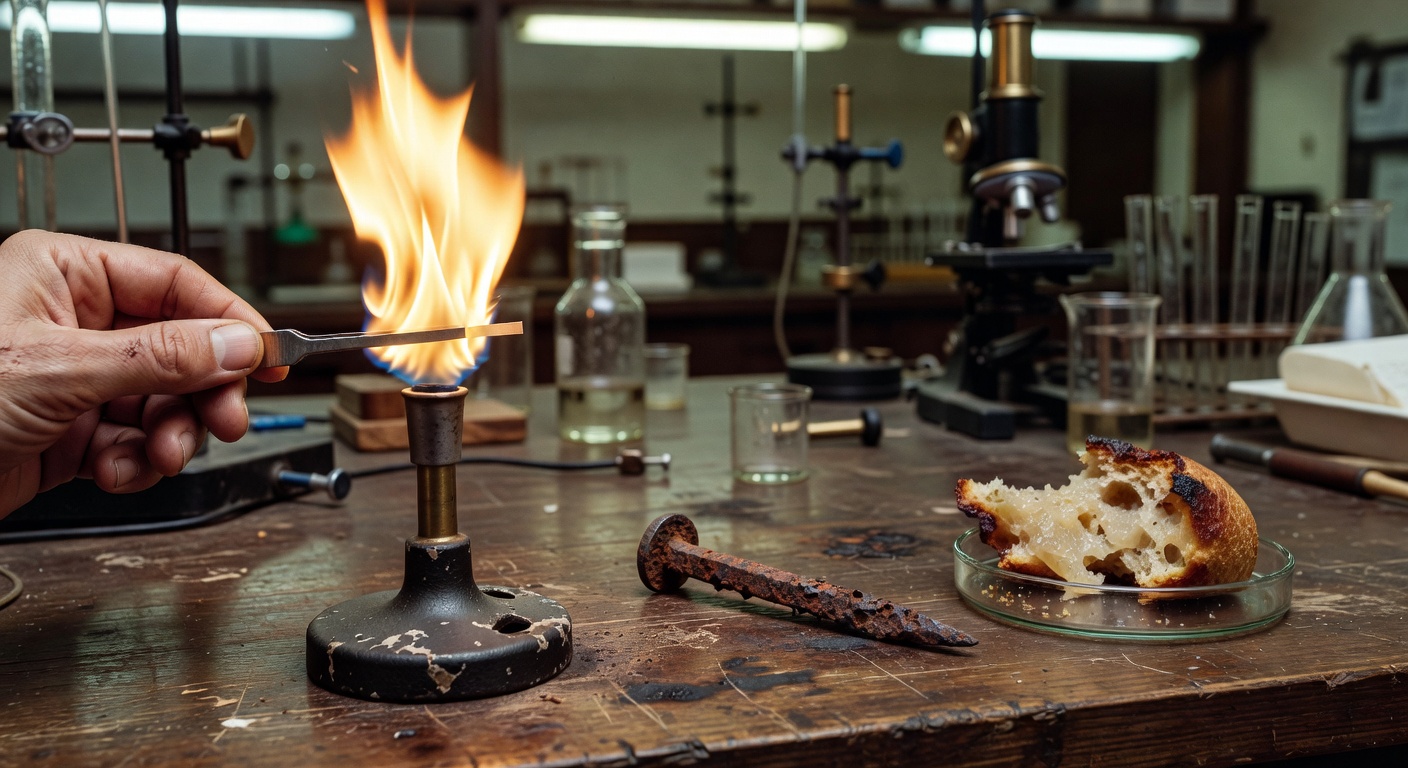
You leave a bike outside for a month. You burn a marshmallow. You digest a burger. These look nothing alike — but they're all the same thing happening at the atomic level. Something is breaking apart and rebuilding into something new. And once you see how, you can't unsee it.
Make your call
You burn wood and the solid disappears. Where do the atoms actually go? Pick your best guess before the answer.
A
The atoms are destroyed by the heat — combustion converts matter into pure energy
B
The carbon atoms grab onto oxygen in the air and become carbon dioxide gas, still floating around you
C
The atoms shrink into ash particles too small to see but still stay in the same place
Here's the core idea: atoms don't appear or disappear. They just rearrange. When wood burns, the carbon atoms in the wood don't vanish — they grab onto oxygen atoms in the air and become carbon dioxide. The wood is gone, but its atoms are still floating around you, just wearing a different outfit. That rearrangement — bonds breaking, new bonds forming — is a chemical reaction. Every single one of them, from explosions to the slow browning of a cut apple.
Analogy
Think of atoms like people in a group chat. Right now they're all in one chat together — that's a molecule. A chemical reaction is when the group chat dissolves and everyone re-adds each other into completely different group chats. The people (atoms) are exactly the same. But the conversations (molecules) are totally new. The old chat is gone. New ones exist that didn't before. That's transformation. Not creation, not destruction — just radical regrouping.
What actually holds those group chats together? Chemical bonds. Specifically, the sharing or swapping of electrons between atoms. When a bond breaks, it costs energy. When a new bond forms, it releases energy. A chemical reaction is basically an energy negotiation — breaking old bonds requires an input, and forming new ones pays you back. If the new bonds release more energy than the old ones cost to break, you get an exothermic reaction: fire, explosions, hand warmers. If forming the new bonds costs more than you get back, you need to keep pumping energy in — that's endothermic: cooking, photosynthesis, melting ice with salt.
Key Insight
Every chemical reaction is an energy trade. Break bonds (costs energy), form bonds (releases energy). Which direction the net energy flows tells you whether something burns hot or goes cold. That's not a detail — that's the whole game.
Example
Baking soda and vinegar. You've probably mixed them and watched them foam. Here's what's actually happening: the acetic acid in vinegar (CH₃COOH) reacts with sodium bicarbonate (NaHCO₃). The atoms reorganize into water, sodium acetate, and — here's the dramatic part — carbon dioxide gas. That gas is what's fizzing. You didn't create the bubbles from nothing. You rearranged atoms until some of them became a gas that needed to escape. The mess is just chemistry doing its thing.
Now it gets interesting. The speed of a reaction isn't fixed. You can make the same reaction happen faster or slower by changing conditions. Temperature is the big one — heat gives atoms more kinetic energy, so they crash into each other harder and more often, which means more successful collisions, which means faster reactions. That's the bike rusting, the marshmallow burning, the burger digesting — same atomic logic, just different speeds. Food rots faster at room temperature than in your fridge for exactly the same reason. Same reaction, same atoms, just slower because the atoms aren't moving as aggressively. Catalysts do something even cooler — they lower the energy barrier for a reaction without being consumed themselves. Your body runs almost entirely on biological catalysts called enzymes. Without them, digesting a meal would take years.
Key Insight
You are a walking chemical reaction factory. Right now, enzymes in your cells are breaking down glucose, transferring electrons, and releasing the energy that keeps you alive. That's not a metaphor. That is literally what's happening inside you as you read this.
Sources
Images from Wikimedia Commons. Attribution required by license.
chemical reaction fire
Generated by Grok Imagine (xAI), prompt: Generate a single 16:9 horizontal image for an educational lesson.
Lesson title: "Why Does Anything Change Into Anything Else?" · Fire, rust, and digestion all come down to atoms breaking apart and bo…
Antoine Laurent Lavoisier (1743–1794) and Marie Anne Lavoisier (Marie Anne Pierrette Paulze, 1758–1836) — 1788
Jacques Louis David via The Metropolitan Museum of Art (Public Domain)
From a kindergarten in Norway. Three children are experimenting with vinegar, baking soda, and orange, non-toxic paint. They are observing a possible reaction.
Pictureflow Media · CC0
Quiz yourself