Science
·
Everything Eats Something Else
Easy
5 min
Everything Eats Something Else
Why killing one species can accidentally destroy an entire forest
Share
In the 1950s, China declared war on sparrows. Mao figured the birds were eating too much grain, so millions of people banged pots and pans until sparrows dropped dead from exhaustion. They killed hundreds of millions of birds. Two years later, China had the worst famine in human history. The sparrows weren't the problem. They were the solution.
Make your call
China killed hundreds of millions of sparrows to protect the grain supply. So why did tens of millions of people starve shortly after? What went wrong?
A
The sparrows had been eating insects that destroyed crops — without them, pests took over
B
Killing the sparrows disrupted rainfall patterns, causing a drought
C
The campaign exhausted so many workers that the harvest couldn't be brought in
Here's what actually happened in China: sparrows ate grain, yes. But they also ate locusts. Remove the sparrows, and the locust population exploded. Locusts devoured the crops. No crops, no food. Tens of millions of people starved. One decision. One species. Catastrophic collapse. That's an ecosystem doing what ecosystems do — everything is connected to everything else, and the connections are invisible until they break.
An ecosystem is just a community of living things interacting with each other and their environment. That sounds boring. Here's the non-boring version: every organism is either eating something or being eaten by something, and that chain of eating is how energy moves through the entire living world. Sunlight hits a leaf. A caterpillar eats the leaf. A bird eats the caterpillar. A hawk eats the bird. The hawk dies, bacteria break it down, and the nutrients go back into the soil to feed the next plant. Energy flows in one direction. Matter loops endlessly.
Analogy
Think of it like a group chat where everyone is sharing content. Producers — plants, algae — are the accounts that create original content (they capture sunlight and turn it into energy). Herbivores are the people who repost it. Carnivores are the people who repost the reposts. Each time something gets reshared, a little quality is lost — energy degrades at every step. By the time you're five links deep, the original signal is almost gone. That's why you almost never see a food chain longer than four or five steps. There's just not enough energy left to sustain another level.
Key Insight
Only about 10% of energy transfers from one level to the next. A plant captures 1,000 calories of sunlight. The deer eating it gets 100 calories. The wolf eating the deer gets 10. This is why large predators are rare — the math simply doesn't support many of them.
A food chain is a single line: grass → rabbit → fox. Clean, simple, and almost never how nature actually works. Real ecosystems are food webs — tangled networks where one organism feeds on many things, and gets eaten by many things. Your fox doesn't just eat rabbits. It eats mice, birds, beetles, and berries. Which means if rabbit populations crash, foxes switch to mice. The web absorbs the shock. This is why biodiversity isn't just a feel-good concept — it's structural insurance. The more species in a web, the more ways energy can flow, and the harder it is to knock the whole thing down.
Example
Yellowstone National Park, 1995. Wolves had been hunted to extinction there for 70 years. Without wolves, elk grazed wherever they wanted — especially along riverbanks, where the grass was lush. They ate everything. Trees couldn't grow. Without tree roots, riverbanks eroded. Rivers changed course. Then scientists reintroduced just 41 wolves. The elk started avoiding open riverbanks — too exposed, too dangerous. Trees grew back. Songbirds returned. Beavers returned. The beavers built dams. The dams created wetlands. Fish populations recovered. The rivers literally changed shape. Biologists call this a trophic cascade — one species at the top reshaping everything below it. The wolves didn't just kill elk. They changed the rivers.
Key Insight
The most powerful species in an ecosystem isn't always the biggest or the most numerous. It's the one whose removal causes everything else to collapse. Ecologists call this a keystone species — like the keystone in an arch. Pull it out, and the whole structure falls.
And here's where it gets personal. Humans have spent centuries simplifying ecosystems — clearing forests, eliminating predators, farming monocultures. Every time we do, we're trading complexity for short-term efficiency. The problem is that complexity is what makes ecosystems resilient. A simplified system is brittle. One bad season, one new pest, one missing species, and the whole thing can fail. The sparrows weren't eating China's grain. They were holding the system together.
Sources
Images from Wikimedia Commons. Attribution required by license.
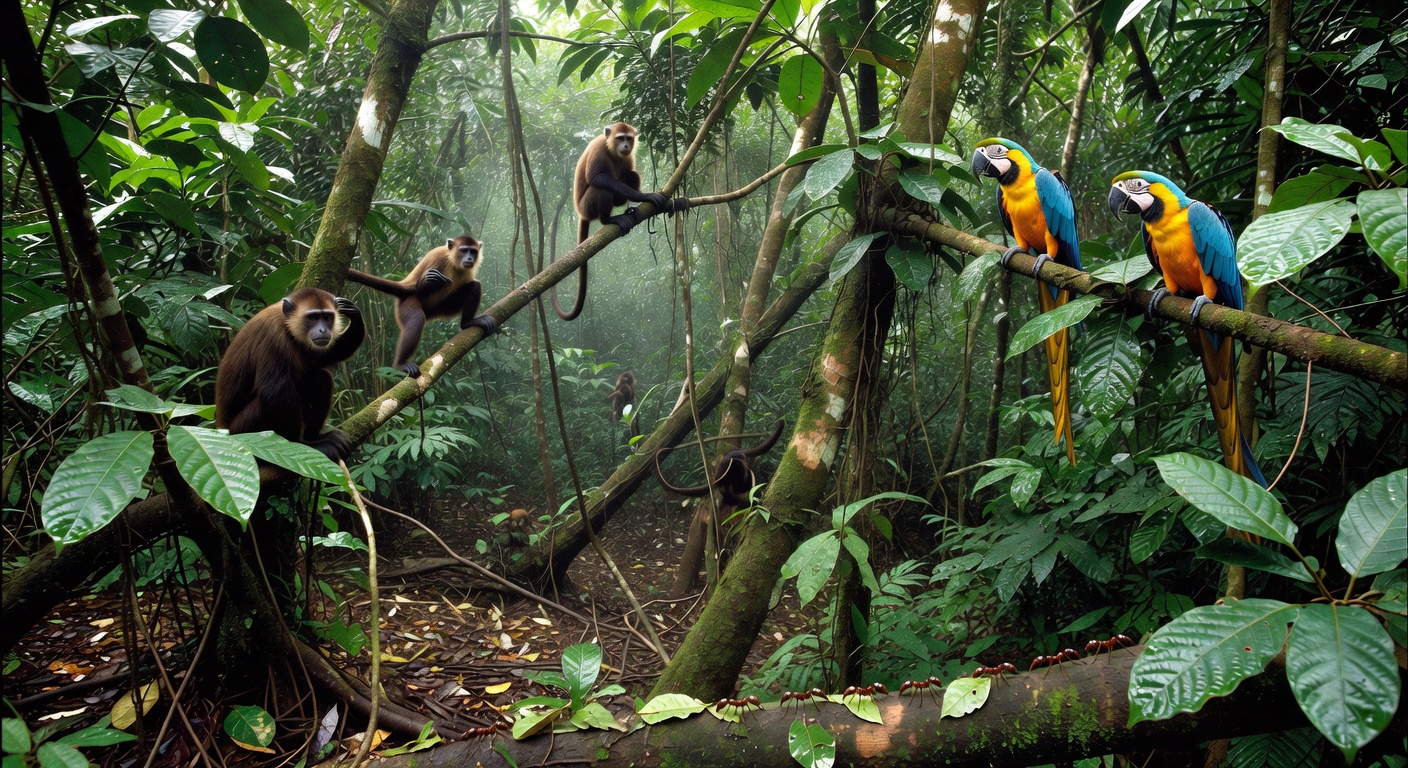
lush rainforest canopy multiple species ecosystem
Generated by Grok Imagine (xAI), prompt: Generate a single 16:9 horizontal image for an educational lesson.
Lesson title: "Everything Eats Something Else" · Why killing one species can accidentally destroy an entire forest
Domain: science
Su…
Space Radar Image of Bahia
JPL via NASA Image Library (Public Domain)
Microorganisms and climate change in marine and terrestrial biomes
From: Scientists’ warning to humanity: microorganisms and climate change
In marine environments, microbial primary production contributes substantially to CO2 sequestration. Marine microorganisms also recycle nutrients for use in the marine food web and in the process release CO2 to the atmosphere. In a broad range of terrestrial environments, microorganisms are the key decomposers of organic matter and release nutrients in the soil for plant growth as well as CO2 and CH4 into the atmosphere. Microbial biomass and other organic matter (remnants of plants and animals) are converted to fossil fuels over millions of years. By contrast, burning of fossil fuels liberates greenhouse gases in a small fraction of that time. As a result, the carbon cycle is extremely out of balance, and atmospheric CO2 levels will continue to rise as long as fossil fuels continue to be burnt. The many effects of human activities, including agriculture, industry, transport, population growth and human consumption, combined with local environmental factors, including soil type and light, greatly influence the complex network of microbial interactions that occur with other microorganisms, plants and animals. These interactions dictate how microorganisms respond to and affect climate change (for example, through greenhouse gas emissions) and how climate change (for example, higher CO2 levels, warming, and precipitation changes) in turn affect microbial responses. OMZ, oxygen minimum zone.
Unknown authorUnknown author · CC BY 4.0
Quiz yourself