Science
·
Why Every Living Thing Is a Prototype
Medium
6 min
Why Every Living Thing Is a Prototype
Evolution is a brutal filter that has been running for 4 billion years.
Share
You share 60% of your DNA with a banana. Not because some designer got lazy — but because both of you descended from the same ancient ancestor, and that ancestor's chemistry worked so well that life never fully let it go.
Here's the setup. Every living thing that reproduces makes copies of itself — but the copies are never perfect. A mutation here, a slightly different protein there. Most of the time, the difference is meaningless. Sometimes it's catastrophic. And occasionally, just occasionally, the difference makes the organism slightly better at surviving and having offspring. That's it. That's the whole engine. Variation, selection, inheritance. Three steps. Four billion years. Every species on Earth.
Analogy
Think about how TikTok's algorithm works. Thousands of videos get made. Most get ignored. A few catch on and get pushed to more people. The ones that get pushed aren't necessarily the 'best' — they're the ones that matched what the current audience responded to. Now imagine that process running for millions of generations, and instead of views, the metric is 'did you survive long enough to have kids.' The organisms that got 'pushed' are the ones whose traits matched their environment. The ones that didn't? Gone. Evolution is basically A/B testing, except the losing variant gets deleted permanently.
Make your call
You share 60% of your DNA with a banana. Before you read why, what's your best guess for how that's even possible?
A
Humans and bananas were deliberately designed with shared chemistry
B
Both humans and bananas descended from the same ancient ancestor, and the chemistry that worked never got replaced
C
DNA is so simple that any two living things will randomly share most of it
The key word in all of this is selection pressure. The environment isn't neutral — it's constantly filtering. A beetle that's slightly better camouflaged gets eaten slightly less often. It survives slightly longer. It has slightly more offspring. Those offspring inherit the camouflage. Over thousands of generations, the poorly-camouflaged beetles just... stop existing in that environment. Nobody chose this. No one planned it. The environment just kept asking the same question — 'can you survive here?' — and only kept the ones who answered yes.
Key Insight
Evolution has no goal. No direction. No endpoint. It doesn't make species 'better' in any absolute sense — it makes them better suited to their current environment. Change the environment, and yesterday's winning trait becomes tomorrow's death sentence.
Example
The most famous real-world proof of this happened in England during the Industrial Revolution. Before factories, peppered moths were mostly light-colored — perfect camouflage against pale, lichen-covered tree bark. Dark moths existed but got eaten constantly. Then factories coated the trees in soot, turning the bark dark. Suddenly the light moths were the visible ones, and the dark moths were invisible. Within decades — not millennia, decades — the dark moth population exploded and the light moths nearly vanished. Same species. Same gene pool. Different environment, different filter, completely different outcome. When clean air laws passed and the soot cleared? The light moths came back. The environment changed the question, and the population changed its answer.
But pay attention. Evolution doesn't just shape bodies — it shapes behavior, immune systems, social structures, even the way cells die. Your cells have a built-in self-destruct sequence called apoptosis. Why would that evolve? Because organisms whose damaged cells killed themselves before turning cancerous had more surviving offspring than organisms whose damaged cells stuck around and caused problems. Even death — at the cellular level — got optimized by selection pressure. That's also why you share 60% of your DNA with a banana — the molecular machinery that worked in your shared ancient ancestor was so effective that 4 billion years of filtering never found a reason to remove it. You are, in every sense, the accumulated result of every ancestor you've ever had surviving long enough to reproduce. Every single one of them made the cut.
Key Insight
You are not the goal of evolution. You are the current draft. The editing isn't done — it never is. Right now, somewhere in your genome, there are mutations your descendants might one day rely on to survive in a world you can't imagine.
Related threads
Science
·
You Are a Walking Instruction Manual
You Are a Walking Instruction Manual
Sources
Images from Wikimedia Commons. Attribution required by license.
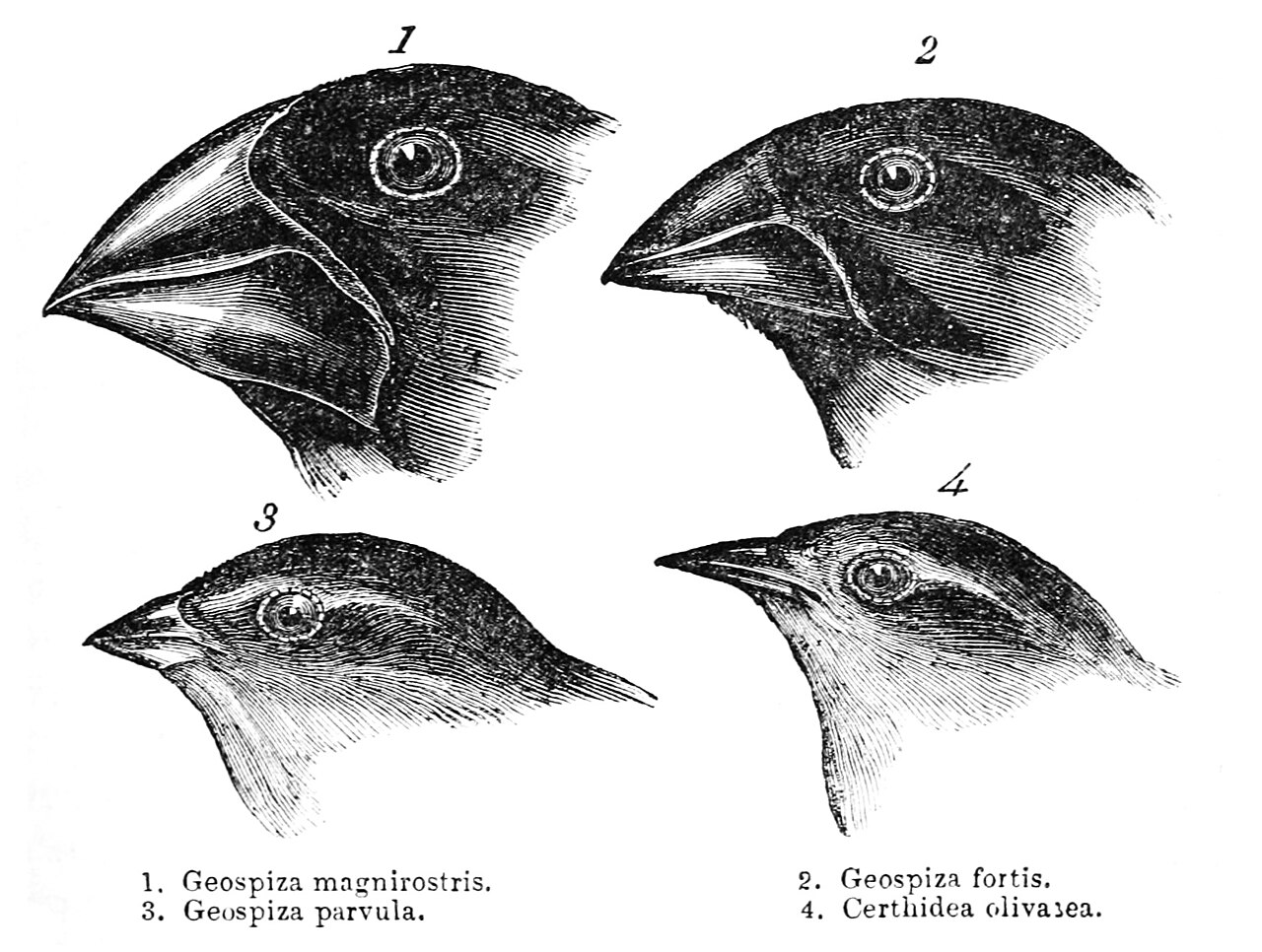
John Gould's illustration of Darwin's finches, 1845 — beak variation across Galápagos islands
John Gould via Wikimedia Commons (Public Domain)
Attacus taprobanis is a moth of Saturniidae family. It is native to southern India and Sri Lanka. This species is very similar in morphology to the much more widely distributed Attacus atlas. It was once considered a subspecies of A. atlas. Here the larva feed on Swietenia macrophylla and later started to pupate by making a cocoon on 13 June 2018. The larva spun a 7-8 cm long papery cocoon interwoven with a leaf. It cut the petiole and attach it to the stem using a strand of silk prior to pupate. This is to prevent accidental falling of the desiccated leaf. The color of the dried leaf matches with the cocoon to offer enough camouflage. The adult moth emerged from the cocoon as photographed here on 07 July 2018. The wingspan of male is about 180-200 mm.
Jeevan Jose, Kerala, India · CC BY-SA 4.0
Quiz yourself