Science
·
You Are 37 Trillion Tiny Decisions
Easy
5 min
You Are 37 Trillion Tiny Decisions
The microscopic machines running every single thing your body does
Share
Right now, while you're reading this, about 3.8 million of your cells just died. And 3.8 million new ones were born to replace them. You didn't decide any of it. It just happened.
Here's something that should mess with your head a little: you are not one thing. You're closer to a city. A city of 37 trillion citizens, each one alive, each one doing a job, each one completely unaware that together they make up a person who reads, worries, and craves snacks at midnight.
Those citizens are cells. And they are the smallest unit of life that can actually do anything on their own. Split a cell in half, and you don't get two smaller living things — you get dead matter. The cell is where life starts.
So what's actually inside a cell? Three things you need to know:
First, the membrane — a thin, flexible boundary that separates the cell from everything outside it. It's not just a wall. It's a bouncer. It decides what gets in (nutrients, signals) and what gets thrown out (waste, toxins).
Second, the nucleus — the cell's headquarters. It holds your DNA, which is basically a 3-billion-letter instruction manual for building and running a human body. The nucleus doesn't do the work itself. It just holds the blueprints.
Third, the cytoplasm — everything else. The gel-like interior where the actual work happens. Proteins get built here. Energy gets made here. Signals get processed here. It's loud and busy and never stops.
Make your call
Every cell in your body has the same DNA. So how does a heart cell know to be a heart cell — and not a skin cell or a brain cell? What's actually different between them?
A
Cells change their DNA as they specialize — each type ends up with a different genetic code
B
The mitochondria in each cell determine what type it becomes based on energy needs
C
Same DNA, but different sections are switched on or off in each cell type
Key Insight
Every cell in your body — from your skin to your heart to your brain — contains the complete instruction manual for building an entire human. The reason a heart cell acts like a heart cell and not a skin cell isn't because it has different DNA. Different chapters of that manual are simply open or closed.
Cells need energy to do all of this, and they have their own power plants.
Inside most of your cells are structures called mitochondria. Their job is to take the food you eat, strip out the energy stored in it, and convert it into a form the cell can actually use (a molecule called ATP). No ATP, no movement, no thought, no heartbeat. Everything runs on it.
This is why when you haven't eaten in hours and you feel like your brain stopped working — it kind of did. Your cells ran low on fuel.
Example
When you cut your finger, you watch something extraordinary happen in slow motion over the next week. First, specialized cells called platelets rush to the site and clot the blood — essentially patching the leak. Then immune cells flood in to kill any bacteria that snuck through. Then skin cells at the edges of the wound start dividing — copying themselves over and over — to grow new tissue and close the gap.
No one coordinated any of this. No signal went out from your brain saying 'attention all departments.' Each type of cell detected the situation and ran its own program. That's cells working exactly as designed.
Key Insight
Cells don't just keep you alive — they ARE you being alive. Every thought you've ever had was a cell firing. Every emotion you've felt was cells releasing chemicals. Every memory you hold is a pattern of connections between cells. There's no 'you' separate from the cells. The cells are the you.
This should make you genuinely respect your own biology: cells divide to make new cells, and every time they do, they copy all 3 billion letters of your DNA with almost zero errors. Your body runs this copy process about 25 million times per second. The error rate is roughly 1 mistake per billion letters — and most of those get caught and fixed by built-in proofreading systems.
When those proofreading systems fail and errors accumulate? That's often how cancer starts. Which means the difference between a healthy body and a sick one is sometimes just a few letters in a 3-billion-letter document.
The stakes are that high. The precision is that insane. Those 3.8 million cells that died while you read the first sentence? This is the system that replaced them — automatically, precisely, without a single conscious decision from you.
Sources
Images from Wikimedia Commons. Attribution required by license.
cell microscope colorful
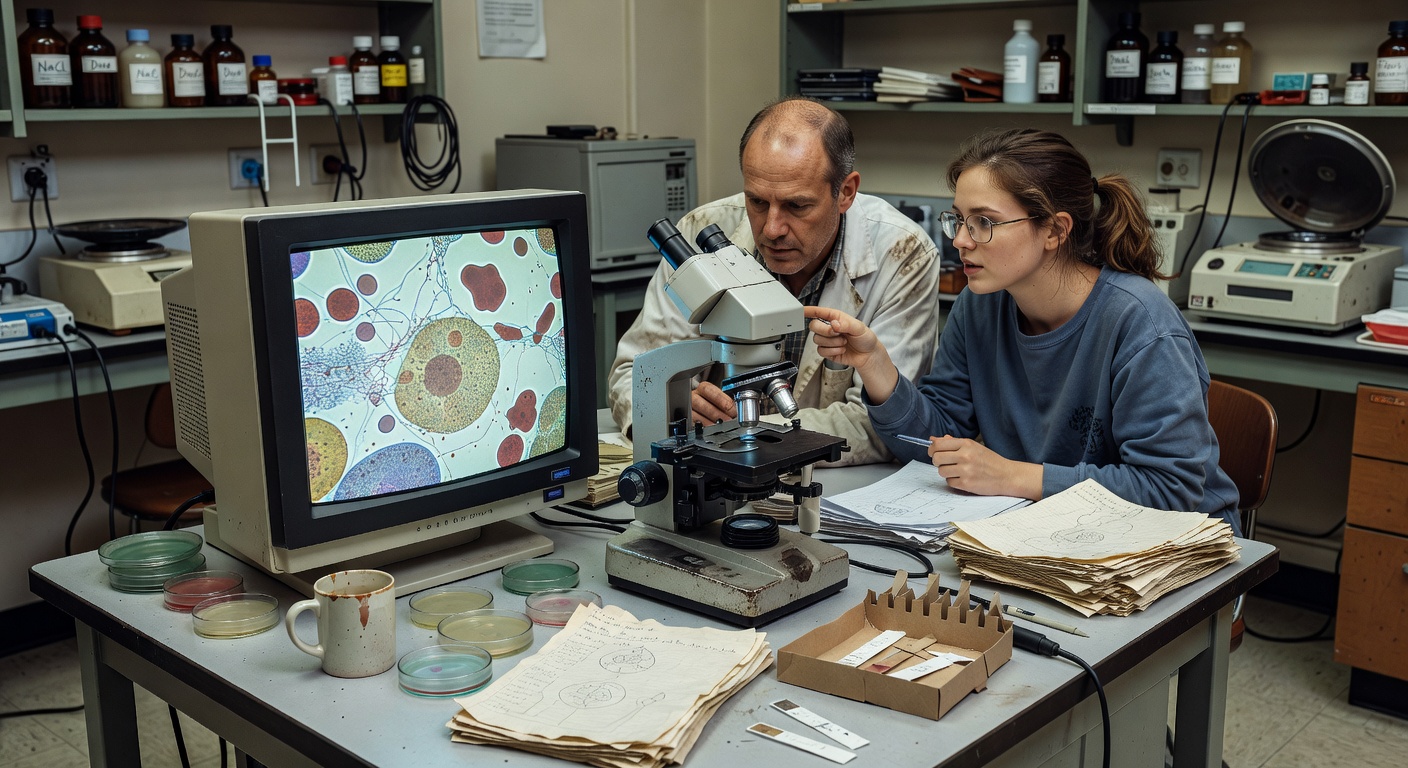
Generated by Grok Imagine (xAI), prompt: Generate a single 16:9 horizontal image for an educational lesson.
Lesson title: "You Are 37 Trillion Tiny Decisions" · The microscopic machines running every single thing your body does
Domain: scien…
Engraving from Micrographia, 1665, by Robert Hooke.
Wellcome Collection (CC BY 4.0)
DNA double helix
Wellcome Collection (CC BY 4.0)
Quiz yourself