Science
·
Light Is Weirder Than You Think
Medium
6 min
Light Is Weirder Than You Think
The thing you call 'light' is a tiny sliver of a vast spectrum that is invisible, everywhere, and passing through you right now.
Share
Right now, your body is being penetrated by radio waves from dozens of stations, Wi-Fi signals from neighboring apartments, and microwave radiation from the cosmic Big Bang itself. You can't feel any of it. That's not science fiction — that's just the part of light your eyes can't see.
Visible light — the stuff your eyes detect, the colors of a sunset, the glow of your phone screen — represents less than 0.0035% of the full electromagnetic spectrum. The rest is out there, doing real things in the real world, completely invisible to you. Radio waves carry your playlists and podcasts. Infrared light is the heat you feel from a campfire before you touch it. X-rays pass through your skin but bounce off bone. Gamma rays can rearrange your DNA. All of these are the same fundamental thing — exactly what's passing through you right now, just at frequencies your body can't register. Different settings on the same dial.
So what is that fundamental thing, exactly? Electromagnetic radiation is a wave of oscillating electric and magnetic fields, moving through space at the speed of light. Electromagnetic radiation and light are the same thing. Every type, from radio to gamma, travels at 300 million meters per second in a vacuum. What changes between them is just one thing: wavelength. How long each wave is. That single difference — long waves versus short waves — is responsible for everything from your Wi-Fi connection to a nuclear explosion.
Make your call
Radio waves, UV light, and X-rays are all passing through or around you right now. What actually makes them different from each other — and from the visible light your eyes detect?
A
They're made of different particles and travel at different speeds
B
They differ only in wavelength, which determines their energy and how they interact with matter
C
They're different phenomena — only visible light and radio waves are truly related
Shorter wavelength doesn't just mean 'different color.' It means more energy per photon. This is why UV light burns your skin but radio waves don't — each UV photon carries enough energy to knock electrons off molecules in your cells. Radio photons are so low-energy they pass right through you without interacting. The same wave type, just wound tighter, goes from harmless background noise to something that can tear through lead. That's not a metaphor. That's a measurable difference in photon energy.
Key Insight
The key insight: light isn't just what you see. It's a spectrum of energy waves defined entirely by wavelength. Longer wavelength = lower energy, passes through things. Shorter wavelength = higher energy, interacts with and can damage matter. Your eyes evolved to see the narrow band where the sun dumps most of its energy. Everything else — radio, microwave, infrared, UV, X-ray, gamma — is the same phenomenon at a different frequency.
Example
Your microwave oven is a perfect demo of all of this. It emits microwaves — electromagnetic radiation with a wavelength of about 12 centimeters. That specific wavelength causes water molecules to rotate and vibrate, generating heat. But the metal walls of the oven reflect microwaves, so the energy stays trapped inside. Your phone uses microwaves too, just at a different frequency, one that passes through walls instead of bouncing off them. Same type of wave. Tiny difference in wavelength. Completely different behavior. That's the spectrum in action.
Related threads
Science
·
Energy Is the Universe's Only Currency
Energy Is the Universe's Only Currency
Sources
Images from Wikimedia Commons. Attribution required by license.
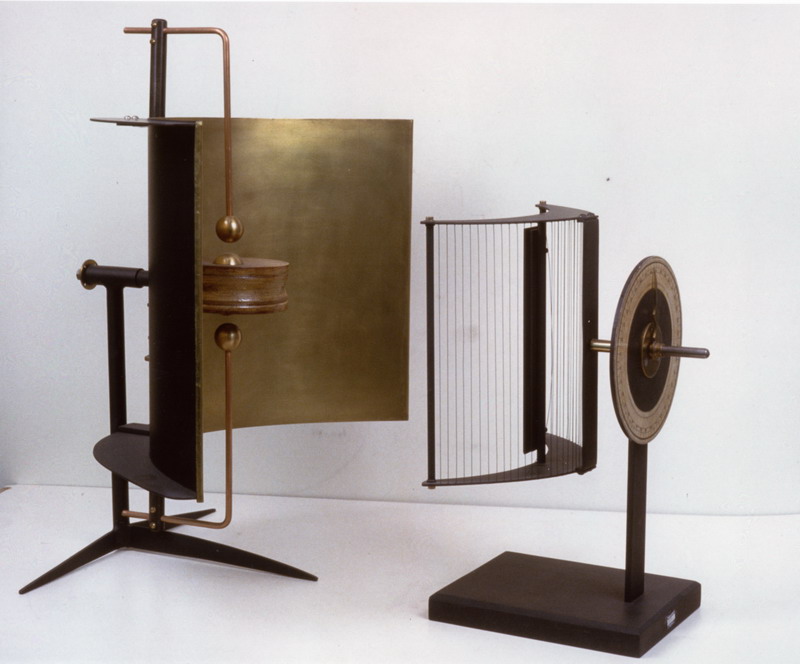
Replica of experimental microwave spark oscillator invented by Augusto Righi around 1894. These oscillators, connected to an induction coil, radiated radio waves with wavelengths less than 10 centimeters in the microwave band. The parabolic reflector focused the radiation into a beam. This type of spark oscillator, invented by Righi (which was based on previous studies by the scientists of Ginevra De la Rive and Sarazin) consisted of 4 brass spheres. The outer 2 were connected to the induction coil which applied a high voltage causing sparks between the spheres. The two inner spheres acted as resonators radiating the microwaves. The spark gaps were surrounded by a vaseline oil bath which decreased the energy losses. These oscillators were used with a receiver also equipped with a parabolic reflector (see attached photographic documentation and object number 8758). Righi used them to duplicate classical optics experiments with radio waves, using quasioptical components such as lenses and prisms of paraffin and sulfur and wire diffraction gratings to refract and diffract radio waves like light waves, to confirm the historic 1887 experiments of Heinrich Hertz, that radio waves and light waves were both forms of electromagnetic waves, differing only in frequency. Righi's oscillators also had great importance for the development of radio communications; in fact fellow Bolognese Guglielmo Marconi the inventor of practical radio in his first experiments in wireless telegraphy used a Righi type oscillator.
Museo Nazionale della Scienza e della Tecnica "Leonardo da Vinci" (costruttore) · CC BY-SA 4.0
The first radio transmitter, the spark oscillator invented by Heinrich Hertz in 1886, with which he demonstrated the existence of radio waves. It consisted of a dipole antenna made of two horizontal wires with metal plates for capacitance on the ends, with a spark gap between the inner ends, with the two sides connected to an induction coil. The induction coil applied pulses of high voltage to it. The coil charged the two sides of the antenna with opposite charges. When the antenna discharged through a spark across the spark gap, it caused standing waves of voltage in the antenna, which radiated the energy as radio waves. The frequency of the waves was determined by the length of the antenna, which functioned as a half-wave dipole. The short antennas used by Hertz generated high frequencies of 50 to 450 MHz. Using his oscillator, Marconi demonstrated standing waves, refraction, diffraction, and polarization of radio waves, establishing that both radio waves and light were electromagnetic waves that had been predicted by James Clerk Maxwell in 1864.
Charles Grinnell Ashley and Charles Brian Hayward · Public domain
Quiz yourself