Science
·
You're Mostly Empty Space
Easy
5 min
You're Mostly Empty Space
The strange truth about what everything is actually made of
Share
The chair you're sitting on right now is 99.9999999% empty space. So is your hand. So is everything you've ever touched. And yet nothing falls through anything. Physics has some explaining to do.
Every single thing you can see, touch, smell, or stub your toe on is made of the same basic building blocks. Your phone. The air. That overpriced coffee. You. All of it, at the deepest level, is just atoms arranged in different ways. The universe is basically LEGO, except the bricks are incomprehensibly small and there are only about 118 kinds of them.
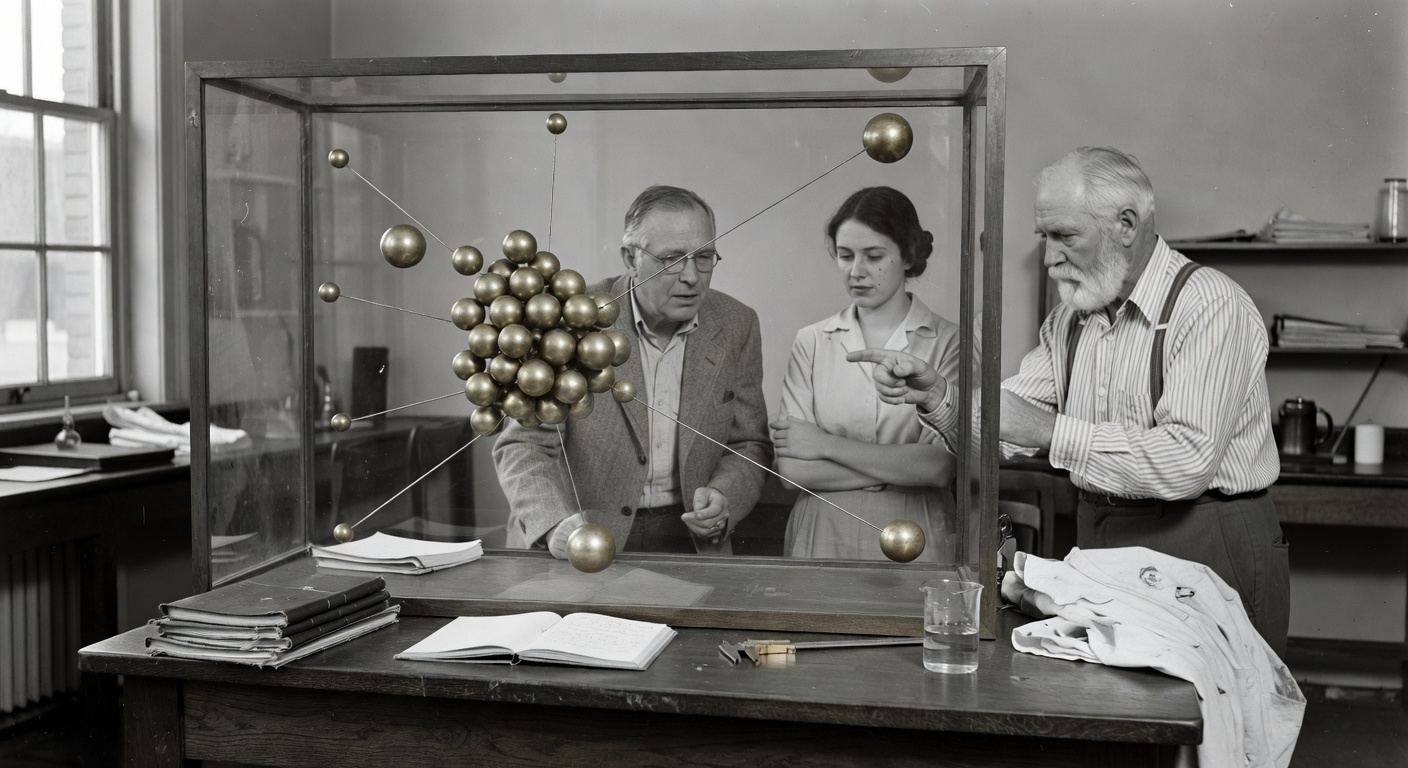
An atom is almost unimaginably tiny. A single strand of your hair is roughly a million atoms wide. If you scaled an atom up to the size of a football stadium, the nucleus — the dense core at the center — would be a marble sitting on the fifty-yard line. Everything else? Empty space. That's not a metaphor. That's literally the structure. A tiny dense center, a cloud of electrons orbiting way out on the edges, and almost nothing in between.
Analogy
Think about the alphabet. Twenty-six letters, and they build every novel, every contract, every text you've ever sent. Change the arrangement and you go from a love letter to an eviction notice. Atoms work the same way. Carbon, hydrogen, oxygen — rearrange them differently and you get sugar, or alcohol, or the plastic in your headphones. Same ingredients. Wildly different results.
So what makes one atom different from another? One thing: the number of protons in its nucleus. That's it. An atom with 1 proton is hydrogen — the lightest element, the most abundant thing in the universe. Add a proton and you get helium. Keep adding and you climb the periodic table. 6 protons? Carbon. 8? Oxygen. 79? Gold. The proton count is the atom's identity. Change it and you literally have a different element — a different substance entirely.
Key Insight
The number of protons in an atom's nucleus is called its atomic number — and it determines everything about what that element is and how it behaves. One proton difference is the difference between lead and gold. Alchemists spent centuries trying to make that swap happen. Turns out it's technically possible. It's just wildly impractical and expensive.
Example
Carbon is the best example of how arrangement changes everything. Pure carbon atoms bonded in a flat hexagonal grid give you graphite — the soft grey stuff in your pencil. The exact same carbon atoms bonded in a rigid three-dimensional structure give you diamond — one of the hardest materials on Earth. Same element. Same atom. Completely different substance, completely different properties, just because the atoms linked up differently. That's the power of structure.
Make your call
Your hand and the chair beneath you are 99.9999999% empty space. So why doesn't your hand pass straight through it? What's actually stopping it?
A
Atoms are packed tightly enough together that there's no room to pass through
B
The nuclei of your atoms and the chair's atoms attract each other, creating resistance
C
Electrons on the outer edges of your atoms and the chair's atoms repel each other
Remember the hook — empty space almost everywhere, and yet nothing falls through anything? Here's the answer. The reason solid things feel solid — the reason your hand doesn't pass through a table — has nothing to do with atoms being packed tightly together. It's electromagnetic repulsion. The electrons on the outer edges of your atoms and the electrons on the outer edges of the table's atoms repel each other. You're not touching the table. You're hovering nanometers above it, held up by invisible electric force fields. Every time you've ever 'touched' something, that's what was actually happening.
Sources
Images from Wikimedia Commons. Attribution required by license.
atom particle visualization
Generated by Grok Imagine (xAI), prompt: Generate a single 16:9 horizontal image for an educational lesson.
Lesson title: "You're Mostly Empty Space" · The strange truth about what everything is actually made of
Domain: science
Subject: atom…
Portrait of Ernest Rutherford from the portrait by Oswald Birley in the Royal Society
General Collections
Keywords: Oswald Birley; Ernest Rutherford
Oswald Birley · CC BY 4.0
Portrait of Ernest Rutherford from the portrait by Oswald Birley in the Royal Society
General Collections
Keywords: Oswald Birley; Ernest Rutherford
Oswald Birley · CC BY 4.0
Quiz yourself