Psychology
·
Social Mind
·
where willpower goes, if it goes anywhere
Medium
6 min
Debate
Does Willpower Run Out?
The self-control experiment millions believed, and what happened when 23 labs re-ran it
Share
You resist the donuts at the morning meeting. You hold your tongue when your coworker says something stupid. You drag yourself to the gym after work. By evening, you eat half a pizza and skip the gym anyway. Coincidence — or did something run out?
Most of what the social mind does happens between people — conformity, obedience, the pull of the group, each covered elsewhere in this series. But one question sits a little differently. It's not about other people reshaping you. It's about whether the act of resisting — of controlling yourself — uses up something finite. Whether willpower is a resource. That question produced one of the most influential findings in 20th-century psychology, and one of the most embarrassing collapses in 21st-century science.
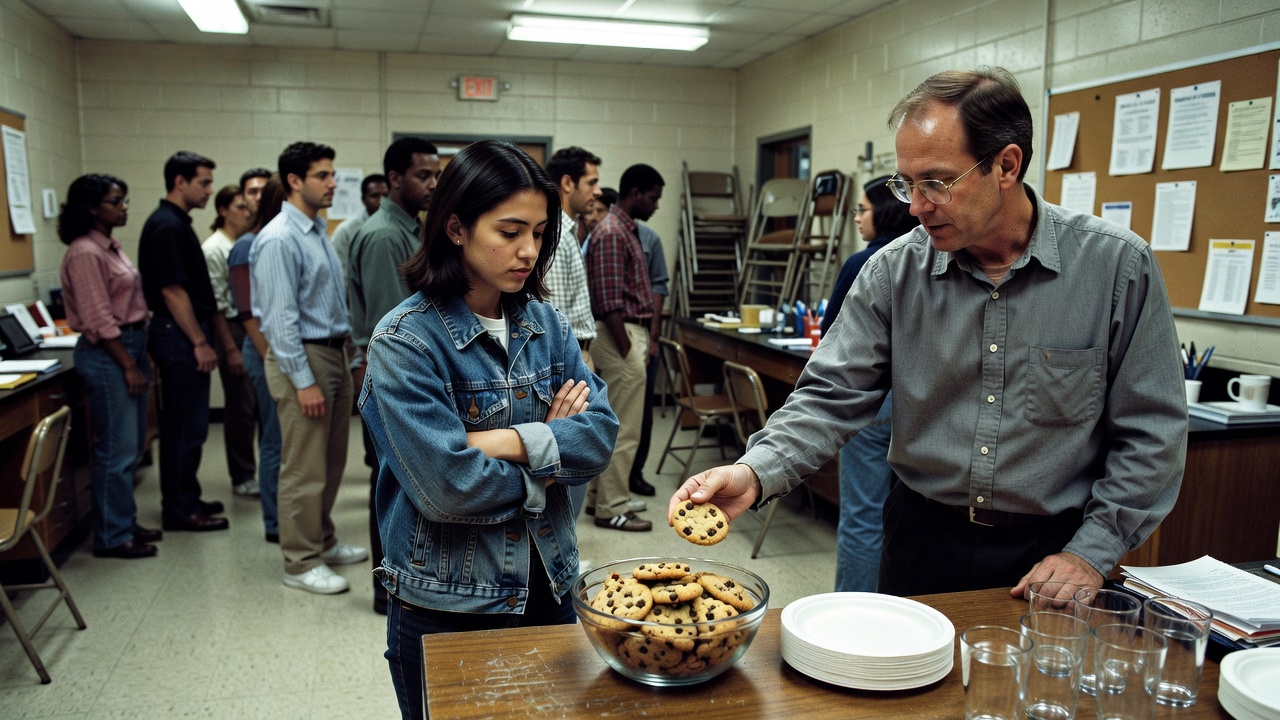
In 1998, Roy Baumeister (b. 1953, United States) — a social psychologist at Case Western Reserve University — published a study that seemed to confirm what everyone already suspected. Participants who had to resist eating chocolate chip cookies sitting right in front of them gave up faster on a subsequent frustrating puzzle than participants who hadn't been asked to resist anything. Baumeister's explanation: self-control draws on a limited mental resource. Use it up on one task, and you have less for the next. He called it ego depletion. The idea spread fast. By the 2010s, it had generated over a thousand follow-up studies and was cited as evidence for everything from why judges give harsher sentences before lunch to why you shouldn't grocery shop hungry.
Make your call
Here's what the debate hinges on. If ego depletion is real, a large study replicating Baumeister's design should show the same result — depleted participants performing worse on the second task. What do you think happened when researchers ran that test across 23 labs in 2016?
A
The effect was confirmed — depleted participants consistently performed worse
B
The effect disappeared — there was no meaningful difference between groups
C
The effect reversed — depleted participants actually performed slightly better
Position A — ego depletion is real — still has serious defenders, and their case isn't trivial. The original findings replicated repeatedly throughout the 2000s. Baumeister and his colleagues point out that the 2016 multi-lab study used a specific protocol — one that may have been too weak to produce depletion in the first place. Meta-analyses pooling hundreds of studies still find a small but detectable effect. And there's a plausible mechanism: glucose. Some research suggests that acts of self-control temporarily lower blood glucose in the brain, and that consuming sugar can restore performance. The strongest version of this position isn't 'willpower is a muscle that gets tired' — it's 'self-control is a biological process with real metabolic costs, and those costs accumulate.'
Position B — ego depletion is mostly an artifact — is now the majority view among researchers who study replication, and their evidence is pointed. The 2016 Many Labs study wasn't the only failure. A 2010 meta-analysis found signs of publication bias so severe that the average effect size in the literature was probably inflated by a factor of two or more. The glucose hypothesis has been directly tested and largely failed — drinking a non-caloric sweet drink (which shouldn't change blood glucose) produced the same 'restoration' effect as actual sugar, suggesting the effect was expectation, not metabolism. The deepest critique is structural: most ego depletion studies were small, run by researchers who believed the hypothesis, and published in journals that preferred positive results. That's a recipe for false positives regardless of what's actually true.
Key Insight
What would settle it: a pre-registered, adequately powered study using a depletion task that Baumeister's team agrees is strong enough to work, run by labs that include both skeptics and believers, with the analysis plan locked before data collection begins. That study hasn't been done. Until it is, both sides can point at the existing record and find what they're looking for — which is itself a lesson about how science works when the effect size is small and the stakes feel high.
Related threads
Psychology
·
You Know the Answer. Why Don't You Say It?
·
conformity
You Know the Answer. Why Don't You Say It?
Psychology
·
You Would Have Pressed the Button
·
obedience to authority
You Would Have Pressed the Button
Psychology
·
Why Corrections Don't Fully Work
·
the continued-influence effect
Why Corrections Don't Fully Work
Sources
Images from Wikimedia Commons. Attribution required by license.
willpower self-control psychology
Generated by Grok Imagine (xAI), prompt: Generate a single 16:9 horizontal image for an educational lesson.
Lesson title: "Does Willpower Run Out?" · The self-control experiment millions believed, and what happened when 23 labs re-ran it
Dom…
replication crisis psychology research
Generated by Grok Imagine (xAI), prompt: Generate a single 4:3 horizontal image for an educational lesson.
Lesson title: "Does Willpower Run Out?" · The self-control experiment millions believed, and what happened when 23 labs re-ran it
Doma…
Quiz yourself