Psychology
·
Memory
·
sleep consolidation
Medium
6 min
Your Brain Studies While You Sleep
Why pulling an all-nighter is the worst study strategy you can choose
Share
Students who sleep 8 hours after studying outperform students who stay up all night reviewing the same material — even when the all-nighters get more hours with the content.
Memory isn't a recording. When you experience something — a conversation, a formula, a face — your brain doesn't save it the way a phone saves a photo. It encodes a rough pattern across a network of neurons, and that pattern is fragile. The first few hours after learning something, the memory exists in a kind of draft state: present, but easily lost. What turns a draft into something durable happens mostly when you're unconscious.
Make your call
You study for an exam, then go straight to sleep. Your friend studies the same material but stays up four more hours reviewing notes before sleeping only briefly. Who remembers more the next morning?
A
Your friend — more review time means more retention
B
You — sleep does something to memory that extra review can't replace
C
About the same — total study time is what matters
During sleep, your brain runs what amounts to a nightly editing session. In the first half of the night, slow-wave sleep dominates — this is deep, quiet sleep where the hippocampus (the brain's short-term intake center) replays the day's experiences and ships them out to the cortex for long-term storage. Think of the hippocampus as a loading dock and the cortex as the warehouse. Slow-wave sleep is the forklift running between them all night.
In the second half of the night, REM sleep takes over. This is where things get stranger. During REM, the brain isn't just moving memories — it's connecting them. New information gets cross-referenced with things you already know. Patterns emerge. Insights that weren't accessible when you were awake suddenly become obvious after a night of sleep. Matthew Walker (b. 1973, United Kingdom), a neuroscientist at UC Berkeley, documented this in his 2017 book Why We Sleep: people who slept between learning a skill and being tested on it didn't just remember better — they discovered shortcuts they hadn't been taught.
Key Insight
Sleep doesn't just preserve what you learned. It reorganizes it — connecting new knowledge to old, surfacing patterns you couldn't see while awake. You don't just remember more after sleep. You understand more.
This is why cutting sleep short is so costly. If you sleep six hours instead of eight, you lose a disproportionate amount of REM sleep — because REM is concentrated in the final two hours of a full sleep cycle. You're not just getting 75% of the benefit. You're gutting the part of sleep that builds understanding, not just recall.
And the damage compounds. Miss sleep on Monday night, and Tuesday's learning lands in a brain that's already behind on processing Monday's material. The backlog grows. The all-nighter before an exam doesn't just fail to help — it actively disrupts the consolidation of everything you learned in the days before.
The practical implication is uncomfortable if you're used to cramming: spacing your study across multiple days — and sleeping between each session — is not a nice-to-have. Each sleep cycle is a consolidation pass. Three study sessions with two nights of sleep between them give your brain two full editing runs before the exam. One marathon session the night before gives it zero.
Memory, it turns out, is a process that continues long after you close the book. The studying you do today won't finish becoming memory until sometime tomorrow morning — assuming you let it.
Related threads
Psychology
·
Your Memory Is Lying to You Right Now
·
reconsolidation
Your Memory Is Lying to You Right Now
Sources
Images from Wikimedia Commons. Attribution required by license.
brain sleep waves
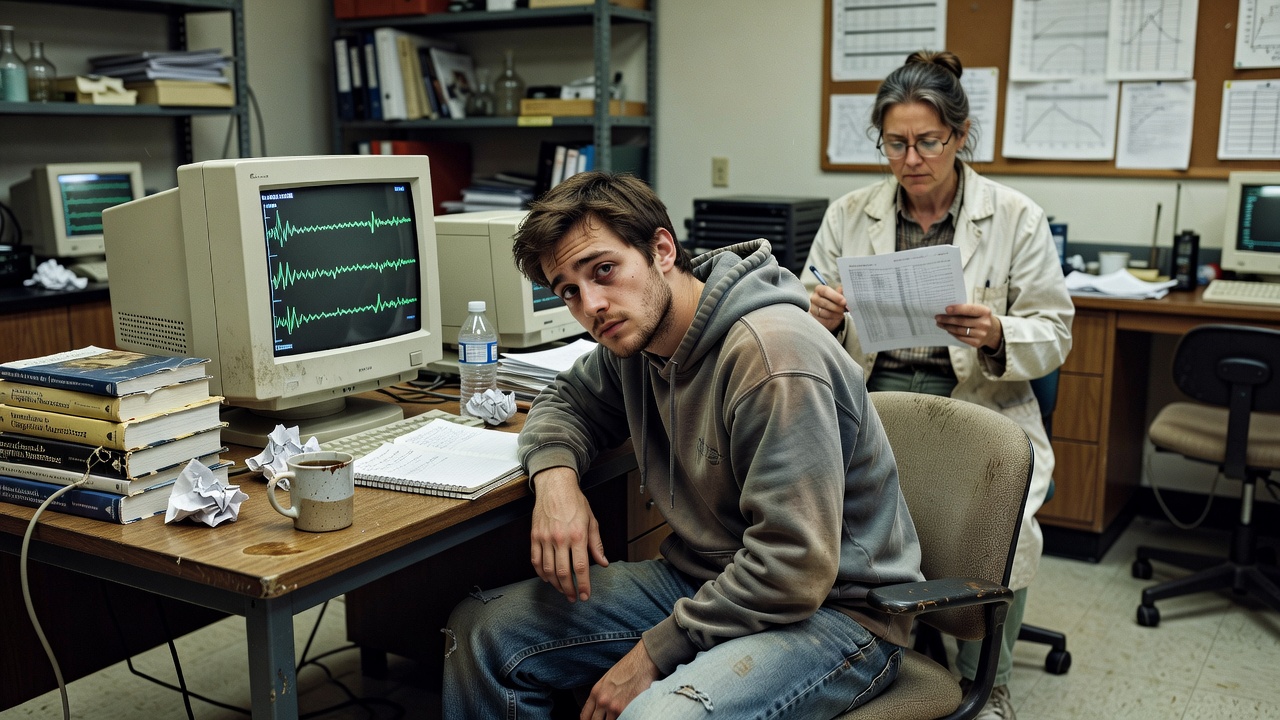
Generated by Grok Imagine (xAI), prompt: Generate a single 16:9 horizontal image for an educational lesson.
Lesson title: "Your Brain Studies While You Sleep" · Why pulling an all-nighter is the worst study strategy you can choose
Domain: ps…
hippocampus brain diagram
Generated by Grok Imagine (xAI), prompt: Generate a single 4:3 horizontal image for an educational lesson.
Lesson title: "Your Brain Studies While You Sleep" · Why pulling an all-nighter is the worst study strategy you can choose
Domain: psy…
Quiz yourself