Psychology
·
Memory
·
reconsolidation
Medium
5 min
Your Memory Is Lying to You Right Now
Why remembering something changes it
Share
Every time you recall a memory, you edit it. The version in your head right now is a copy of a copy of a copy, each retelling quietly rewriting the one before. The original is gone. And the more often you remember something, the less like the original it becomes.
Most people think memory works like a video camera: experiences get recorded, stored, and played back intact. Neuroscience says otherwise. Memory is a reconstruction — every time you remember something, your brain actively rebuilds it from fragments, filling gaps with whatever makes sense right now. This means your memories aren't archives. They're drafts. And every time you open a draft, you risk editing it.
Make your call
You remember your first day at a new job clearly. But every time you've told that story at parties, you've remembered it again. What has happened to the original memory?
A
It's been reinforced — repeated recall makes it more accurate
B
It's stayed the same — memories are stored and retrieved, not changed
C
It's been subtly rewritten each time you recalled it
The mechanism is called reconsolidation. When a memory is first formed, it goes through a process called consolidation — the brain stabilizes it into long-term storage. For decades, scientists assumed that once a memory was consolidated, it was locked. Then in 2000, neuroscientist Karim Nader (b. 1969, Canada) ran an experiment that cracked that assumption open. He reactivated a fear memory in rats, then blocked the protein synthesis their brains needed to re-stabilize it. The memory disappeared. Not weakened — gone. The implication: every time a memory is recalled, it becomes temporarily unstable again. It has to be re-saved. And re-saving is not a perfect copy — it's a new file, written in the context of who you are right now.
Key Insight
Remembering is not playback. It's rewriting. Every single time.
You can feel this in your own life if you know where to look. Think about a story you've told many times — a funny thing that happened on a trip, a bad date, a childhood moment. Now ask yourself: are you remembering the event, or are you remembering the last time you told the story about the event? The details that got laughs stayed. The parts that didn't land got trimmed. The timeline shifted to make the punchline land cleaner. You didn't lie. Your brain just optimized the draft. This is why eyewitness testimony is so unreliable — not because people are dishonest, but because the act of recounting what they saw, over and over to police and lawyers and family, slowly overwrites the original with a version shaped by every question they were ever asked. Elizabeth Loftus (b. 1944, United States) — the psychologist who has spent fifty years documenting false memories — showed that simply asking "did you see the broken glass?" after a car accident video (there was no broken glass) caused people to later remember broken glass. The question planted the fragment. Reconsolidation did the rest.
There's a strange upside to all of this. If recalling a memory makes it temporarily malleable, that means it can be deliberately reshaped. Therapists are exploring whether reconsolidation can be used to treat PTSD — reactivating a traumatic memory in a safe context, then allowing it to re-stabilize with the terror dampened. The memory doesn't disappear, but its emotional charge can be rewritten. The same mechanism that makes your memories untrustworthy might also make them healable. That first-day-at-work story you've told a hundred times? You've probably lost the real thing. But the version you carry now is the one that matters to you — and your brain built it, piece by piece, every time you remembered.
Related threads
Psychology
·
Your Brain Studies While You Sleep
·
sleep consolidation
Your Brain Studies While You Sleep
Sources
Images from Wikimedia Commons. Attribution required by license.
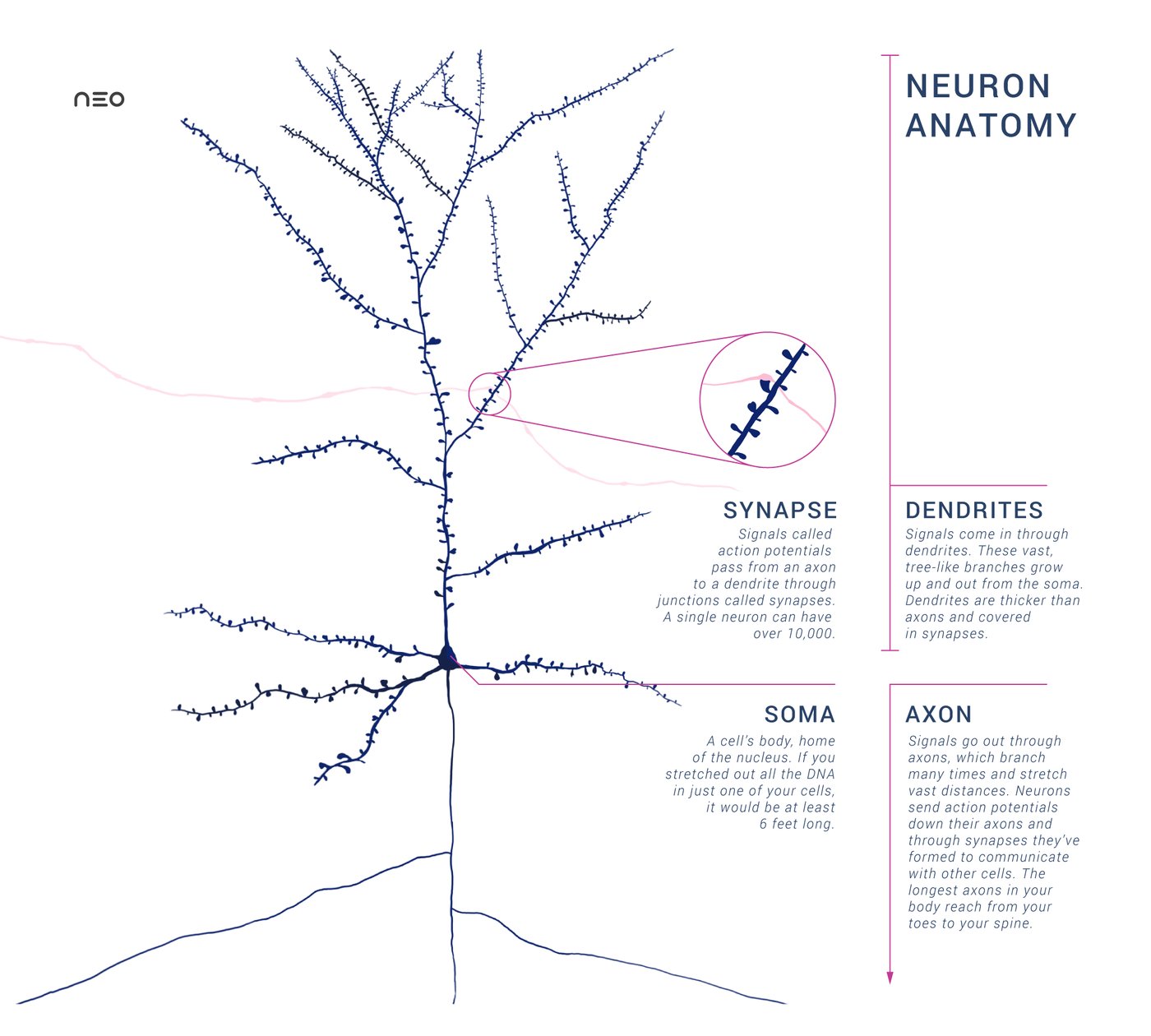
This schematic shows a single pyramidal neuron, the dominant excitatory neuron of cerebral cortex, with an synaptic connection from an incoming axon. It briefly explains the soma, dendrites, axon, and synapse and was created by Amy Sterling and Daniela Gamba for Neo Brain Game.
Amyleesterling · CC BY-SA 4.0
rat maze neuroscience experiment
Generated by Grok Imagine (xAI), prompt: Generate a single 4:3 horizontal image for an educational lesson.
Lesson title: "Your Memory Is Lying to You Right Now" · Why remembering something changes it
Domain: psychology
Subject: rat maze neur…
Quiz yourself