Personal-finance
·
How Money Machines Make Money
·
the million-dollar bet on doing nothing…
Medium
6 min
Primary Source
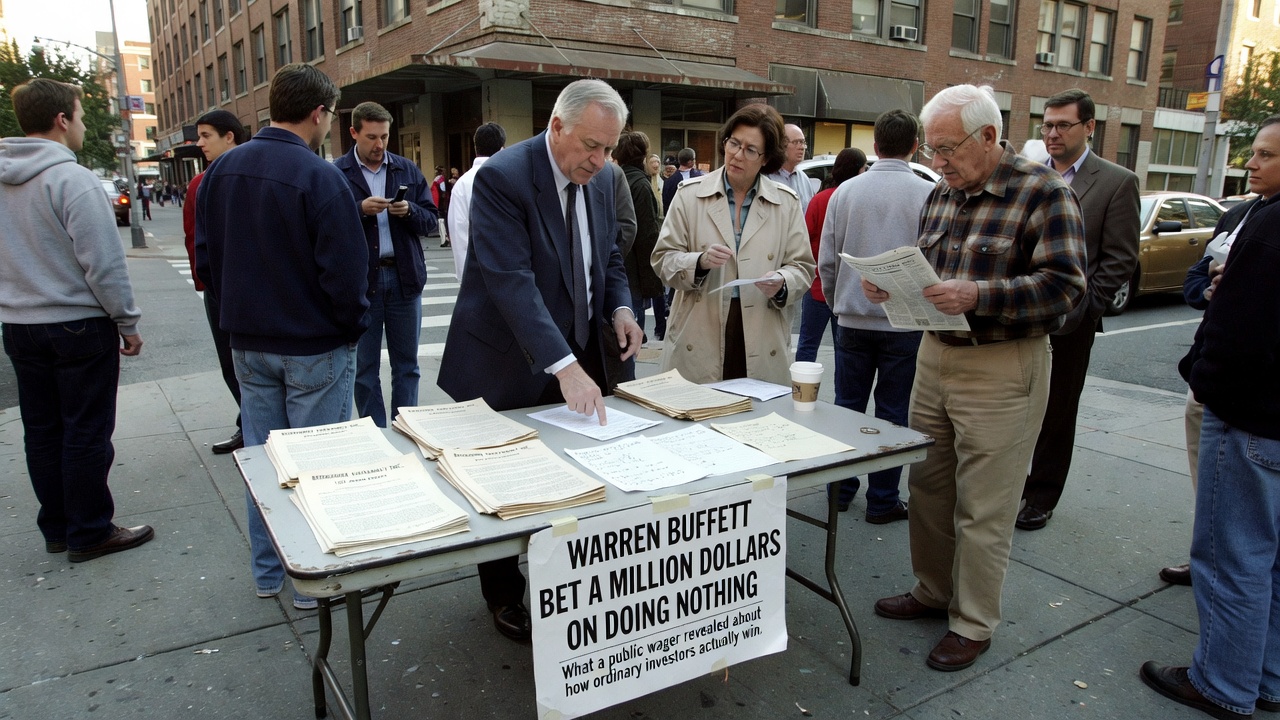
Warren Buffett Bet a Million Dollars on Doing Nothing
What a public wager revealed about how ordinary investors actually win
Share
In 2007, Warren Buffett — arguably the greatest stock-picker alive — made a $1 million bet that stock-picking was a loser's game. Not for other people. For everyone. Including professionals paid millions to do exactly that.
Most of what you hear about investing involves someone doing something — a fund manager picking winners, an analyst reading earnings calls, a trader timing the market. The premise is that skill beats passivity. This lesson is about the one time someone put real money on the opposite idea, wrote about it publicly, and won. To understand why it matters, you need to know one thing about how Wall Street makes money: actively managed funds charge fees — typically 1-2% of your assets per year — whether they beat the market or not. That fee is the machine. And the bet was about whether the machine was worth it.
Make your call
Buffett bet that a simple S&P 500 index fund — no manager, no strategy, just owning a slice of 500 large American companies — would outperform a hand-picked portfolio of hedge funds over ten years. What do you think happened?
A
The hedge funds won — professional managers justified their fees
B
It was roughly a tie — both strategies performed similarly
C
The index fund won by a wide margin
Key Insight
The following is excerpted from Warren Buffett's 2017 Berkshire Hathaway Annual Shareholder Letter, describing the outcome of the bet he made in 2007 against hedge fund manager Ted Seides:
"Over the years, I've often been asked for investment advice, and in the process of answering I've learned a good deal about human behavior. My regular recommendation has been a low-cost S&P 500 index fund. To their credit, my friends who possess only modest means have usually followed my suggestion.
I believe, however, that none of the mega-rich individuals, institutions or pension funds has followed that same advice when I've given it to them. Instead, these investors politely thank me for my thoughts and depart to listen to the siren song of a high-fee manager or, in the case of many institutions, to seek out another breed of hyper-helper called a consultant.
That professional, however, faces a problem. Can you imagine an investment consultant telling clients, year after year, to just … do nothing? Long ago, Sir Isaac Newton gave us three laws of motion, which were the work of genius. But Sir Isaac's talents didn't extend to investing: He lost a bundle in the South Sea Bubble, explaining later, 'I can calculate the movement of the stars, but not the madness of men.' If he had not been traumatized by this loss, Sir Isaac might well have gone on to discover the Fourth Law of Motion: For investors as a whole, returns decrease as motion increases."
— Warren Buffett, 2017 Berkshire Hathaway Annual Shareholder Letter
Look at that last sentence. 'For investors as a whole, returns decrease as motion increases.' Buffett is saying that every trade, every reallocation, every brilliant fund manager doing their job — all of that activity, in aggregate, costs investors money. Not because the managers are incompetent. Because every transaction has a cost, and those costs compound over decades the same way returns do. A 1.5% annual fee sounds like nothing. On a $100,000 portfolio over 30 years, it costs you roughly $140,000 in foregone returns. That's not a rounding error. That's a second retirement.
The Newton reference isn't decoration. Buffett is making a specific point: intelligence doesn't protect you from this. The South Sea Bubble of 1720 wiped out some of the sharpest minds in England because they confused the feeling of understanding a situation with actually being able to predict it. The hedge fund managers Buffett bet against weren't frauds. They were genuinely skilled. They just couldn't overcome the drag of their own fees. And here's the part that closes the loop on the original bet: the hedge fund manager who took Buffett's wager, Ted Seides, conceded in 2017 before the ten years were even up. He saw the math and stopped arguing with it.
The mechanism Buffett is describing isn't really about index funds specifically. It's about the compounding cost of activity versus the compounding return of patience. This is why the lesson is called 'doing nothing' — not because you put your money under a mattress, but because you resist the constant pressure to do something clever with it. The financial industry is structured to make inaction feel irresponsible. Buffett's letter is a rare piece of evidence that inaction, done right, is its own form of discipline. The mega-rich ignored his advice, as he notes. The question the letter leaves open — pointed directly at you — is whether you will too.
Related threads
Personal-finance
·
Your Card Company Gets Paid Every Time You Swipe
·
how a credit card makes money even when…
Your Card Company Gets Paid Every Time You Swipe
Personal-finance
·
When Losing Money Is the Smart Move
·
lottery tickets and insurance can both…
When Losing Money Is the Smart Move
Personal-finance
·
Your Raise Won't Cost You Money
·
the bracket myth
Your Raise Won't Cost You Money
Sources
Images from Wikimedia Commons. Attribution required by license.
Warren Buffett annual letter
Generated by Grok Imagine (xAI), prompt: Generate a single 16:9 horizontal image for an educational lesson.
Lesson title: "Warren Buffett Bet a Million Dollars on Doing Nothing" · What a public wager revealed about how ordinary investors act…
Berkshire Hathaway annual report 2017
Generated by Grok Imagine (xAI), prompt: Generate a single 4:3 horizontal image for an educational lesson.
Lesson title: "Warren Buffett Bet a Million Dollars on Doing Nothing" · What a public wager revealed about how ordinary investors actu…
Quiz yourself