Personal-finance
·
How Money Machines Make Money
·
the bracket myth
Medium
5 min
Your Raise Won't Cost You Money
Why the most common fear about tax brackets is completely backwards
Share
You're offered a $5,000 raise. A coworker tells you to turn it down — 'It'll push you into a higher bracket and you'll take home less.' You've probably heard some version of this. It's one of the most widespread financial myths in existence. And it has caused real people to refuse real money.
Most financial tools have a hidden logic — the mechanism that makes them actually work. Credit cards profit off merchants even when you pay on time. Index funds beat most professionals through sheer inaction. Tax brackets are no different: there's a mechanism underneath, and if you misread it, you'll make decisions that actively hurt you. The bracket myth is the most expensive misreading of all.
Here's what people think tax brackets mean: if you earn $50,000 and the 22% bracket starts at $44,726, then crossing that line means the IRS taxes your entire $50,000 at 22%. So earning more could somehow net you less. This is wrong. Completely, structurally wrong. But it's a logical mistake to make if nobody ever showed you how brackets actually work.
Make your call
You earn $44,000 this year. Your boss offers you a $2,000 raise, which pushes part of your income into the next tax bracket. What happens to your take-home pay?
A
It goes up — you keep most of the raise
B
It stays the same — the extra tax wipes out the raise
C
It goes down — the higher bracket taxes your whole income at the new rate
Tax brackets are marginal. That word matters. 'Marginal' means each bracket only applies to the slice of income that falls inside it — not to everything you earned.
Picture it as a series of buckets. The first $11,600 of your income fills the 10% bucket. The next chunk — from $11,601 to $47,150 — fills the 12% bucket. If you earn $50,000, only the $2,850 above $47,150 gets taxed at 22%. Everything below that line stays in the lower buckets.
So when your coworker warns you about 'jumping into the 22% bracket,' what they're actually describing is: a few hundred dollars of your raise getting taxed at 22% instead of 12%. The rest of your income is completely unaffected. You still come out ahead.
Key Insight
A higher bracket never taxes your whole income. It taxes one more slice of it. Your effective tax rate — what you actually pay as a percentage of total income — always rises more slowly than the bracket rate. Always.
Example
Run the numbers on that $5,000 raise. Say you were earning $45,000, and the 22% bracket kicks in at $44,726. That means $274 of your current income is already in the 22% bracket. The raise pushes another $5,000 in there.
Tax on that $5,000 at 22%: $1,100.
What you keep: $3,900.
Your coworker's advice — turn down the raise — would have cost you $3,900 in take-home pay to avoid paying $1,100 in taxes. The 'expensive' bracket cost you $1,100. Refusing it cost you nearly four times that.
There is no income level at which earning more money makes you poorer. The math doesn't allow it.
Related threads
Personal-finance
·
Your Card Company Gets Paid Every Time You Swipe
·
how a credit card makes money even when…
Your Card Company Gets Paid Every Time You Swipe
Personal-finance
·
When Losing Money Is the Smart Move
·
lottery tickets and insurance can both…
When Losing Money Is the Smart Move
Personal-finance
·
Warren Buffett Bet a Million Dollars on Doing Nothing
·
the million-dollar bet on doing nothing…
Warren Buffett Bet a Million Dollars on Doing Nothing
Sources
Images from Wikimedia Commons. Attribution required by license.
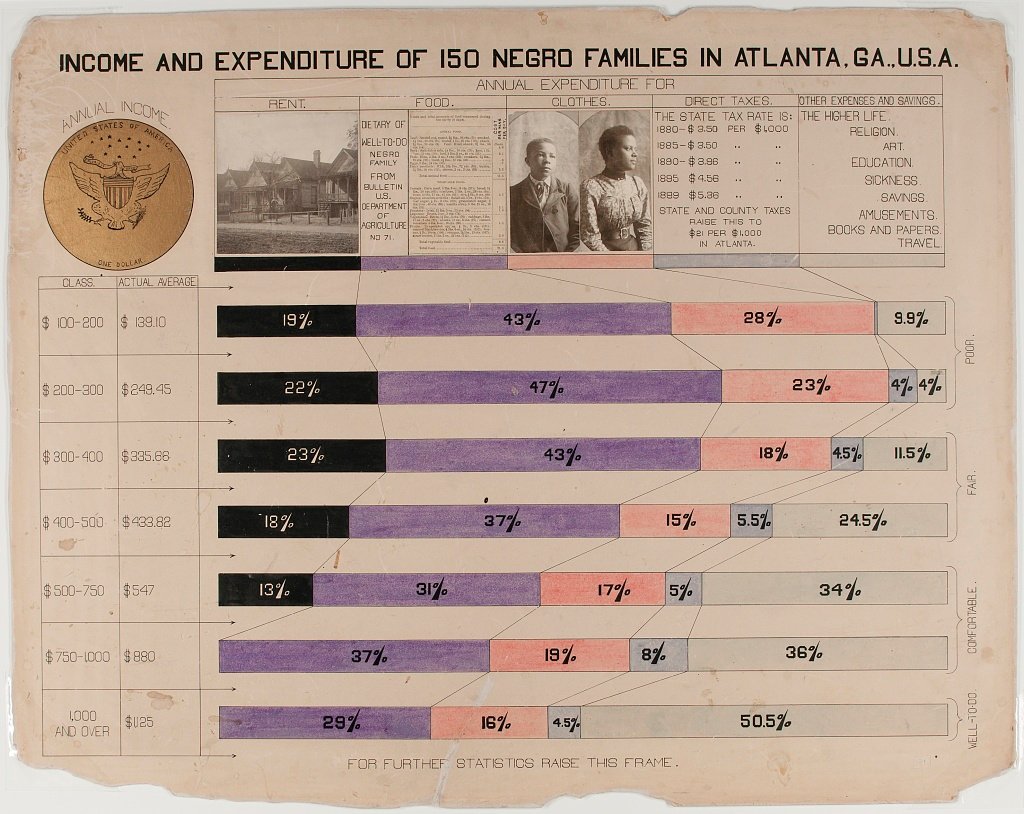
[The Georgia Negro] Income and expenditure of 150 Negro families in Atlanta, Ga., U.S.A.
Library of Congress · Public Domain via Library of Congress
marginal tax bracket diagram
Generated by Grok Imagine (xAI), prompt: Generate a single 4:3 horizontal image for an educational lesson.
Lesson title: "Your Raise Won't Cost You Money" · Why the most common fear about tax brackets is completely backwards
Domain: personal…
Quiz yourself