Personal-finance
·
Risk And Pricing
·
what diversification actually buys you…
Medium
5 min
Why Mixing Bad Bets Can Make a Safe Portfolio
What diversification actually purchases and why it isn't what most people think
Share
Two investments. One crashes whenever it rains. One crashes whenever it's sunny. Hold either one alone and you're ruined half the year. Hold both — and somehow you're fine all year. That's not magic. It's the only free lunch in finance.
Every financial decision involves risk — the chance that things go worse than you hoped. Insurance, credit, and investing are all machines for moving risk around, and each one charges a price for it. This lesson is about one specific trick for managing risk yourself, without paying anyone else to take it: diversification. Most people think it just means 'own a lot of stuff.' It means something more precise than that — and the precision is what makes it actually work.
Start with a single stock. Say you put all your savings into one airline. When travel booms, you do great. When a pandemic grounds every plane on earth, you're wiped out. That's concentrated risk — your entire outcome is tied to one outcome. Now add a second stock: a videoconferencing company. When people can't travel, they video-call instead. Its best days are the airline's worst days. Own both, and the swings cancel out. You've given up the chance of a huge win on either one, but you've also protected yourself from catastrophic loss on either one. That trade is what diversification buys.
Make your call
Here's the key question: you add a second investment to your portfolio. When does it actually reduce your risk?
A
When the second investment is very safe on its own
B
When the second investment moves differently from the first
C
When the second investment is in a completely different industry
The word economists use is correlation. When two assets are perfectly correlated, they move in lockstep — when one falls 10%, the other falls 10%. Owning both is no different from owning one. When two assets are uncorrelated, their movements are basically independent — what happens to one tells you almost nothing about what happens to the other. And when two assets are negatively correlated — like that airline and that videoconferencing company — their bad days tend to be each other's good days. Negative correlation is the strongest form of diversification. Uncorrelated is the realistic version most portfolios aim for. The enemy of diversification isn't volatility. It's correlation — assets that all fall together when anything goes wrong.
Key Insight
Diversification doesn't eliminate risk. It eliminates the specific type of risk that comes from betting everything on one outcome. The risk that remains — the kind that hits everything at once, like a global recession — is the price you still pay for being invested at all. Mixing assets only works against risks that don't move together.
This is why 'just buy more stocks' can be a trap. In 2008, owning 500 different stocks didn't save most investors — because almost all stocks fell together when the financial system seized up. That's correlated risk surviving a diversified-looking portfolio. The investors who held some bonds, some cash, some international assets, saw those positions cushion the blow — not because those assets were safe, but because they didn't all crash for the same reason at the same time. The rain-and-sun investments from the hook work because their failure conditions are opposites. Real diversification is the same logic applied across your whole portfolio: find things whose bad days don't overlap.
Related threads
Personal-finance
·
Your Emergency Fund Is Doing Something
·
emergency funds
Your Emergency Fund Is Doing Something
Personal-finance
·
You're Paying to Lose a Bet Every Month
·
insurance is a bet you hope to lose —…
You're Paying to Lose a Bet Every Month
Personal-finance
·
Should You Buy a Home or Keep Renting?
·
rent or buy
Should You Buy a Home or Keep Renting?
Sources
Images from Wikimedia Commons. Attribution required by license.
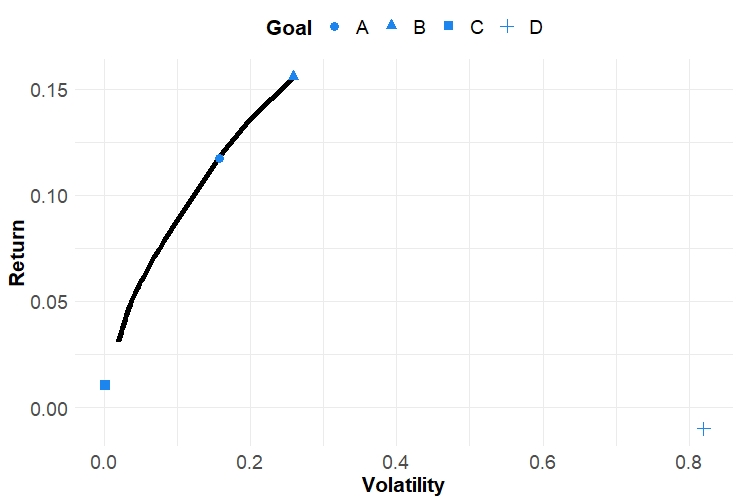
Goals-based optimization results in investment portfolios that may or may not lie on the mean-variance efficient frontier. When a goal is valued highly enough it receives a capital allocation sufficient to keep it on the frontier (A and B in the picture). However, when the goal is more aspirational (and valued less) the portfolio departs from the frontier in favor of high-variance investments. In this example, portfolio C is fully funded and therefore allocated to the risk-free asset. Though not necessarily mean-variance efficient, goals-based portfolios will generate portfolios with higher probabilities of goal achievement than mean-variance portfolios.
Fjparker · CC BY-SA 4.0
asset correlation matrix heatmap
Generated by Grok Imagine (xAI), prompt: Generate a single 4:3 horizontal image for an educational lesson.
Lesson title: "Why Mixing Bad Bets Can Make a Safe Portfolio" · What diversification actually purchases and why it isn't what most peo…
Quiz yourself