Personal-finance
·
Risk And Pricing
·
insurance is a bet you hope to lose —…
Medium
5 min
You're Paying to Lose a Bet Every Month
Why insurance only works if most people never use it
Share
Every month, you hand money to a company and hope you never get anything back. That's not a scam. That's insurance — and understanding why it works changes how you think about every financial risk you carry.
Money is full of hidden machines for moving risk around. Credit moves the risk of non-payment from lenders to borrowers. Investments move the risk of loss toward whoever wants a shot at gains. Insurance is a different kind of machine — it doesn't eliminate risk, it pools it. A hundred thousand people each face a small chance of a catastrophic loss. Insurance says: instead of one of you getting wiped out, all of you pay a little, and whoever gets hit gets covered. The catastrophe still happens. The financial ruin doesn't.
This is where the bet framing clicks into place. When you buy car insurance, you're betting the insurer that you'll have an accident. They're betting you won't. If you go a decade without a claim, you 'lose' — you paid premiums and got nothing back. But you didn't actually lose, because the whole point was to protect against the scenario where you'd need $40,000 you don't have. The 'loss' is the cost of sleeping soundly. Most people, most years, sleep soundly. That's what makes the whole system work.
Make your call
Say 10,000 people each face a 1% chance of a $50,000 loss this year. An insurer offers to cover everyone. What does the insurer charge each person, at minimum, to break even?
A
$50,000 — the full cost of the loss
B
$500 — their expected share of the loss
C
$50 — a small fee to join the pool
That $500 is called the actuarial price — the pure math of what the pool costs. But your actual premium is higher, because the insurer also needs to cover operating costs, profit margin, and something called adverse selection. Adverse selection is the reason insurance pricing gets complicated fast: the people most likely to buy insurance are the people most likely to need it. If an insurer priced everyone the same, the healthy and careful would opt out, leaving only the sick and reckless in the pool — which would blow up the math entirely. So insurers don't treat you as 'everyone.' They sort you. Your age, your driving record, your ZIP code, your health history — all of it is the insurer's attempt to put you in the right sub-pool, where the price actually reflects your risk.
Key Insight
The premium you pay is never random. It's a company's best guess at your expected loss, plus a margin. When your rate goes up after an accident, they're not punishing you — they're updating their model. You revealed information about which sub-pool you actually belong to.
This is also why the bet framing matters for deciding what to insure. Insurance makes financial sense when two conditions are true: the potential loss would genuinely wreck you, and the probability is high enough that the expected value calculation is real. It makes less sense when the loss is affordable — paying $15/month to insure a $200 appliance is often just the retailer capturing profit. The insurer knows most appliances don't break in year one. You know it too. But the fear of the specific bad outcome overrides the math. Good financial instincts mean knowing when you're buying real protection versus when you're paying for the feeling of protection.
Related threads
Personal-finance
·
Your Emergency Fund Is Doing Something
·
emergency funds
Your Emergency Fund Is Doing Something
Personal-finance
·
Should You Buy a Home or Keep Renting?
·
rent or buy
Should You Buy a Home or Keep Renting?
Personal-finance
·
The Stranger Who Decides If You Get the Loan
·
what a credit score actually measures…
The Stranger Who Decides If You Get the Loan
Sources
Images from Wikimedia Commons. Attribution required by license.
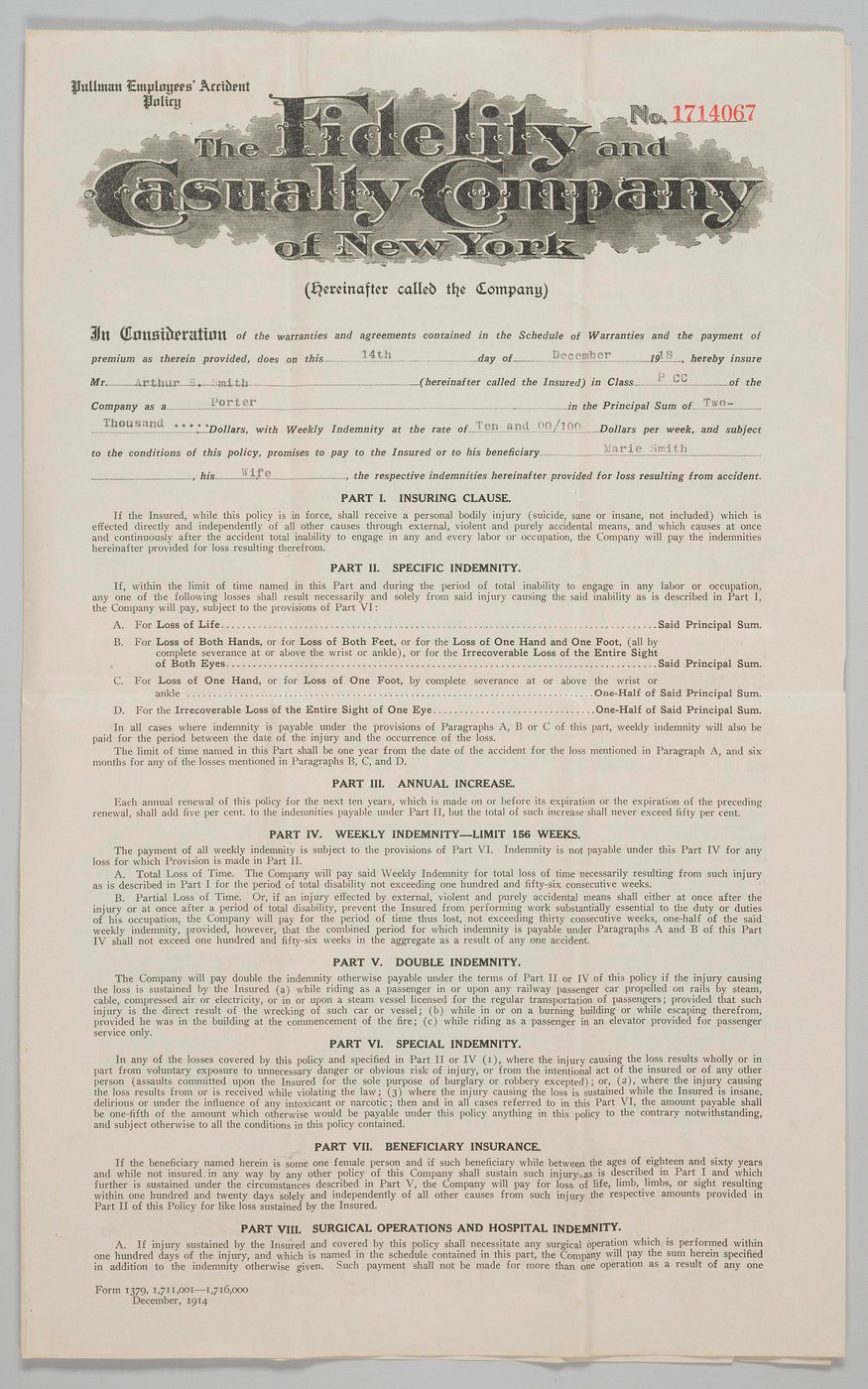
Insurance policy issued to Arthur S. Smith — 1918
Collection of the Smithsonian National Museum of African American History and Culture via Smithsonian Open Access (CC0)
Insurance Company of North America Fire Mark — ca 1800
Gift of CIGNA Museum and Art Collection via Smithsonian Open Access (CC0)
Quiz yourself