Personal-finance
·
Compounding
·
what a dollar saved at 25 becomes at 65…
Medium
5 min
The Dollar You Save at 25 Is Worth More Than You Think
Why starting early matters more than saving more
Share
Two people save the same total amount of money. One starts at 25, one starts at 35. At 65, the person who started earlier has nearly twice as much — even though they put in the same dollars.
Compounding is what happens when your money earns a return — and then that return earns a return too. Not just on what you put in, but on everything that accumulated before. It sounds simple. The math is not dramatic at first. But stretch it across 40 years and it becomes one of the most powerful forces in personal finance, quietly working in the background whether you're paying attention or not.
Start with $5,000 at age 25. Assume a 7% annual return — roughly what a broad stock index has averaged over long periods, after inflation. At the end of year one, you have $5,350. You didn't do anything. The $350 showed up because your money was working. Year two, you earn 7% on $5,350 — not just the original $5,000. That extra $24.50 feels like nothing. It is almost nothing. But this is where people make the mistake of stopping the math too early.
Make your call
That $5,000 invested at 25 with a 7% annual return. What do you think it becomes by age 65?
A
Around $19,000 — seven percent times forty years
B
Around $40,000 — a solid gain but nothing shocking
C
Around $75,000 — fifteen times what you put in
Key Insight
One $5,000 investment at age 25, left alone at 7% annual return, becomes approximately $74,872 by age 65. You contributed $5,000. The other $69,872 came from time.
Now run the same math starting at 35. Same $5,000, same 7% return, but only 30 years instead of 40. You end up with about $38,061. That one decade of delay cost you $36,000 — on a single $5,000 investment. This is why the two people in the hook end up so far apart even when they save the same total amount. The person who started at 25 didn't just save longer. They gave their early dollars an extra decade to multiply, and those early dollars do the most compounding because they have the most time. A dollar saved at 25 does more work than three dollars saved at 45.
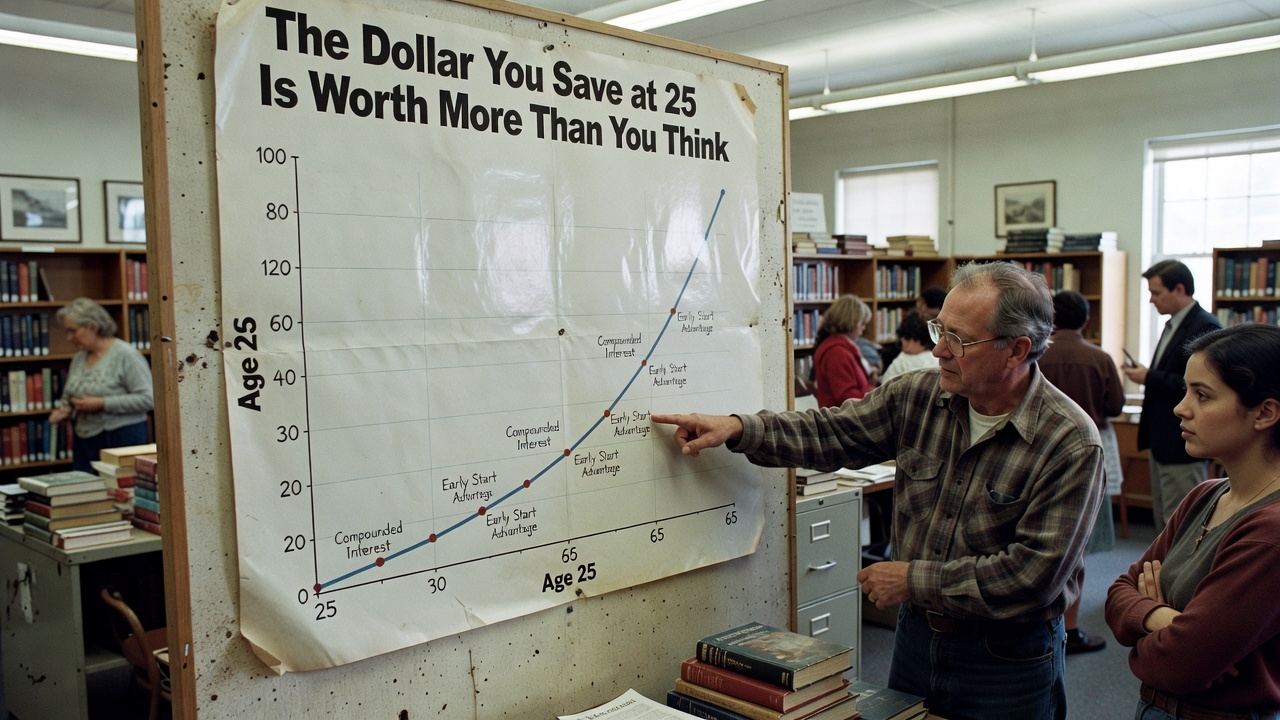
The reason this feels counterintuitive is that the growth is back-loaded. For the first ten or fifteen years, your balance climbs slowly enough that it barely feels like anything is happening. The curve is nearly flat. Then it bends. In the final decade before 65, that $5,000 investment grows by more than it did in the first three decades combined. Most of the wealth arrives at the end — which means most people who start late never see the part of the curve where the real action is. Starting at 25 doesn't just give you more time. It puts you on a completely different curve.
Related threads
Personal-finance
·
The Fee That Silently Eats Your Retirement
·
how an expense ratio compounds in…
The Fee That Silently Eats Your Retirement
Personal-finance
·
The Market Doesn't Reward Clever
·
why markets punish the in-and-out…
The Market Doesn't Reward Clever
Sources
Images from Wikimedia Commons. Attribution required by license.
exponential growth chart
Generated by Grok Imagine (xAI), prompt: Generate a single 16:9 horizontal image for an educational lesson.
Lesson title: "The Dollar You Save at 25 Is Worth More Than You Think" · Why starting early matters more than saving more
Domain: per…
Benjamin Franklin — 1787
National Portrait Gallery, Smithsonian Institution via Smithsonian Open Access (CC0)
Quiz yourself