Personal-finance
·
Compounding
·
how an expense ratio compounds in…
Medium
5 min
The Fee That Silently Eats Your Retirement
Why a number smaller than your rounding error is the most expensive thing you own
Share
Two people invest $10,000 at 25. Same market, same returns, same retirement date. One ends up with $140,000. The other ends up with $97,000. They made identical decisions — except one tiny number on a form they probably never read.
Compounding is the process where your returns earn their own returns. Put $1,000 in the market, earn 7%, now you have $1,070. Next year, 7% of $1,070 — not $1,000. The base keeps growing, so each year's gains are bigger than the last. Given enough time, this turns modest savings into serious money. But compounding is indifferent to direction. It works just as ruthlessly in reverse — and that's where expense ratios come in.
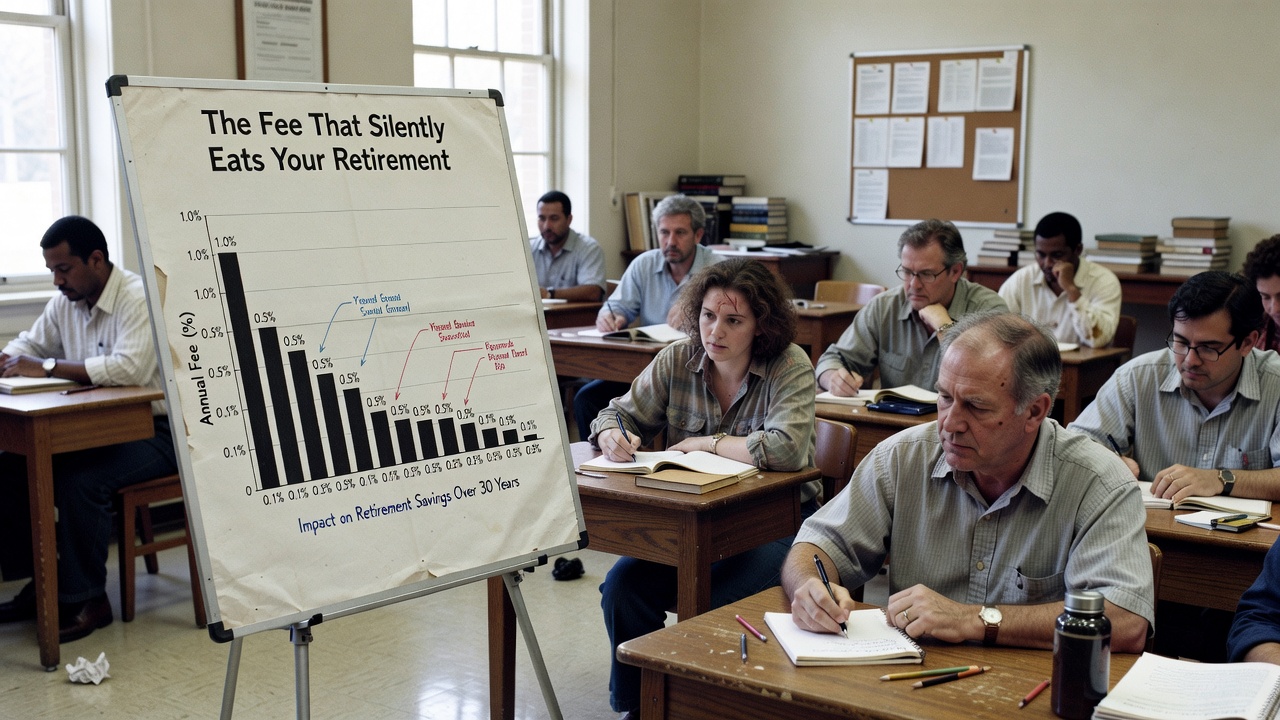
An expense ratio is the annual fee a fund charges to manage your money. It sounds bureaucratic. It looks harmless. A typical actively managed mutual fund charges around 1%. An index fund might charge 0.03% to 0.10%. The difference — roughly 0.9 percentage points — seems like noise. It is not noise. It is the single most consequential number in your retirement account, and almost nobody reads it.
Make your call
Say you invest $50,000 at age 30 and leave it alone until 65. The market returns 7% annually. One fund charges 0.1% per year. Another charges 1.1% per year. After 35 years, how much does the fee difference cost you?
A
Around $5,000 — fees are small, so the damage is small
B
Around $20,000 — meaningful but manageable
C
Around $60,000 — more than you originally invested
Here's the arithmetic. At 6.9% net (7% minus 0.1% fee), $50,000 grows to roughly $484,000 over 35 years. At 5.9% net (7% minus 1.1% fee), the same $50,000 grows to about $421,000. The fee didn't just skim $5,000 off the top — it compounded against you every single year. Each year you paid the fee, you lost not just that money but all the future growth that money would have generated. By year 35, the 1% fee has consumed more than 13% of your final balance. Across a typical retirement portfolio, that's often a third of what you would have had.
Key Insight
A 1% annual fee doesn't cost you 1% of your retirement. It costs you 20–30% of your final balance — because every dollar paid in fees is a dollar that never compounds forward for the next 10, 20, or 30 years.
This is why the two investors from the hook ended up $43,000 apart despite making identical choices. The one who lost out wasn't careless with their money — they just picked a fund with a higher expense ratio and didn't notice. The fee was listed on page 47 of the prospectus, expressed as a percentage so small it fit inside a decimal point. The fix is straightforward: before putting money in any fund, look up its expense ratio. For broad market index funds, anything above 0.20% is worth questioning. Anything above 0.75% needs a very good reason to exist. The market's returns are uncertain. The fee is guaranteed — and it compounds every year you stay.
Related threads
Personal-finance
·
The Dollar You Save at 25 Is Worth More Than You Think
·
what a dollar saved at 25 becomes at 65…
The Dollar You Save at 25 Is Worth More Than You Think
Personal-finance
·
The Market Doesn't Reward Clever
·
why markets punish the in-and-out…
The Market Doesn't Reward Clever
Sources
Images from Wikimedia Commons. Attribution required by license.
investment fund fees chart
Generated by Grok Imagine (xAI), prompt: Generate a single 16:9 horizontal image for an educational lesson.
Lesson title: "The Fee That Silently Eats Your Retirement" · Why a number smaller than your rounding error is the most expensive thin…
compound growth fee comparison graph
Generated by Grok Imagine (xAI), prompt: Generate a single 4:3 horizontal image for an educational lesson.
Lesson title: "The Fee That Silently Eats Your Retirement" · Why a number smaller than your rounding error is the most expensive thing…
Quiz yourself