Mathematics
·
Everything Changes. But How Fast?
Medium
5 min
Everything Changes. But How Fast?
The single idea behind calculus that will change how you see the world.
Share
Your phone goes from 100% battery to dead in 6 hours. But it didn't die smoothly — it crawled from 100 to 80, then sprinted from 30 to zero. Same total drop. Wildly different speeds. That difference — how fast something changes at any given moment — is the entire idea behind calculus.
You already understand rate of change. You just don't call it that. When you check if your Uber is getting closer fast enough, when you notice your follower count spiked after one post, when you feel a conversation shift from awkward to easy — you're tracking how fast something is changing. Not just that it changed. How fast. That instinct is the seed of one of the most powerful ideas in mathematics.
Analogy
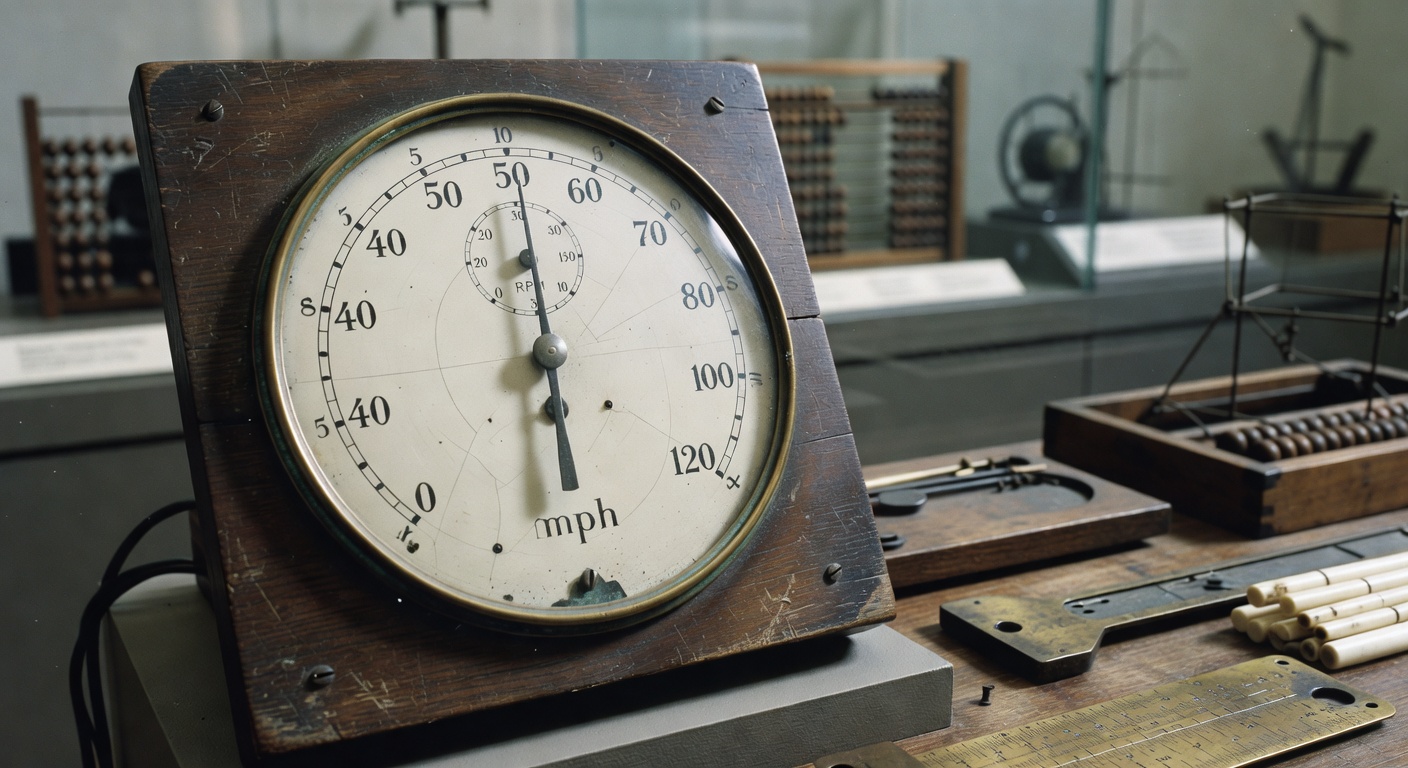
Think about driving on a highway. Your trip odometer says you traveled 120 miles in 2 hours. So your average speed was 60 mph. Simple. But you know that's not the whole story — you were stuck at 20 mph in traffic for 30 minutes, then hit 80 mph on the open stretch. The average hides all the action. What if you wanted to know your exact speed at 1:47pm? That's not an average anymore. That's your speed at a single instant — and capturing that exact, instantaneous rate of change is precisely what calculus was invented to do.
Picture a graph with time on the horizontal axis and distance on the vertical. A straight diagonal line means you're moving at a constant speed — the slope of that line is your rate of change. Now imagine the line curves — steep at first, then flattening out. That curve is telling you: fast at the start, slowing down later. The steepness of the curve at any single point is your instantaneous rate of change. The whole game of calculus is figuring out how to measure that steepness at exactly one point.
Make your call
Your phone battery dies unevenly, your Uber crawls then sprints, your portfolio creeps then surges. How do mathematicians pin down the exact speed of change at a single instant — a point with no width at all?
A
They calculate the average rate over the whole interval and use that as the best estimate
B
They zoom in on the curve until it looks like a straight line, then measure that
C
They sample many small intervals and take the most common speed
Measuring the steepness of a curve at a single point turns out to be strange. A point has no width. No rise, no run. You can't just divide. Mathematicians solved this with a beautifully sneaky trick: zoom in. If you zoom into any smooth curve far enough, it starts to look like a straight line. And straight lines? You can measure those. The rate of change at a single instant is the slope of that straight line you get when you zoom in infinitely close. That's it. That's the derivative — and it's exactly why your phone battery can sprint from 30% to zero while barely moving from 100 to 80. You just understood the core idea of calculus.
Key Insight
Average rate of change asks: how much did things change overall? Instantaneous rate of change asks: how fast is it changing right now? The gap between those two questions is the gap between basic arithmetic and calculus — and it took humanity until the 1600s to bridge it.
Example
Music platforms track not just how many streams a song gets, but how fast that number is growing. A song with 1 million streams that doubled in a week is treated completely differently from one that took a year to hit the same number. The rate of change of popularity is the signal. Same logic applies to stock prices, viral posts, and the spread of a cold through your friend group. The raw number matters less than how fast it's moving — and whether that speed itself is speeding up or slowing down.
That last part — whether the rate of change is itself changing — is where things get genuinely mind-bending. Your salary going up is good. Your salary going up faster every year is better. Your salary growth slowing down is a warning sign, even if you're still getting raises. This is the difference between the rate of change and the rate of change of the rate of change. Mathematicians call the second one the second derivative. You don't need that term. You just need to know: sometimes the most important thing isn't how fast something is moving, but whether it's accelerating or decelerating. That distinction quietly runs the world.
Sources
Images from Wikimedia Commons. Attribution required by license.
speedometer close up
Generated by Grok Imagine (xAI), prompt: Generate a single 16:9 horizontal image for an educational lesson.
Lesson title: "Everything Changes. But How Fast?" · The single idea behind calculus that will change how you see the world.
Domain: m…
curved graph speed distance
Generated by Grok Imagine (xAI), prompt: Generate a single 4:3 horizontal image for an educational lesson.
Lesson title: "Everything Changes. But How Fast?" · The single idea behind calculus that will change how you see the world.
Domain: ma…
Quiz yourself