
Mathematics
·
How to Tame Numbers That Break Your Brain
Medium
6 min
How to Tame Numbers That Break Your Brain
The trick mathematicians use to make the incomprehensibly huge feel small
Share
The number of atoms in the observable universe is roughly 10 to the power of 80. The number of possible chess games is 10 to the power of 120. Those two numbers look close on paper — but the second one is literally a trillion trillion trillion trillion times bigger. Logarithms are the only reason we can even write that sentence without losing our minds.
Here's the problem with exponential growth: it gets out of hand so fast that normal math breaks. You can't put 'the number of atoms in the universe' on a graph next to 'the population of Earth' without one of them being literally invisible. The numbers are so different in scale that comparing them is like trying to weigh a grain of sand next to a planet.
So mathematicians asked a simple question: what if instead of working with the numbers themselves, we worked with their exponents? What if, instead of writing 1,000,000,000, we just wrote 9 — because 10 to the power of 9 is a billion? That's it. That's logarithms.
Analogy
Think about how you talk about music volume. You don't say 'that speaker is producing 0.002 watts of acoustic power.' You say it's 83 decibels. Decibels are a logarithmic scale — every 10 decibels is actually 10 times more power. A concert at 110 dB isn't a little louder than a conversation at 60 dB. It's 100,000 times louder.
Or think about your phone's signal bars. You don't see the actual radio wave strength in milliwatts. You see 1, 2, 3, 4, or 5 bars — a compressed, human-readable version of a wildly varying number. Logarithms do exactly that: they compress enormous ranges into something your brain can actually work with.
Make your call
Those two numbers from the opening — 10⁸⁰ atoms in the universe, 10¹²⁰ possible chess games — look almost neighborly written that way. But how much bigger is 10¹²⁰ than 10⁸⁰, really?
A
About 40 times bigger — you just subtract the exponents
B
10⁴⁰ times bigger — a 1 followed by 40 zeros
C
1,200 times bigger — the exponents multiply
So what is a logarithm, mechanically? It answers one question: 'What power do I need to raise this base to, in order to get this number?'
Log base 10 of 1,000 = 3. Because 10³ = 1,000.
Log base 10 of 1,000,000 = 6. Because 10⁶ = 1,000,000.
Log base 10 of 1 = 0. Because 10⁰ = 1.
The logarithm is just the exponent, pulled out and handed to you. That's the whole thing. Exponents ask 'if I start at 10 and multiply this many times, where do I end up?' Logarithms ask the reverse: 'I ended up here — how many times did I multiply?'
Key Insight
Logarithms are the inverse of exponents — the same way subtraction undoes addition, or division undoes multiplication. Every time you see a log, ask yourself: 'what exponent am I looking for?' That question always has one answer.
Example
The Richter scale for earthquakes is logarithmic. A magnitude 5 earthquake isn't twice as powerful as a magnitude 4 — it's ten times as powerful. A magnitude 7 is 1,000 times more powerful than a magnitude 4. This is why earthquake scientists can't just use regular numbers: the difference between the smallest detectable tremor and the largest earthquake ever recorded spans a factor of about 100 billion. Logarithms let them fit that entire range onto a scale from 0 to 10. And remember the opening gap between 10⁸⁰ and 10¹²⁰? Subtract those exponents and you get 40 — a tidy number on a log scale, and an incomprehensible 10⁴⁰ without one.
Same with the pH scale for acidity. Same with how astronomers measure star brightness. Same with how your ears actually process sound — your hearing is logarithmic by design. Your brain already thinks in logs. Mathematicians just wrote it down.
Here's where logarithms become genuinely useful beyond just rescaling big numbers. Because of how exponents work, logarithms turn multiplication into addition.
log(A × B) = log(A) + log(B)
This sounds like a footnote. It's actually revolutionary. Before calculators existed, multiplying giant numbers was a nightmare. But if you could look up the logarithm of each number in a table, add those two logs together, then look up what number that sum corresponds to — you just multiplied two enormous numbers using only addition. This is how engineers built bridges, how navigators plotted courses, how scientists ran calculations for centuries. Slide rules — those analog calculator sticks you've seen in old photos — work entirely on this principle.
Key Insight
The single most important logarithm in all of science isn't log base 10 — it's the 'natural log,' written ln, which uses the base e (roughly 2.718). It shows up everywhere exponential growth appears: population models, compound interest, radioactive decay, algorithms. Whenever something grows or shrinks at a rate proportional to its current size, ln is the tool that makes it solvable. You'll meet it constantly.
Related threads
Mathematics
·
Why Doubling Breaks Your Brain
Why Doubling Breaks Your Brain
Sources
Images from Wikimedia Commons. Attribution required by license.
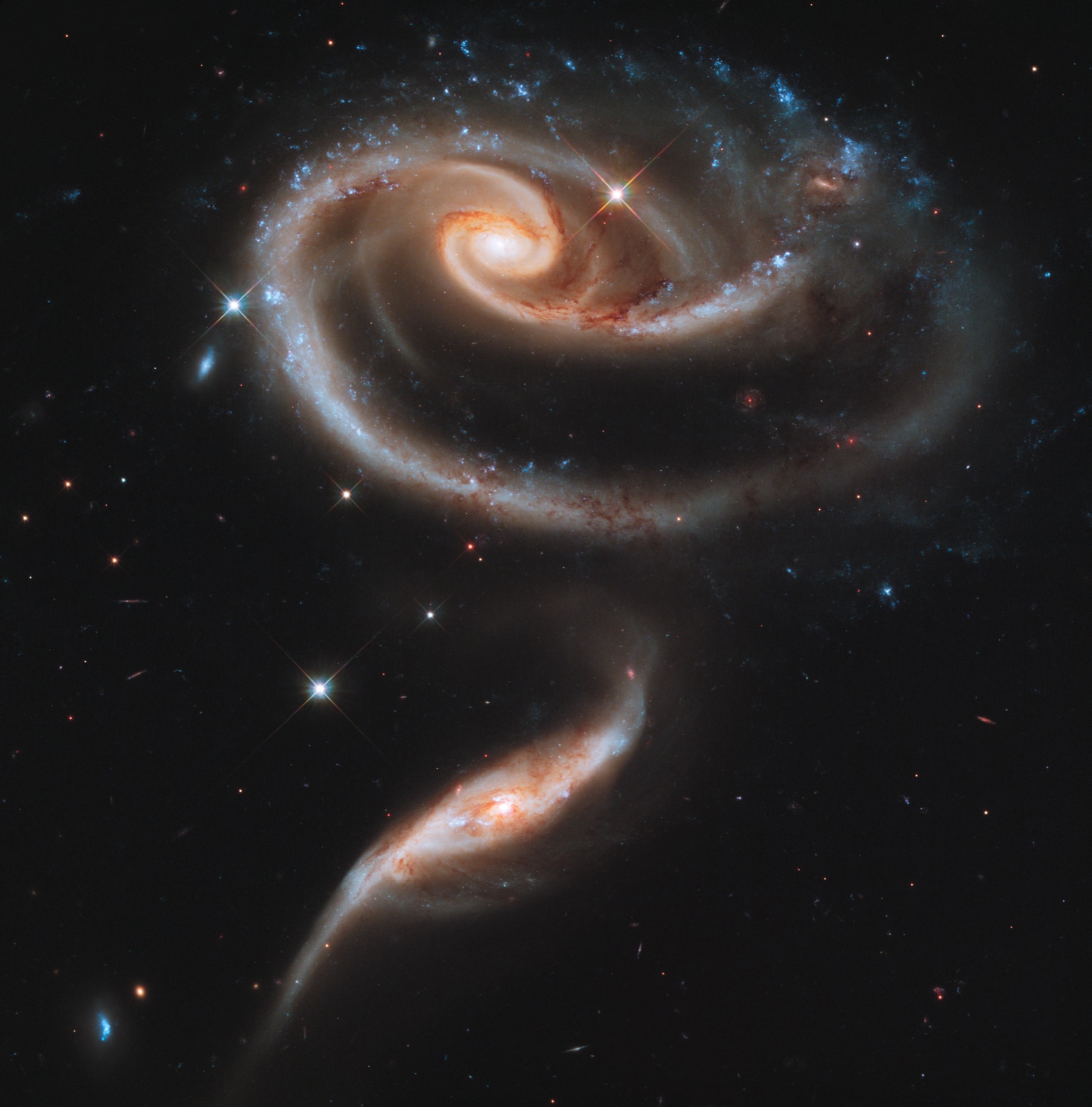
This Hubble Space Telescope image shows a group of interacting galaxies called Arp 273. The larger of the spiral galaxies, known as UGC 1810, has a disk that is tidally distorted into a rose-like shape by the gravitational tidal pull of the companion galaxy below it, known as UGC 1813. A swath of blue jewels across the top is the combined light from clusters of intensely bright and hot young blue stars. These massive stars glow fiercely in ultraviolet light.
The smaller, nearly edge-on companion shows distinct signs of intense star formation at its nucleus, perhaps triggered by the encounter with the companion galaxy.
A series of uncommon spiral patterns in the large galaxy is a tell-tale sign of interaction. The large, outer arm appears partially as a ring, a feature seen when interacting galaxies actually pass through one another. This suggests that the smaller companion actually dived deep, but off-center, through UGC 1810. The inner set of spiral arms is highly warped out of the plane with one of the arms going behind the bulge and coming back out the other side. How these two spiral patterns connect is still not precisely known.
A possible mini-spiral may be visible in the spiral arms of UGC 1810 to the upper right. It is noticeable how the outermost spiral arm changes character as it passes this third galaxy, from smooth with lots of old stars (reddish in color) on one side to clumpy and extremely blue on the other. The fairly regular spacing of the blue star-forming knots fits with what is seen in the spiral arms of other galaxies and is predictable based on instabilities in the gas contained within the arm.
The larger galaxy in the UGC 1810 - UGC 1813 pair has a mass that is about five times that of the smaller galaxy. In unequal pairs such as this, the relatively rapid passage of a companion galaxy produces the lopsided or asymmetric structure in the main spiral. Also in such encounters, the starburst activity typically begins in the minor galaxies earlier than in the major galaxies. These effects could be due to the fact that the smaller galaxies have consumed less of the gas present in their nucleus, from which new stars are born.
Arp 273 lies in the constellation Andromeda and is roughly 300 million light-years away from Earth. The image shows a tenuous tidal bridge of material between the two galaxies that are separated by tens of thousands of light-years from each other.
The interaction was imaged on December 17, 2010, with Hubble's Wide Field Camera 3 (WFC3).
This Hubble image is a composite of data taken with three separate filters on WFC3 that allow a broad range of wavelengths covering the ultraviolet, blue, and red portions of the spectrum.
NASA, ESA, and the Hubble Heritage Team (STScI/AURA) · Public domain
Part of the historical seismometer with the seismogram, which has been used at the Institute of Geophysics of the Czech Academy of Science.
Petr Brož (Czech Academy of Science) · CC BY-SA 4.0
Keuffel & Esser "Beginner's Slide Rule" (reverse side), model 4058C, wood-framed cursor, made in USA, circa 1930s. This is the underside of a low-cost slide rule intended for students and other beginners, with its scales printed directly on wood rather than engraved into celluloid facing. It is a basic "Mannheim-type" slide rule, with two single-decade (1-to-10) scales C and D for ordinary multiplication and division, and two two-decade (1-to-100) scales A and B for calculations involving squares and square roots. This is a view of the rule's underside, which has an extensive table of equivalents. On the right end is a transparent notch with hairline; this shows the back side of the removable, reversible slide, with its sine (S), tangent (T), and logarithm (L) scales.)
Joe Haupt from USA · CC BY-SA 2.0
Quiz yourself