
Mathematics
·
Every Input Gets Exactly One Answer
Medium
5 min
Every Input Gets Exactly One Answer
The simple rule that secretly powers almost all of mathematics.
Share
You text someone. They reply. You text again. They reply again — but this time with a completely different person's response. Same number, different person. That's not how phones work. And it's not how functions work either. But understanding why reveals something surprisingly deep about how math describes reality.
Here's the core idea: a function is a rule that takes any input you give it and returns exactly one output. Not two. Not zero. One. Every time, for every input, without exception. That's the whole thing. But the word 'exactly' is doing a lot of work here — and unpacking it is where it gets interesting.
In math notation, this looks like f(x) = something. The f is the machine's name. The x is the slot where you put your input. Whatever comes out is the output. So f(x) = x + 3 means: whatever number you put in, add 3 and that's your answer. Put in 5, get 8. Put in 100, get 103. Put in -7, get -4. Same rule, every time, no surprises.
Make your call
Back to that confused phone contact — same number, different person replying. What exactly is the rule that a function must follow to avoid this kind of chaos?
A
Every output must be unique — no two inputs can share the same output.
B
Each input must produce exactly one output.
C
The rule must work the same way in both directions — one input to one output, and one output back to one input.
Picture an arrow diagram with two columns. Left column: your inputs — say 2, 5, and 9. Right column: your outputs. Each number on the left has exactly one arrow pointing to a number on the right. 2 → 5. 5 → 8. 9 → 12. That's a function. Now picture a diagram where 5 has TWO arrows — one pointing to 8 and another pointing to 11. Same input, two different outputs. That's the broken vending machine. Not a function.
Key Insight
The rule is one-way: one input must give exactly one output. But the reverse doesn't have to be true. Two different inputs CAN give the same output — that's totally fine. In a vending machine world, B4 and C7 can both give you Doritos. What's not allowed is B4 giving you Doritos AND Sprite at the same time.
Example
Your phone's autocorrect is a function. A mistyped word goes in (input), one suggestion comes out (output). Same typo, same fix — every time. Or think about your phone's face ID: your face goes in, one decision comes out (unlock or don't). The algorithm doesn't sometimes unlock, sometimes explode, sometimes show you a recipe. One input, one output, every time. That's a function doing real work in the world.
Here's the catch — not everything that looks like a rule is a function. Take 'what grade did you get on the test?' If you took one test, there's one answer. Function. But 'what's your mood today?' — same person, same day, ask twice and you might get two different answers. Not a function. That's exactly what made the phone scenario so wrong — one number, two different people replying. The test for whether something is a function is always the same: can a single input ever produce more than one output? If yes, it's not a function. If no, you're good.
Related threads
Mathematics
·
The Letter That Unlocks Every Equation
The Letter That Unlocks Every Equation
Sources
Images from Wikimedia Commons. Attribution required by license.
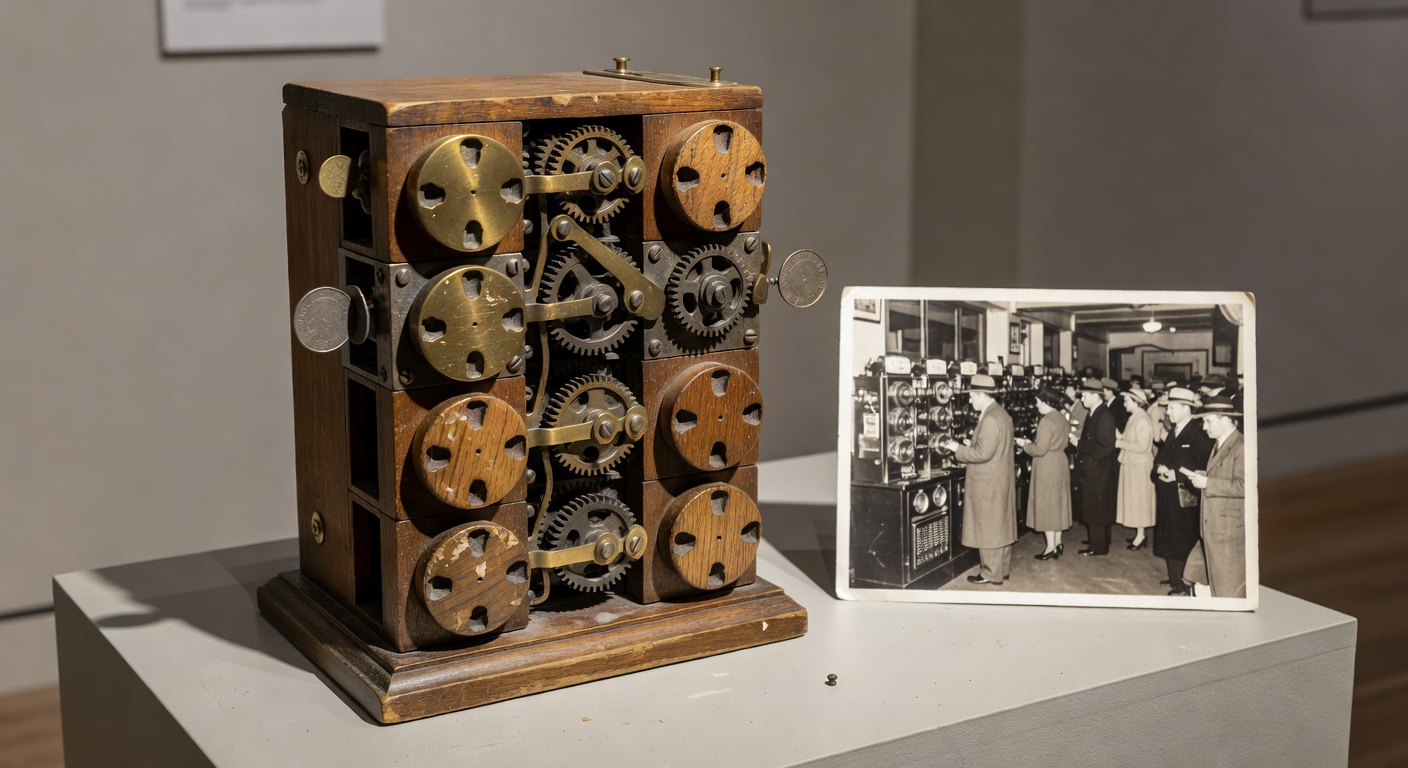
vending machine selection
Generated by Grok Imagine (xAI), prompt: Generate a single 16:9 horizontal image for an educational lesson.
Lesson title: "Every Input Gets Exactly One Answer" · The simple rule that secretly powers almost all of mathematics.
Domain: mathema…
On the NCBI website the web BLAST tool will have buttons similar to this layout. The color coded arrows show the input and output based on the input you have and the tool you select.
Htetlak · CC BY-SA 4.0
Quiz yourself