
Mathematics
·
The Number That Shouldn't Exist
Easy
5 min
The Number That Shouldn't Exist
How humanity spent thousands of years doing math without a symbol for nothing.
Share
You can count to ten without thinking. So could ancient Romans. But they couldn't do long division, build reliable calendars, or invent algebra. Why? They were missing a number you use every day without noticing it means anything at all.
For most of human history, zero didn't exist. Not because people were bad at math — the Egyptians built the pyramids, the Greeks invented geometry, the Romans ran a continent-spanning empire. These were not stupid people. But none of them had a symbol for nothing. And that absence quietly crippled everything they tried to calculate.
Example
Try this: write 2025 in Roman numerals. It's MMXXV. Now write 2005. That's MMV. Now try to multiply MMXXV by MMV without converting them first. You can't — not really. There's no way to line up the digits, carry numbers, or track place value, because Roman numerals have no concept of an empty position. No zero means no placeholder. No placeholder means every calculation is a nightmare you solve by hand on an abacus and then just... hope you wrote down right.
Make your call
The Romans built aqueducts and ran an empire. So what stopped them from doing long division? What's the one thing missing from their number system that made complex calculation nearly impossible?
A
They had no symbol for nothing — no zero, no placeholder, so digits couldn't carry positional meaning
B
Roman numerals used too many symbols, making numbers too long to work with
C
Romans relied on geometry instead of arithmetic, so they never developed the need
Zero was invented — not discovered, invented — at least twice in history, independently, by two different civilizations. The Babylonians had a placeholder symbol around 300 BCE. The Maya developed their own version around 350 CE. But the zero that actually changed the world came from India, around the 5th century CE. An Indian mathematician named Brahmagupta was the first person to write down rules for how zero behaves: what happens when you add it, subtract it, multiply by it. He treated nothing as a number. That was a genuinely radical idea.
Analogy
Think about your phone's contact list. Every contact has a name and a number. Now imagine a contact list where you could only save numbers that had actual digits — no zeros allowed. So 07700 900461 becomes 7799461. Suddenly two completely different people have the same number. Everything breaks. Zero is not just a symbol for nothing. It is a position holder that makes every other digit mean something different depending on where it sits. The 1 in 10 and the 1 in 100 are different because of the zeros behind them. Without zero, place value collapses, and without place value, modern arithmetic is basically impossible.
Key Insight
Zero does two completely different jobs, and both are essential. Job one: it's a placeholder that gives other digits their value (the difference between 1, 10, and 100). Job two: it's an actual number representing the quantity of nothing — something you can add, subtract, and calculate with. Most ancient civilizations got neither. The Indians got both. That's why their number system — transmitted through Arab scholars, which is why we call them Arabic numerals — is the one the entire modern world runs on.
Zero also broke some mathematicians' brains. What does it mean to have nothing? If you have zero apples, do you have apples? Medieval European scholars actually resisted zero for centuries — partly because the Catholic Church associated it with the void, with nothingness, with dangerous ideas. Merchants who used it were sometimes accused of sorcery. The number that seems most harmless caused genuine civilizational arguments. Brahmagupta also tried to figure out what happens when you divide by zero — and got it wrong, which is fine, because that problem is still technically unsolved today. Dividing by zero breaks mathematics in ways that even modern computers can't handle without crashing.
Key Insight
That number you use every day without noticing — the one the Romans were missing — turns out to be load-bearing. Without zero: no algebra, no calculus, no binary code, no computers, no internet. Every piece of digital technology you've ever touched runs on binary — ones and zeros. Zero isn't just a number. It's the foundation that all of modern civilization is quietly built on.
Related threads
Mathematics
·
Numbers Are a Technology We Invented
Numbers Are a Technology We Invented
Sources
Images from Wikimedia Commons. Attribution required by license.
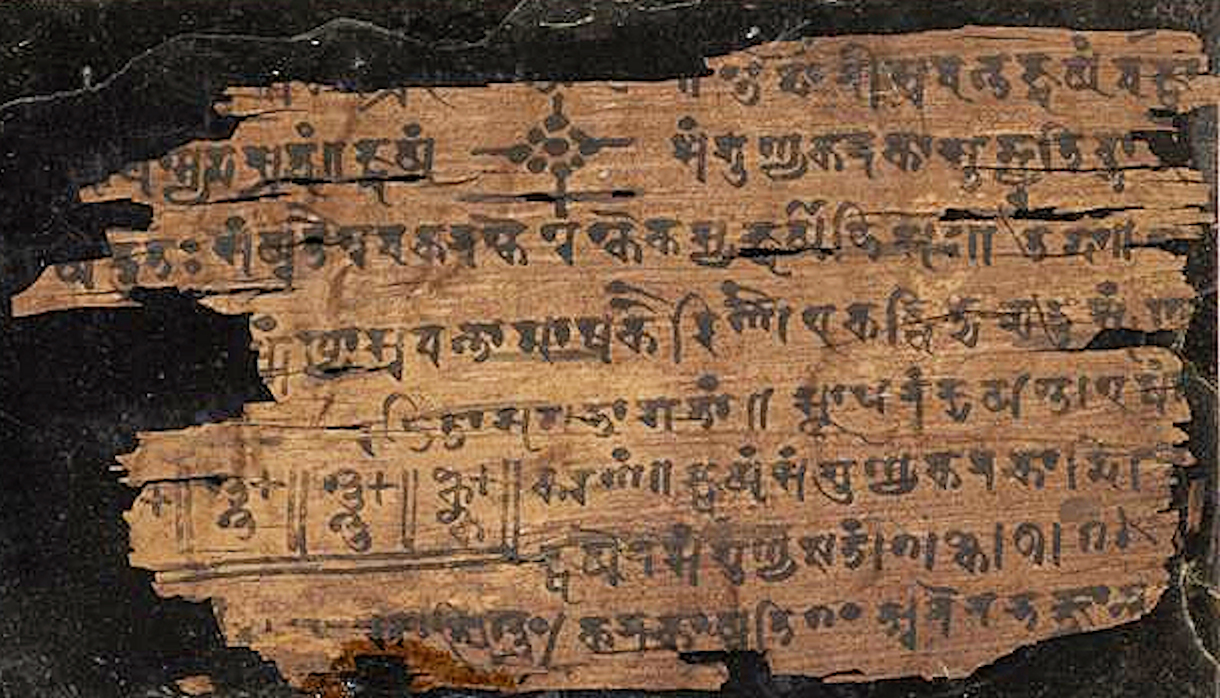
Full page of the Bakhshali manuscript (3rd–4th century CE) — the oldest known document containing a written zero
Bodleian Library via Wikimedia Commons (Public Domain)
Latin-language inscription dated from 9 May 1613 (An[nus] Dom[ini] MDCXIII nonis ma[ius], along with other Roman numerals), engraved on a stone of the western wall of the Notre-Dame cathedral in Luxembourg City.
Cayambe · CC BY-SA 3.0
Quiz yourself