Mathematics
·
Numbers Are a Technology We Invented
Easy
5 min
Numbers Are a Technology We Invented
We built numbers to survive, and the way we built them is genuinely strange.
Share
Look at three coffee cups. You didn't count them. You just knew there were three. Now look at seven. Probably you're counting now — one, two, three, four... That gap, between what you can see at a glance and what you have to count, is older than language. And it's where numbers actually came from.
Here's the problem your ancestors had. You've got a flock of sheep. You let them out in the morning, they come back at night. But did they ALL come back? You can't know unless you can track 'how many.' Without numbers, you're just guessing. And guessing wrong means a wolf ate your livelihood while you weren't paying attention.
So humans invented a solution: a one-to-one system. One pebble per sheep. Every morning, drop a pebble in a pouch as each sheep leaves. Every evening, take one out as each sheep returns. If pebbles are left over, sheep are missing. No counting required. No concept of 'fourteen' needed. Just: pebbles match sheep, or they don't.
That's not arithmetic. That's survival.
Analogy
Think about how you split a restaurant bill with friends. Before anyone does math, there's a moment where you just know something's off — too much money, not enough, someone didn't chip in. You feel the mismatch before you calculate it. That instinct is ancient. What numbers did was give that instinct a language.
Your ancestors felt 'something's missing' long before they could say 'three sheep are gone.' Numbers turned a vague feeling into a precise tool.
Make your call
You glanced at three coffee cups and just *knew*. But why does that instant recognition fall apart somewhere around five or six? What actually forces us to start counting?
A
We lose focus — attention drifts and the brain gives up on large groups
B
Our brains hit a hard perceptual limit, and counting is the workaround we invented to get past it
C
We were never taught to recognize larger groups instantly, so it's just a training gap
Here's something you do without noticing. Show a baby two dots, then three dots. They look longer at the change. Same with crows, monkeys, even fish. Almost every brain on Earth can tell 'one, two, three, four' apart at a glance — no counting, no language. Psychologists call this subitizing — and it's exactly the gap the hook pointed at, between the three cups you just knew and the seven you had to count.
But go past four and the trick stops working. Five dots versus six? You actually have to count. That cliff — between what brains see instantly and what they have to work for — is where numbers had to come in. Counting is the cheat code we built to push past four.
Key Insight
Numbers aren't a thing you find in nature. They're a thing you use to describe relationships between things in nature. That distinction sounds small. It isn't. It's why math can describe everything from music to black holes — because it was never really about the objects. It was always about the structure underneath.
But pay attention. At some point, humans realized something radical: the pebbles and the sheep don't actually matter. What matters is the pattern.
Three sheep. Three pebbles. Three days until the festival. Three strangers at the gate. The 'three-ness' is the same across all of them. It doesn't belong to any one thing — it's a property that floats free of the objects themselves.
That leap, from 'three pebbles' to just 'three,' is one of the most powerful abstractions in human history. It's the moment numbers stopped being a counting trick and became a universal language.
Example
Different civilizations invented numbers independently, and they didn't all make the same choices. The Babylonians used base 60 — which is why you still have 60 seconds in a minute and 360 degrees in a circle. The Maya used base 20, probably because they counted fingers AND toes. The system you grew up with — base 10 — almost certainly exists because most humans have ten fingers.
The math itself is universal. The notation is just... whatever worked for whoever invented it first. You'd think there'd be one obvious way to write numbers. There isn't. There are dozens. And they all work.
So what IS a number, actually? Mathematicians spent centuries fighting about this. The honest answer: a number is an abstract object that represents a quantity or position, defined entirely by its relationships to other numbers. Three isn't three because of anything physical. Three is three because it comes after two and before four, because it's one more than two, because two of them make six.
Numbers are defined by what they DO, not what they ARE. Which sounds like philosophy until you realize it's why you can do math with imaginary numbers, infinite numbers, and numbers that break every intuition you have — and still get answers that are genuinely useful in the real world.
The abstraction isn't a bug. It's the whole point.
Key Insight
You didn't learn numbers because they exist in the world. You learned them because they're the most powerful compression tool ever invented — a way to take messy, complicated reality and squeeze it into something you can think about, compare, and manipulate. Every equation you've ever seen is just that sheep-counting trick, scaled up to the size of the universe.
Sources
Images from Wikimedia Commons. Attribution required by license.
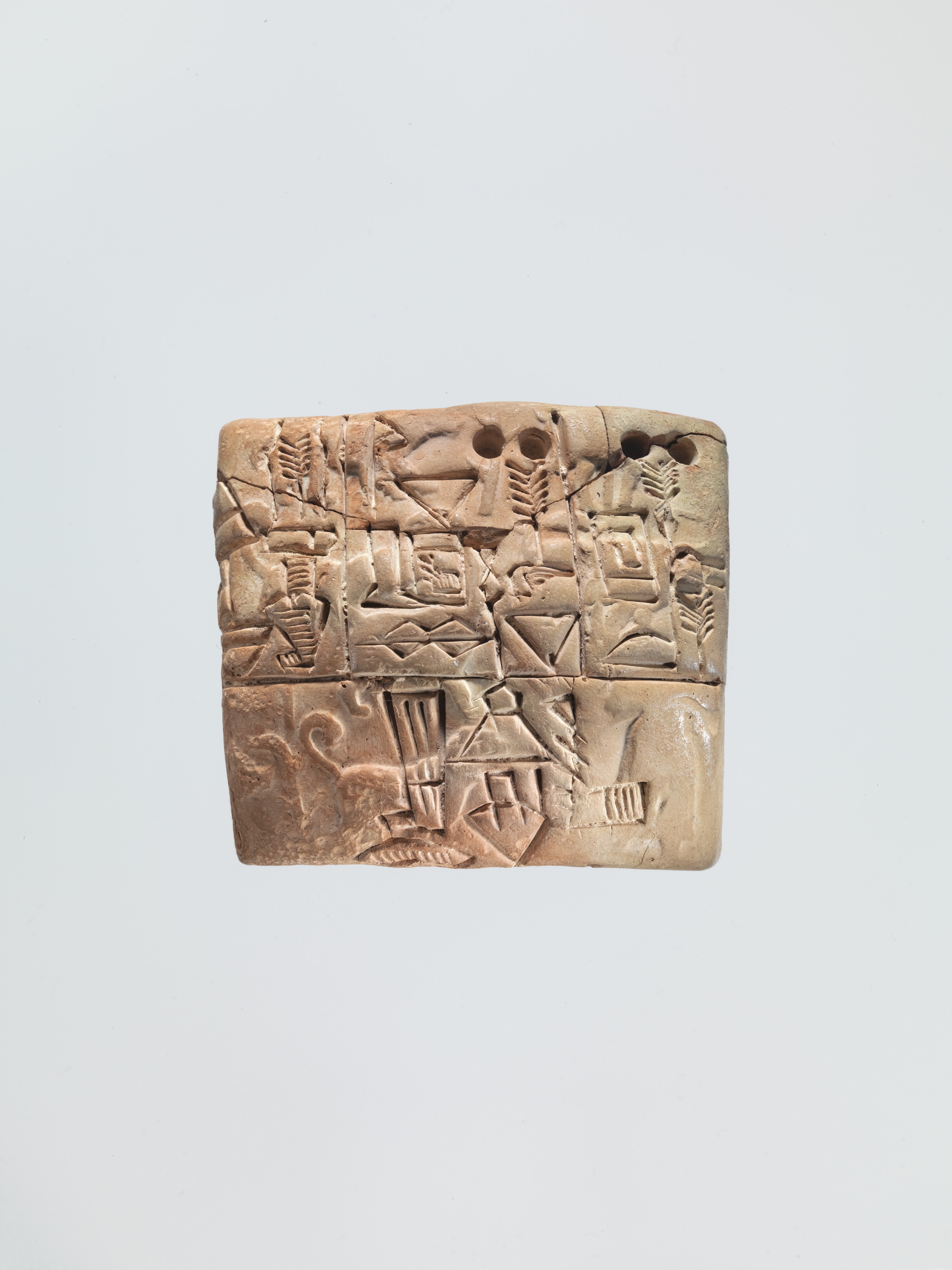
Proto-Cuneiform tablet with seal impressions: administrative account of barley distribution with cylinder seal impression of a male figure, hunting dogs, and boars — ca. 3100–2900 BCE — Sumerian
Sumerian via The Metropolitan Museum of Art (Public Domain)
Small clay tablet with cuneiform writing on both sides (in Akkadian language), from Early Old Babylonian period. It displays an account of labor, specifically referring to numbers of bricks carried by workers.
Original author unknown. Translation help provided by Manuel Molina. · Public domain
Quiz yourself