
History
·
How Half the World Broke Free
Medium
8 min
How Half the World Broke Free
In less than 30 years, dozens of countries that didn't exist suddenly did.
Share
In 1939, the British Empire controlled roughly a quarter of the Earth's land surface. By 1975, almost all of it was gone. Not conquered. Not lost in a single war. Just... dismantled. How does the most powerful empire in history simply stop existing?
Empires run on a story. The story Britain told was that it was bringing civilization, order, and progress to places that couldn't manage without it. For a long time, enough people — including some of the colonized — half-believed it. Then World War 2 happened, and the story fell apart in the worst possible way.
Britain and France spent six years telling their colonial subjects that they were fighting for freedom, democracy, and the right of people to govern themselves. Millions of Indians, Africans, and Southeast Asians fought and died for that cause. And when the war ended, they looked at their colonial rulers and said: okay, so... us too, right?
The colonial powers had no good answer. They'd just spent years making the argument for their own undoing.
Make your call
Here's the question the hook leaves hanging: how does the most powerful empire in history simply stop existing in 30 years? What was the deciding factor that finally made Britain and France let go?
A
The colonial powers genuinely changed their values — fighting for freedom while denying it became morally untenable
B
Empire became economically and militarily unsustainable, making staying more costly than leaving
C
The United States pressured Britain and France to decolonize as a condition of postwar aid
But the war didn't just create moral pressure — it created a power vacuum. Britain and France came out of WW2 exhausted and broke. Running an empire costs money: you need administrators, soldiers, infrastructure, courts. Suddenly, the math didn't work anymore. The colonies that were supposed to enrich the empire were becoming expensive liabilities at exactly the moment the empire could least afford them.
Two new superpowers emerged from the war — the US and the Soviet Union — and neither of them liked European empires. The US had its own anti-colonial founding myth. The Soviets actively encouraged independence movements to pull new nations into their orbit. For the first time, colonial powers were getting international pressure from above while getting revolutionary pressure from below.
Example
India is the clearest case study. By 1945, the Indian National Congress had been fighting for independence for decades, led by figures like Gandhi and Nehru. But what actually made Britain let go wasn't just moral persuasion — it was the realization that holding India by force would require a military commitment Britain simply couldn't afford anymore. In 1947, Britain handed over power and left. India and Pakistan became independent almost overnight.
The speed shocked everyone. And it sent a signal to every other colony on earth: if India could do it, so could we.
Within a decade, the dominoes started falling. Ghana in 1957. Nigeria in 1960. Algeria in 1962 — though that one cost a brutal war. By the mid-1970s, the European empires that had carved up the world were reduced to their home countries plus a few scattered islands.
Key Insight
So how does the most powerful empire in history simply stop existing? Decolonization wasn't charity. Colonial powers didn't leave because they suddenly developed a conscience. They left because the combination of local resistance, international pressure, and economic exhaustion made staying more costly than going. Independence movements won not just by being morally right — but by making empire too expensive to maintain.
But leaving wasn't clean. And this is the part that still echoes today.
When European powers drew colonial borders, they weren't following ethnic groups, languages, or historical territories. They were drawing lines that suited European administrative convenience — often literally at a conference table in Berlin in 1884, with rulers and maps, while the people being divided weren't in the room. When independence came, those arbitrary borders became the borders of new nations.
Suddenly you had countries where dozens of ethnic groups who'd been played against each other under colonial rule were now supposed to form a unified government. The colonial powers had also systematically extracted wealth, suppressed local institutions, and educated only a tiny elite to serve the administration — not to run an independent country. Decolonization gave people their flags and their seats at the UN. It didn't give them functioning economies or centuries of institutional experience.
Key Insight
The borders drawn by colonial powers in Africa and Asia were designed to divide, not to reflect the people living within them. When those borders became the borders of independent nations, they locked in conflicts that are still playing out today. The map of modern geopolitics is, in large part, a map of colonial decisions made by people who never visited the places they were drawing.
So what did decolonization actually achieve? It ended formal political control — the governors, the viceroys, the foreign armies. That was real and it mattered enormously. But critics, including many post-colonial thinkers like Frantz Fanon, argued that economic control often stayed in place. Western companies still owned the mines and the plantations. New nations took out loans from Western banks. Trade relationships kept former colonies dependent on selling raw materials and buying finished goods — the same dynamic as before, just without the flag.
Some called this neo-colonialism: independence in name, dependence in practice. Whether that framing captures the full picture is genuinely debated. But the fact that most of the world's wealthiest nations today are the former colonizers, and most of the poorest are the formerly colonized, is not a coincidence that history lets you ignore.
Related threads
History
·
How the World Burned Twice in 30 Years
How the World Burned Twice in 30 Years
Sources
Images from Wikimedia Commons. Attribution required by license.
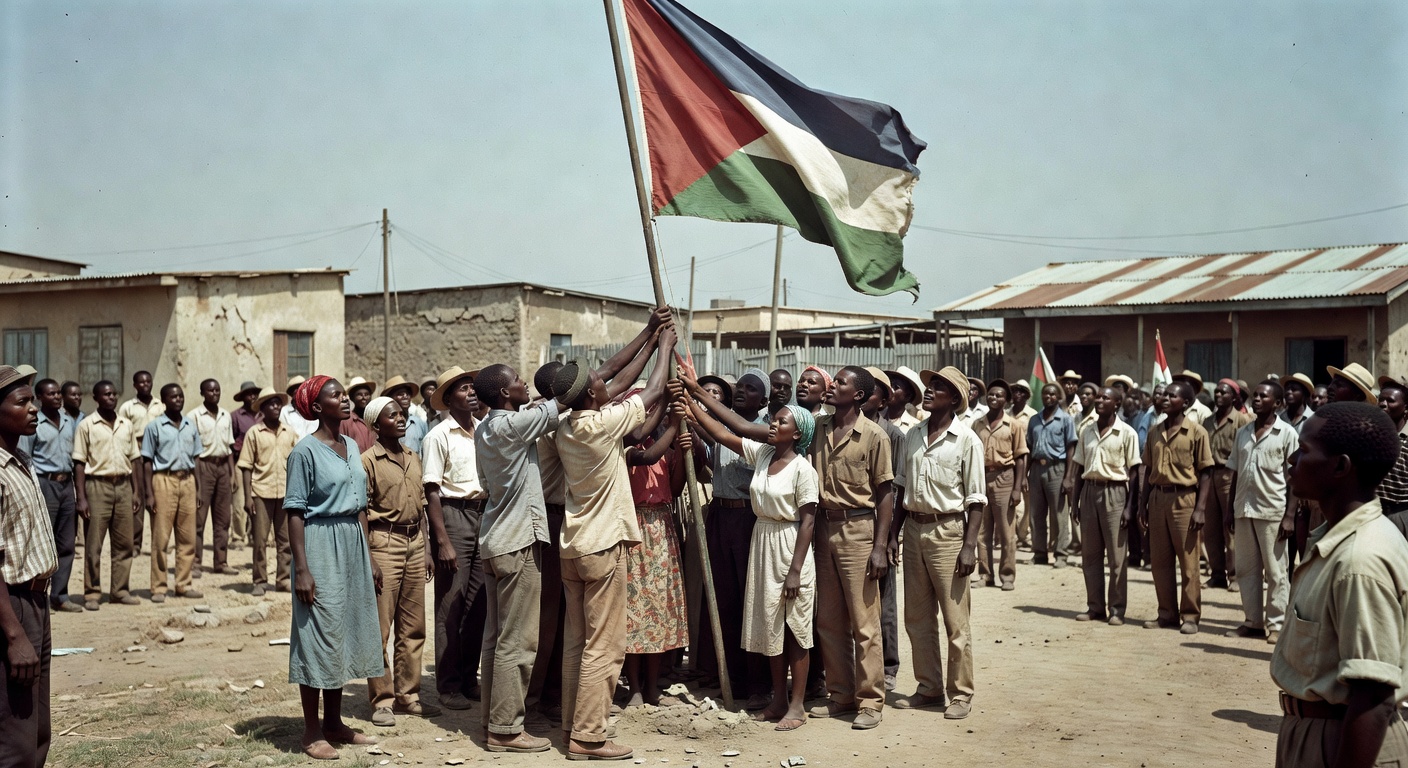
independence flag raising crowd
Generated by Grok Imagine (xAI), prompt: Generate a single 16:9 horizontal image for an educational lesson.
Lesson title: "How Half the World Broke Free" · In less than 30 years, dozens of countries that didn't exist suddenly did.
Domain: hi…
A riddle wrapped in a mystery inside an enigma -- Churchill
Library of Congress · Public Domain via Library of Congress
The Dutch founding of New York,
Library of Congress · Public Domain via Library of Congress
Quiz yourself