History
·
The War Nobody Actually Fought
Medium
7 min
The War Nobody Actually Fought
How two superpowers held the whole world hostage without ever firing at each other.
Share
Imagine two people pointing loaded guns at each other's heads for 45 years. Neither pulls the trigger. But everyone around them keeps getting shot. That's the Cold War — and it shaped almost every conflict you've heard of since 1945.
World War 2 ends in 1945. The Nazis are defeated. You'd think the world exhales. Instead, the two countries that did the most to win — the US and the Soviet Union — immediately start staring each other down.
The problem wasn't territory. It was a deeper question: how should human society be organized?
The US said: private ownership, free markets, elected governments. The Soviets said: collective ownership, state-run economies, one-party rule. Both sides believed — genuinely believed — that their system was the future of humanity. And both had nuclear weapons. So instead of fighting each other directly, they spent the next four and a half decades fighting everywhere else.
This is what 'proxy war' means — and once you understand it, you start seeing it everywhere.
Korea, 1950: North Korea (Soviet-backed) invades South Korea (US-backed). The US sends troops. China sends troops. 40,000 Americans die. The border ends up almost exactly where it started. The US and USSR never officially fought.
Vietnam, 1955-1975: Same playbook. The US pours in money, weapons, and eventually 500,000 soldiers to stop a communist takeover. The Soviets and Chinese arm the other side. 58,000 Americans die. 2 million Vietnamese die. Vietnam goes communist anyway.
Angola, Nicaragua, Afghanistan, Cuba — the list goes on. The Cold War wasn't cold for the people actually living in it.
Key Insight
The Cold War's defining logic: if you can't destroy your enemy, make sure they can't win anywhere else. Every country that 'went communist' was seen as a domino — and the US was terrified of where the falling would stop. This 'Domino Theory' sent a generation to wars they couldn't explain at dinner.
Make your call
Two superpowers both have nuclear weapons aimed at each other. Why doesn't either one ever pull the trigger? What actually keeps the guns from going off for 45 years?
A
Diplomatic treaties — formal agreements that legally prevented either side from striking first
B
Mutually Assured Destruction — launching first guarantees your own annihilation too, so neither side dares
C
Military stalemate — neither side had weapons accurate enough to guarantee a decisive first strike
And here's where it gets genuinely terrifying — the nuclear part.
By the early 1950s, both sides had hydrogen bombs capable of destroying entire cities. By the 1960s, they had enough to end human civilization multiple times over. The strategy was called MAD — Mutually Assured Destruction — and it was exactly as insane as it sounds.
The logic: if you launch at me, I launch at you, we both die, so neither of us launches. It worked. Barely. In 1962, the Cuban Missile Crisis brought the world within hours of nuclear war — the Soviets had missiles in Cuba pointed at US cities, the US was ready to invade. Thirteen days of back-channel negotiation, and both sides backed down. The people alive today exist partly because two men in 1962 decided not to press a button.
Example
The Space Race is the Cold War in its purest form — competition without combat.
1957: The Soviets launch Sputnik, the first satellite. It's the size of a beach ball and just beeps. Americans panic. If they can put something in orbit, they can put a nuclear warhead anywhere on Earth.
1961: Soviet cosmonaut Yuri Gagarin becomes the first human in space. The US is humiliated.
1969: Apollo 11 lands on the Moon. Neil Armstrong steps out. The US wins — not because it needed the Moon, but because it needed the world to see that capitalism could do things communism couldn't.
Every rocket launch was a flex. Every satellite was a message. The Space Race was a propaganda war fought with physics.
The Cold War ends not with a bang but with a collapse.
By the 1980s, the Soviet economy is buckling. Decades of military spending, a disastrous war in Afghanistan, and a system that couldn't produce enough consumer goods had drained the USSR. Soviet leader Mikhail Gorbachev tries to reform it — glasnost (openness), perestroika (restructuring). Instead of saving the system, the reforms reveal how broken it is.
1989: The Berlin Wall falls. East Germans literally tear it apart with hammers while guards stand by. One by one, Soviet satellite states break free. In 1991, the Soviet Union itself dissolves into 15 separate countries.
The US doesn't win the Cold War so much as the Soviet Union loses it. And the world that emerges — with one superpower instead of two — is the world you grew up in. Everyone around them kept getting shot — Korea, Vietnam, Angola, Afghanistan. Every geopolitical tension you follow today has a root somewhere in those 45 years.
Sources
Images from Wikimedia Commons. Attribution required by license.
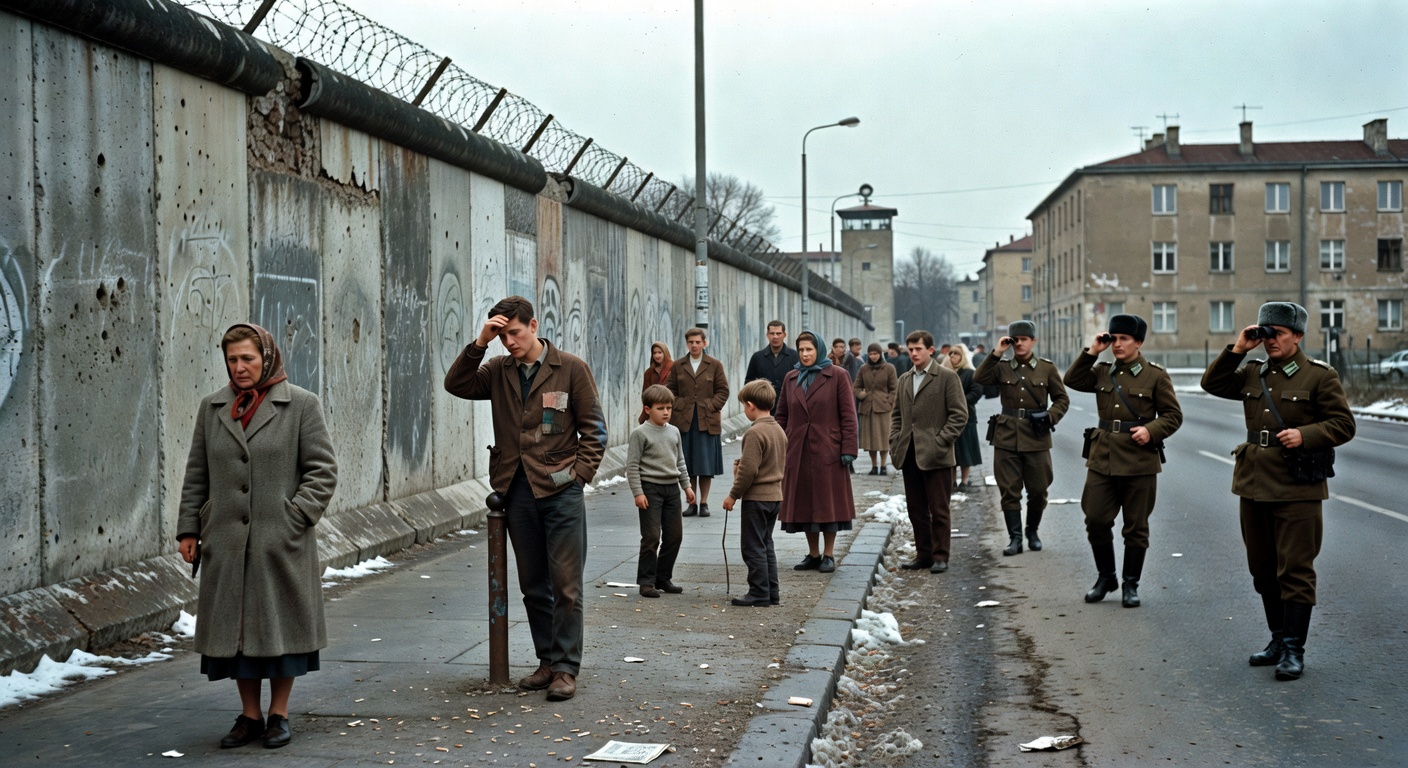
Berlin Wall cold war
Generated by Grok Imagine (xAI), prompt: Generate a single 16:9 horizontal image for an educational lesson.
Lesson title: "The War Nobody Actually Fought" · How two superpowers held the whole world hostage without ever firing at each other.
…
Yalta summit in February 1945 with (from left to right) Winston Churchill, Franklin Roosevelt and Joseph Stalin. Also present are USSR Foreign Minister Vyacheslav Molotov (far right); Field Marshal Alan Brooke, Admiral of the Fleet Sir Andrew Cunningham, RN, Marshal of the RAF Sir Charles Portal, (standing behind Churchill); George Marshall, Army Chief of Staff and Fleet Admiral William D. Leahy, USN, (standing behind Roosevelt). This Kodak Kodachrome photograph was not colorized.
U.S. Army Signal Corps Collection · Public domain
[Pictorial newsmap illustrating the U.S. naval blockade during the Cuban Missile Crisis in 1962]
Library of Congress · Public Domain via Library of Congress
Quiz yourself