History
·
How the World Burned Twice in 30 Years
Medium
8 min
How the World Burned Twice in 30 Years
The war that reshaped every border, every government, and every assumption about what humans are capable of.
Share
Between 1939 and 1945, somewhere between 70 and 85 million people died. That's more than the entire current population of the UK — gone in six years. And the terrifying part? It was almost entirely preventable.
World War I ended in 1918 with a peace treaty so brutal it felt less like diplomacy and more like revenge. Germany was blamed for everything, stripped of territory, and forced to pay reparations so massive they weren't fully paid off until 2010. Yes, 2010. The victors thought they were punishing Germany. What they actually did was plant a seed of rage that would grow into something far worse than the war they'd just survived.
Make your call
The hook says WWII was almost entirely preventable. Before we get into how it actually started — what do you think was the single biggest reason fascism was able to take hold in Germany and drag the world into war?
A
Hitler concealed his true ideology until he had enough power to act on it
B
Economic ruin and national humiliation made ordinary people willing to follow someone who gave them enemies to blame
C
Democratic institutions in Germany were too fragile to resist a military takeover
Into that rage stepped Adolf Hitler. He didn't seize power through a coup — he was voted in. Germany in the early 1930s was economically destroyed, politically humiliated, and desperate for someone to blame and someone to follow. Hitler offered both. He blamed Jewish people, communists, and foreign powers for Germany's suffering. He promised national rebirth, military strength, and greatness. And millions of people, many of them ordinary, educated, and not cartoonishly evil, said yes. That's the part history classes tend to skip over. Fascism didn't win by hiding what it was. It won because enough people wanted what it was selling.
Analogy
Think about how misinformation spreads on social media. A post that makes you feel angry and gives you someone to blame gets shared way more than a nuanced post that asks you to sit with complexity. Now imagine that dynamic, but instead of a tweet, it's a charismatic leader speaking to a stadium of 100,000 people with no fact-checkers, no opposing feeds, and state control of every newspaper and radio station. That's the information environment Hitler operated in. The propaganda wasn't just lies — it was emotionally engineered content optimized for a population already primed to believe it.
Germany wasn't alone. Italy under Mussolini and Japan under a militarist government were also pursuing aggressive expansion. When Germany invaded Poland in September 1939, Britain and France finally said enough — and declared war. What followed was a global conflict fought on six continents, from the beaches of Normandy to the jungles of the Pacific to the deserts of North Africa. The scale is almost impossible to absorb. The Soviet Union alone lost an estimated 27 million people. The United States, which entered after Japan bombed Pearl Harbor in December 1941, mobilized 16 million soldiers. Every major economy on earth was redirected toward killing.
Key Insight
The Holocaust wasn't a side effect of the war. It was a deliberate, industrialized genocide — the systematic murder of six million Jewish people, plus millions of Roma, disabled people, gay people, and political prisoners. Nazi Germany built an entire infrastructure of death: trains, camps, bureaucracies, record-keeping. This is what happens when a government combines modern technology with dehumanizing ideology and removes every check on its power. It's not ancient history. It happened within living memory.
The war ended in two stages. Germany surrendered in May 1945 after Soviet forces reached Berlin and Hitler died by suicide in his bunker. Japan surrendered in September 1945 — but only after the United States dropped atomic bombs on Hiroshima and Nagasaki, killing an estimated 110,000 to 210,000 people instantly and through radiation. The debate over whether that decision was justified still runs hot among historians. What's not debated: it changed warfare forever. Humanity had built a weapon capable of ending civilization, and it had already used it.
Key Insight
WWII didn't just end — it reorganized the entire world. The United Nations was created to prevent another war of this scale. The United States and Soviet Union emerged as superpowers, setting up the Cold War that would define the next 45 years. European empires began to collapse. Israel was founded in 1948. The war's shadow stretches into almost every political conflict you read about today — and that's what makes the hook's claim sting: with different choices at Versailles, in the 1930s, or in the corridors of appeasement, most of it was avoidable.
Sources
Images from Wikimedia Commons. Attribution required by license.
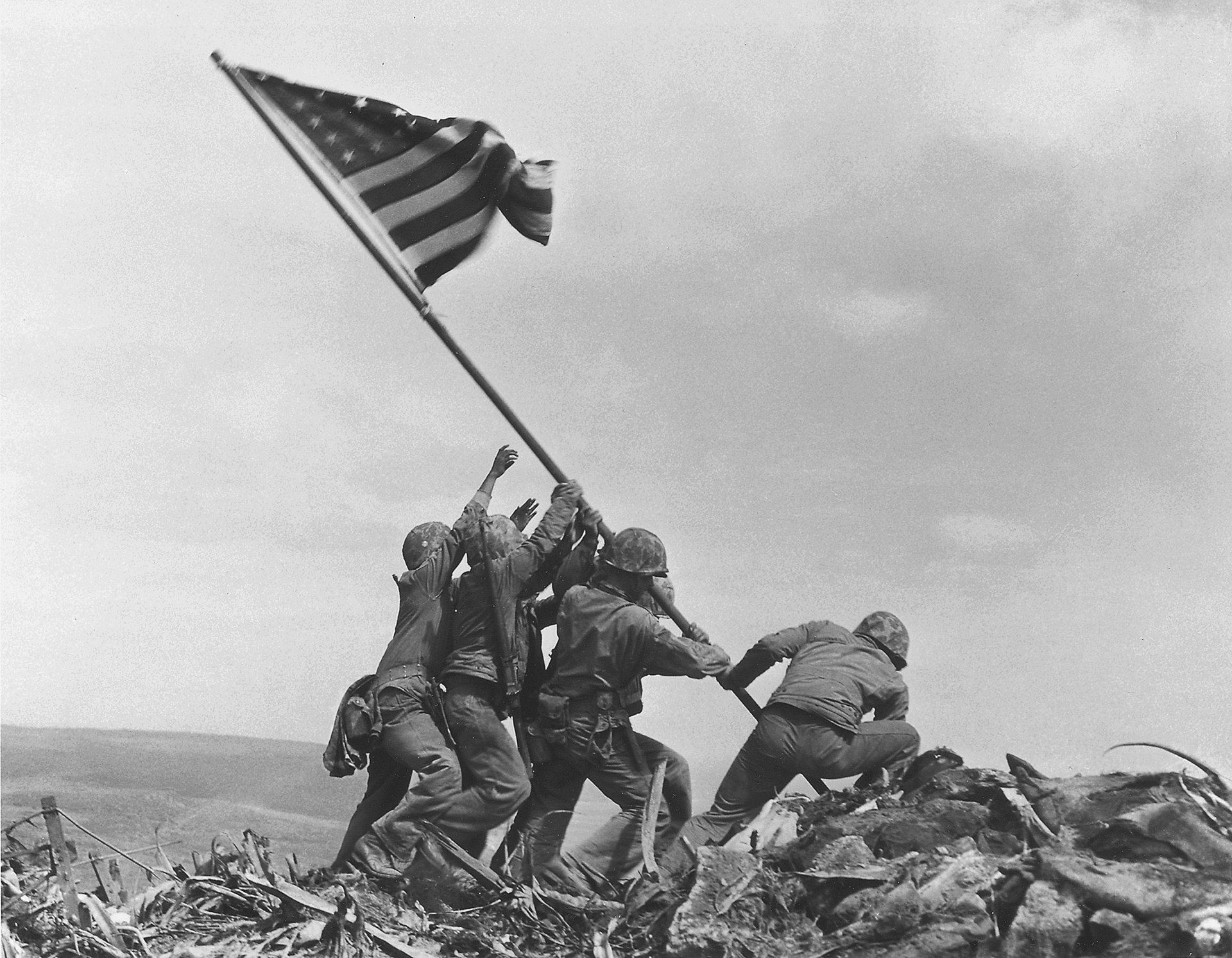
Raising the Flag on Iwo Jima — Joe Rosenthal's Pulitzer-winning AP photograph, 23 February 1945
Joe Rosenthal / Associated Press via Wikimedia Commons (Public Domain)
Signing of the Treaty of Versailles, 1919 — 1919
National Portrait Gallery, Smithsonian Institution; transfer from the Smithsonian American Art Museum; gift of an anonymous donor, 1926 via Smithsonian Open Access (CC0)
[Hitler, Count Ciano and von Ribbentrop]
Library of Congress · Public Domain via Library of Congress
Quiz yourself