History
·
How a Single Bullet Broke the World
Medium
7 min
How a Single Bullet Broke the World
The assassination that triggered a war nobody planned but everyone had already built.
Share
One gunshot in a city most Europeans couldn't find on a map killed 20 million people, toppled four empires, and redrew every border on the continent. Not because one murder is that powerful — but because the world had secretly wired itself to explode. The bullet just flipped the switch.
Europe in 1914 looked stable. Thriving, even. Industrial cities were booming, global trade was at record highs, and the major powers hadn't fought each other in decades. Most people assumed a big war was basically impossible — too expensive, too destructive, too bad for business. They were spectacularly wrong. Under the surface, the continent had been quietly building the most dangerous political structure imaginable: a web of alliances where every country had promised to fight if any other country got hit first. It sounds like a deterrent. It was actually a detonator.
Analogy
Think about group chat dynamics when two friends have beef. If everyone in the chat has pre-committed to backing their closest friend, one argument between two people pulls in the whole group within minutes. Nobody wanted a 47-person blowup. But everyone made promises before things got heated, and now those promises are the problem. Europe's alliance system worked exactly like this — except the 'group chat' had armies. Germany backed Austria-Hungary. Russia backed Serbia. France backed Russia. Britain backed France. One fight between two countries and the whole continent was in it within six weeks.
But alliances alone don't start wars. You also need the thing that makes countries think fighting is worth it in the first place. That thing was nationalism — and by 1914, it had been cranked up to a level that's hard to overstate. Nationalism told people that their ethnic group deserved its own country, that foreign rulers were illegitimate, and that dying for your nation was the highest possible honor. This was genuinely exciting to a lot of people. It was also a direct threat to every multi-ethnic empire in Europe — especially Austria-Hungary, which controlled dozens of different ethnic groups who all wanted their own state. When a Bosnian-Serb nationalist named Gavrilo Princip shot Archduke Franz Ferdinand in Sarajevo on June 28, 1914, he wasn't just killing a man. He was pulling the pin on a grenade that nationalism had spent 30 years building.
Make your call
The assassination of Franz Ferdinand set off a chain reaction that pulled every major European power into war within 38 days. What was the real reason the whole continent went up — not just Austria and Serbia?
A
Nationalist movements had been destabilizing governments for years, making leaders eager for a fight
B
A web of alliance commitments meant any two-country conflict automatically triggered obligations across the whole continent
C
Military leaders had been secretly planning a major war for years and used the assassination as their opening
Example
Here's how fast it unraveled. Austria-Hungary blamed Serbia for the assassination and issued a set of demands so humiliating they were designed to be rejected. Serbia rejected two of them. Austria declared war. Russia, as Serbia's protector, began mobilizing its army. Germany, bound to Austria, declared war on Russia. France, bound to Russia, got pulled in. Germany's war plan required invading France through Belgium to knock them out fast — so Germany invaded Belgium. Britain, which had guaranteed Belgian neutrality, declared war on Germany. In 38 days, a regional dispute between Austria and Serbia had become a continental war involving every major power in Europe. Nobody had planned this exact outcome. Everyone had built the system that made it inevitable.
Key Insight
The scariest thing about WWI isn't that it happened — it's that nobody wanted it to go this far, and it happened anyway. The alliance system created a situation where every leader's rational response to each step made the overall catastrophe worse. That's not a history lesson. That's a warning about how systems can produce outcomes that none of the people inside them actually chose.
Here's the catch. Everyone expected a short war. Germany's entire strategy — the Schlieffen Plan — was built around knocking out France in six weeks before Russia could fully mobilize in the east. It didn't work. France held. And then both sides dug trenches. What started as a war of movement became a war of attrition — hundreds of miles of muddy ditches where men lived like rats and died by the thousands to gain a few hundred yards. The industrial revolution, which had made Europe so wealthy, now supplied both sides with machine guns, artillery, poison gas, and barbed wire. The same technology that built the modern world was being used to grind it apart.
That one bullet in Sarajevo had flipped the switch on a world that was already wired to explode — and by November 1918, when it finally ended, the damage wasn't just physical. Four empires had collapsed: the Ottoman, Austro-Hungarian, Russian, and German. The map of Europe was redrawn by victorious powers who drew borders with more attention to their own interests than to the ethnic groups living there — planting seeds for the next catastrophe. The old order — the world of emperors, aristocrats, and European dominance — was gone. What replaced it was unstable, resentful, and broke. You probably know where that leads. But that's the next story.
Related threads
History
·
The Machine That Ate the World
The Machine That Ate the World
Sources
Images from Wikimedia Commons. Attribution required by license.
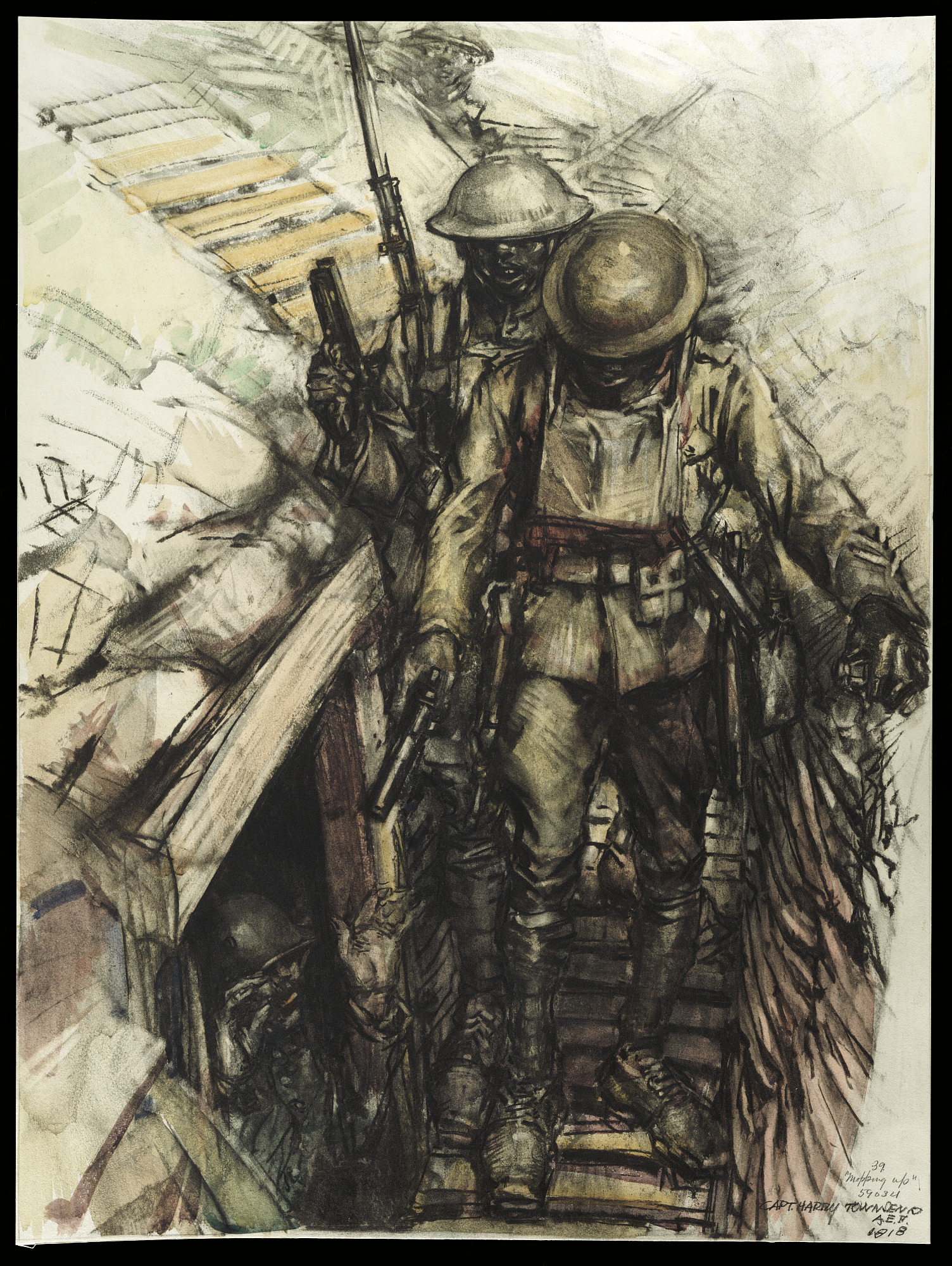
Mopping up — 1918
War Department. Historical Branch of the General Staff via Smithsonian Open Access (CC0)
Franz Ferdinand assassination Sarajevo
Generated by Grok Imagine (xAI), prompt: Generate a single 4:3 horizontal image for an educational lesson.
Lesson title: "How a Single Bullet Broke the World" · The assassination that triggered a war nobody planned but everyone had already b…
Archduke Franz Ferdinand in Sarajevo, June 1914
Heir to the Austro-Hungarian throne Archduke Franz Ferdinand and his wife, Sophie, get into a motor car to depart from the City Hall, Sarajevo, shortly before they were assassinated by the Serbian nationalist Gavrilo Princip on 28 June 1914.
Unknown authorUnknown author · Public domain
Quiz yourself