History
·
The Machine That Ate the World
Medium
7 min
The Machine That Ate the World
How a century of steam and iron rewired everything humans thought they knew about work, power, and daily life.
Share
In 1750, your great-great-great-grandmother made cloth by hand, the same way her grandmother did, and her grandmother before that. By 1850, a single factory with machines run by children could out-produce an entire village of skilled weavers. The weavers didn't adapt. They starved. And the world that replaced theirs is the one you're living in right now.
For almost all of human history, if you wanted more output, you needed more people. More farmers to grow more food. More weavers to make more cloth. The math was brutally simple: human hands were the bottleneck, and there was no way around it.
Then, starting in Britain around the 1760s, someone figured out how to replace human muscle with steam. Not just assist it — replace it. One steam-powered loom could do the work of dozens of skilled weavers. One steam engine could pump water out of a mine faster than hundreds of workers with buckets. The bottleneck didn't just widen. It basically disappeared.
And that changed everything downstream — who had money, who had power, where people lived, and what a 'normal' life even looked like.
Make your call
Your great-great-great-grandmother's village of skilled weavers is about to be wiped out by a factory. What actually kills their way of life — and why can't skill or quality save them?
A
Customers stop valuing craftsmanship and simply prefer the look of machine-made cloth
B
The factory undercuts the price so dramatically that skill becomes economically irrelevant
C
The weavers can't get access to the raw materials anymore, since factories buy it all up
Analogy
Think about what streaming did to the music industry. Before it, if you wanted to hear a song, someone had to physically make a CD, ship it to a store, and you had to drive there and buy it. The whole chain required enormous human effort at every step.
Streaming didn't just make music cheaper. It collapsed the entire cost structure. Suddenly, the people who owned the distribution — the record labels, the stores — lost most of their leverage. The artists who understood the new system thrived. The ones who didn't got left behind.
The steam engine was streaming for literally everything. It didn't just make production faster. It collapsed the cost structure of making goods, which obliterated the people who'd built their lives around the old system — and handed enormous power to whoever owned the new machines.
Here's what made Britain the place where this happened first — and it wasn't an accident.
Britain had coal deposits close to the surface, which meant cheap fuel. It had rivers and ports everywhere, which meant cheap transport. It had a patent system that let inventors actually profit from their ideas, which meant people were incentivized to invent. And it had a colonial empire pumping in raw materials — cotton from America, metals from India — at prices that were kept artificially low by the brutal logic of empire.
Remove any one of those ingredients and the Industrial Revolution either happens somewhere else or happens later. This is worth sitting with: the revolution that built the modern world wasn't inevitable. It was a specific set of conditions colliding in one place at one time.
Key Insight
The Industrial Revolution didn't just change HOW things were made. It changed WHO had power. For centuries, wealth meant land — you were powerful because you owned fields and the peasants who worked them. Industrialization transferred that power to whoever owned factories and machines. Aristocrats who'd been on top for generations suddenly found themselves outpaced by mill owners and railroad barons who'd been nobody a generation before. The entire social hierarchy got scrambled in about 80 years.
Example
Manchester, England in 1800: population around 25,000. Manchester in 1850: over 300,000. That's not growth — that's an explosion. And it happened in cities across Britain, then Europe, then America, as people flooded in from the countryside chasing factory wages.
Except the cities weren't ready. There was no sewage infrastructure, no housing regulation, no concept of urban planning at that scale. Families of six lived in single rooms. Rivers ran black with industrial waste. Cholera outbreaks killed thousands at a time because drinking water and sewage were basically the same thing.
This is the part the 'progress' framing tends to skip — and it's exactly what happened to those weavers from 1750: for the first few generations of workers, industrialization was genuinely brutal. Longer hours than farm work, more dangerous conditions, no job security, and you lived in a city that was actively trying to kill you. The wealth being generated was real — it just wasn't going to them.
But pay attention — the misery is what eventually produced modern politics.
When you concentrate thousands of workers in the same place doing the same job under the same terrible conditions, something happens that couldn't happen when those same people were scattered across individual farms: they start talking to each other. They realize their problem isn't personal bad luck. It's structural. And they start organizing.
Labor unions, the push for voting rights, child labor laws, the entire concept of the weekend — all of it came out of workers in industrial cities figuring out that collective action was the only leverage they had against factory owners. The Industrial Revolution created the conditions for its own pushback. You can't have a labor movement without labor concentrated in one place with shared grievances.
Key Insight
The most underrated consequence of industrialization: it created the concept of 'the economy' as something governments are responsible for. Before factories, most people were subsistence farmers — what you grew, you ate. When millions of people became wage workers dependent on factory owners staying in business, a recession didn't mean a bad harvest. It meant mass unemployment and starvation in cities. Suddenly, governments had to care about economic conditions in a way they never had before. That tension — between markets and governments — is still the central argument of modern politics.
Sources
Images from Wikimedia Commons. Attribution required by license.
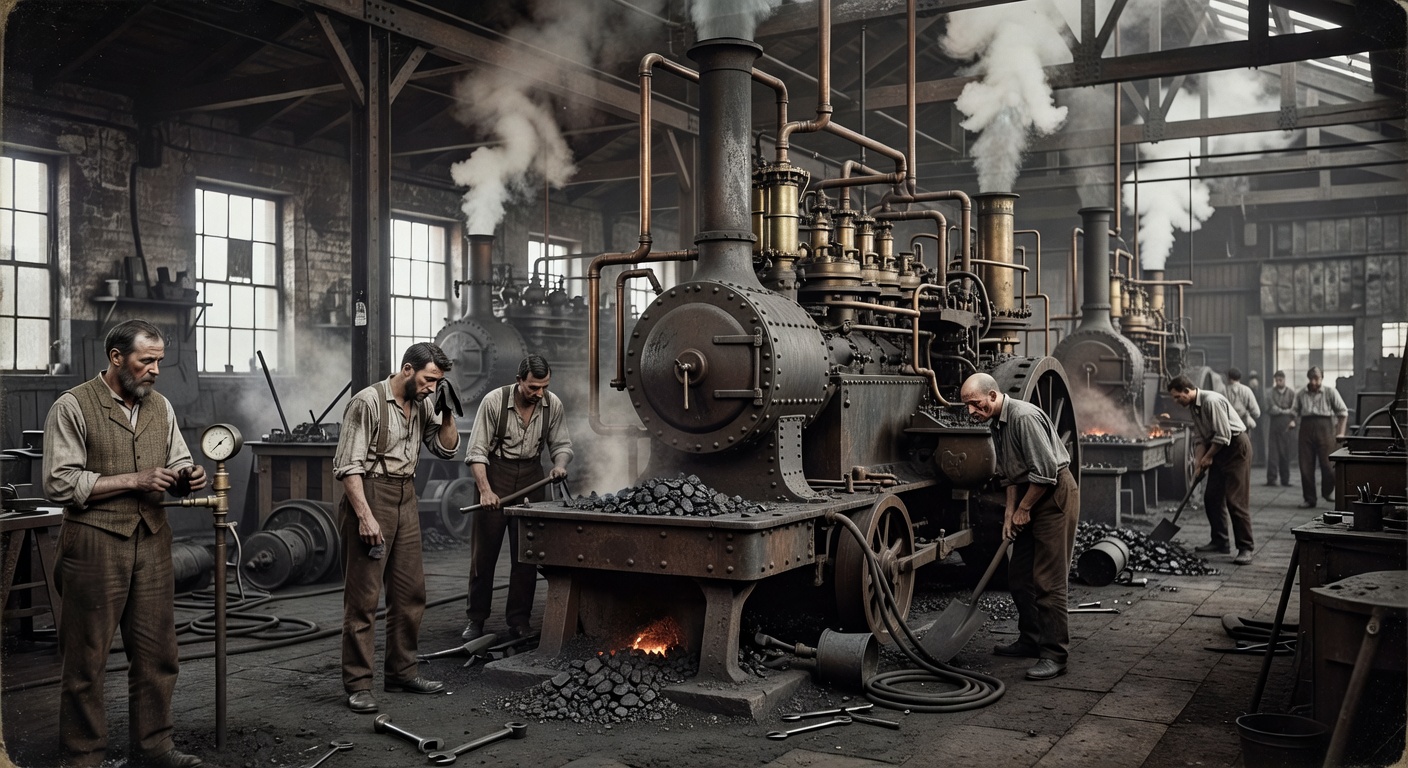
Victorian factory steam engine
Generated by Grok Imagine (xAI), prompt: Generate a single 16:9 horizontal image for an educational lesson.
Lesson title: "The Machine That Ate the World" · How a century of steam and iron rewired everything humans thought they knew about wo…
Textiles: a spinning jenny. Engraving by W. Lowry, 1811.
Iconographic Collections
Keywords: J. Wilson Lowry
Wikimedia Commons · CC BY 4.0
The Horse Fair — 1852–55
Rosa Bonheur via The Metropolitan Museum of Art (Public Domain)
Quiz yourself