History
·
The Ideas That Broke Every Government
Medium
7 min
The Ideas That Broke Every Government
A handful of philosophers rewired how humans think about power and the world never recovered.
Share
What if the government only gets to exist because you allow it to? That sounds like something a Reddit thread would argue. But 300 years ago, that single idea was so dangerous that kings wanted the people who wrote it dead.
Before the 1600s, the answer to 'why does the king get to rule?' was basically: God said so. The divine right of kings wasn't just a political theory — it was the operating system of every European government. Question it, and you weren't just being rebellious. You were committing blasphemy. The church and the crown were the same machine, and they had a monopoly on what counted as truth.
Then the Scientific Revolution happened. Suddenly, people like Newton were proving that you could understand the universe through observation and reason — no priests required. And a group of thinkers looked at that and thought: wait. If reason can explain gravity and planetary motion... why can't reason explain how governments should work?
Make your call
The hook asked it straight: why should a government get to exist at all? Before reading further — what do you think Enlightenment thinkers said was the real source of a government's power?
A
Tradition and divine authority — some rulers are simply born with the right to govern
B
The consent of the governed — government is a deal, and citizens can cancel it
C
Military strength — whoever can maintain order earns the right to rule
Analogy
Think about how terms of service work. You click 'I agree' and the app gets to use your data. You consented. The deal is valid because you chose it.
Enlightenment thinkers — especially John Locke — basically invented that logic for government. They called it the social contract. The idea: you don't just get ruled because some king was born into the right family. Government is a deal. Citizens give up some freedoms (like punching whoever you want) in exchange for protection, rights, and order. The government holds up its end, you hold up yours.
And here's the part that changed everything: if the government breaks the deal — if it stops protecting your rights and starts violating them — you can cancel the subscription. You can revolt. Locke wrote this in 1689. It was basically a philosophical Terms of Service with a cancellation clause that terrified every monarch in Europe.
Locke wasn't alone. The Enlightenment was less a single movement and more a group chat of brilliant, argumentative people who kept pushing each other's ideas further.
Voltaire weaponized sarcasm against the church and arbitrary power — his writing was so sharp that France banned his books and exiled him twice, which of course made everyone want to read them more. Montesquieu looked at the British system of government and noticed something: when one person holds all the power, things go badly. His fix was separation of powers — split the government into branches that check each other. Sound familiar? The U.S. Constitution is basically a Montesquieu fan project.
Rousseau took the social contract further and got weird with it. He argued that society itself corrupts people — that we're born free but end up in chains of inequality and hierarchy. His ideas were the most radical, and also the most dangerous. Revolutionaries in France would later use Rousseau to justify a lot of things Rousseau probably didn't intend.
Key Insight
The Enlightenment's core bet: human reason — not tradition, not scripture, not royal bloodlines — is the best tool for figuring out how society should be organized. Everything else follows from that.
Here's where it stops being philosophy and starts being history.
By the 1770s, a group of colonists in America had been reading all of this. That dangerous idea from the hook — that government only exists because you allow it to — is exactly what Thomas Jefferson was reaching for. He didn't invent it: he took it directly from Locke and dressed it up in better prose. The Declaration of Independence is an Enlightenment document. It's a formal argument, structured like a logical proof, explaining why breaking the social contract justified revolution.
A decade later, the French Revolution exploded — messier, bloodier, and more radical. The same ideas about reason and rights got pushed further, faster, by people with a lot more grievances. Liberty, equality, fraternity. The guillotine. The Enlightenment had lit a fuse that nobody could fully control.
Example
Want to see how deep this goes? Pull out any government document from the modern world.
The UN Declaration of Human Rights (1948): 'All human beings are born free and equal in dignity and rights.' Locke's natural rights, repackaged for the 20th century.
The U.S. Bill of Rights: freedom of speech, freedom of religion, protection from arbitrary government power. Voltaire and Montesquieu would recognize every line.
The structure of almost every democratic government on earth — executive, legislative, judicial branches checking each other — is Montesquieu's blueprint, copied and adapted across 200 years.
You live inside an architecture that Enlightenment thinkers designed. You just don't notice it because it's the water you swim in.
And here's where it gets complicated — because the Enlightenment wasn't a clean victory for reason and justice.
The same thinkers who wrote about universal human rights largely meant 'rights for people who look like us.' Slavery continued. Women were excluded. Locke himself invested in the slave trade. The gap between the ideals the Enlightenment proclaimed and the reality it actually built is one of the defining tensions of the next 300 years of history — and honestly, still today.
The ideas were revolutionary. The people holding them were products of their time. That contradiction is worth sitting with, because it means the Enlightenment wasn't an ending — it was an argument that's still running.
Sources
Images from Wikimedia Commons. Attribution required by license.
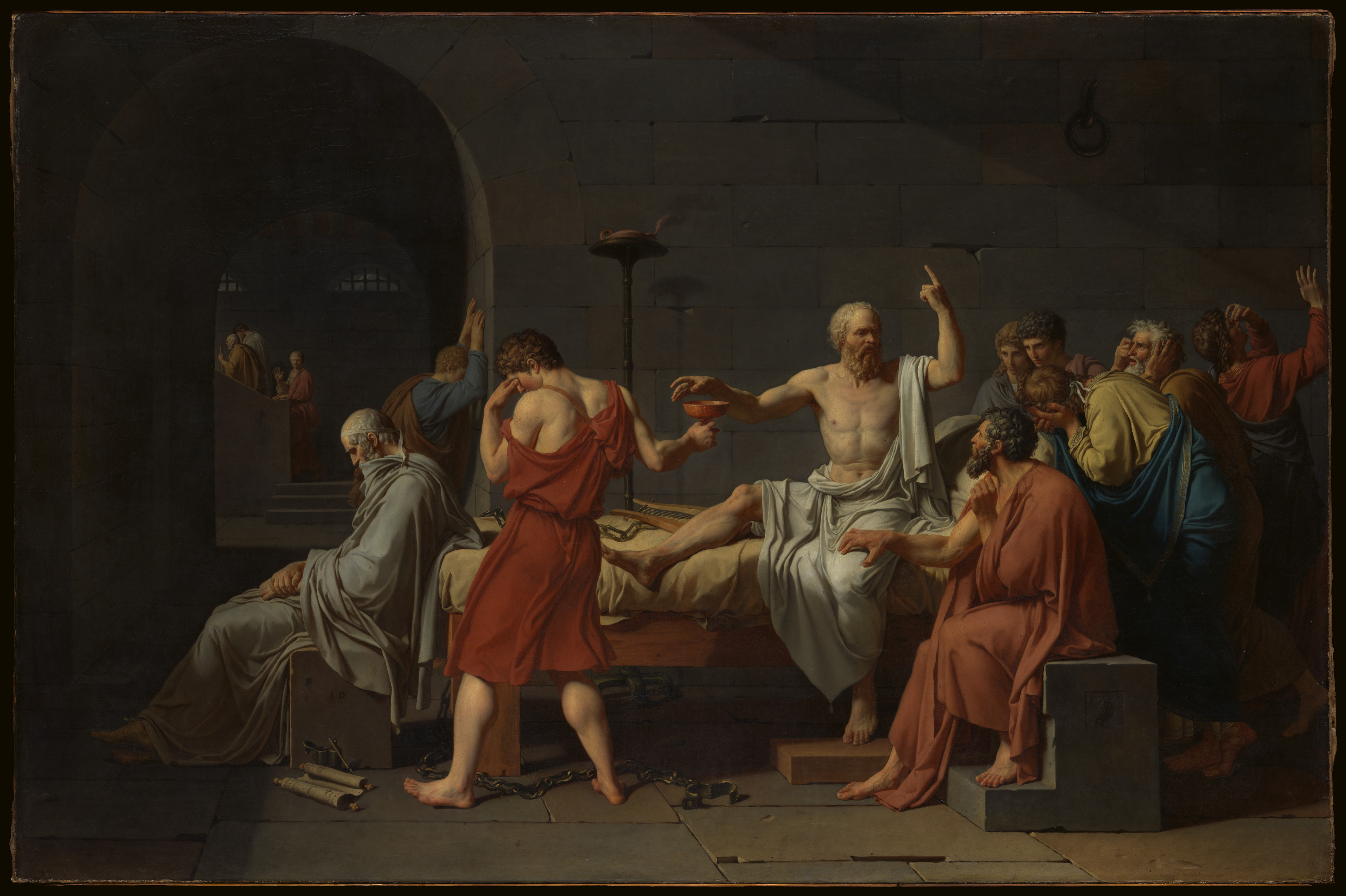
The Death of Socrates — 1787
Jacques Louis David via The Metropolitan Museum of Art (Public Domain)
Catalogue of the engraved portraits of Washington
Library of Congress · Public Domain via Library of Congress
Declaration of Independence Desk — 1775-1776
Transfer Department of State via Smithsonian Open Access (CC0)
Quiz yourself