History
·
Who Told You That Was True?
Medium
7 min
Who Told You That Was True?
How a handful of rebels replaced a thousand years of 'because we said so' with something far more powerful.
Share
For over a thousand years, if you wanted to know how the human body worked, the correct answer was: check what a Greek guy named Galen wrote in 200 AD. Even if your own eyes told you something different — you were wrong. Then a few people decided to actually look. And everything broke open.
Here's the world before the Scientific Revolution: knowledge has a hierarchy, and at the top sits Authority. The Church, ancient Greek philosophers — especially Aristotle — and the Bible. If Aristotle said heavy objects fall faster than light ones, that was settled. Nobody tested it. Testing it would almost imply you didn't trust Aristotle, which was basically heresy. The system worked like a citation chain where every source pointed back to the same three books written 1,500 years ago. New observations that contradicted the old texts weren't treated as discoveries. They were treated as mistakes.
Analogy
Imagine your group chat has one person — call them the Authority — who has been in the chat since the beginning. Every time someone posts a new take, five other people reply 'but what did Authority say about this?' And if your take contradicts Authority's old message from 2009, you're the problem. That's medieval European intellectual life. The chat is locked. Authority's old messages are pinned. And anyone who tries to start a new thread gets ratio'd by priests. The Scientific Revolution is the moment someone finally said: 'What if we just... tried it and saw what happened?'
The shift didn't happen overnight, and it didn't start with one genius. It started with a Polish astronomer named Nicolaus Copernicus quietly publishing a book in 1543 — the same year he died, which was probably not a coincidence timing-wise. His claim: the Earth goes around the Sun, not the other way around. This contradicted Aristotle, common sense, and the Church's cosmology all at once. He knew it. So he was careful. But the idea was out. Here's the part most people miss — Copernicus wasn't even doing experiments. He was just doing the math differently and realizing the old model had too many patches and workarounds to actually be right.
Make your call
Galileo points his telescope at Jupiter and sees moons orbiting it. What makes this one observation so dangerous to the established worldview?
A
It showed the universe was far larger than the Church had claimed
B
It proved there were centers of orbit other than Earth, breaking the model entirely
C
It contradicted Aristotle's claim that the planets were made of perfect, unchanging material
Example
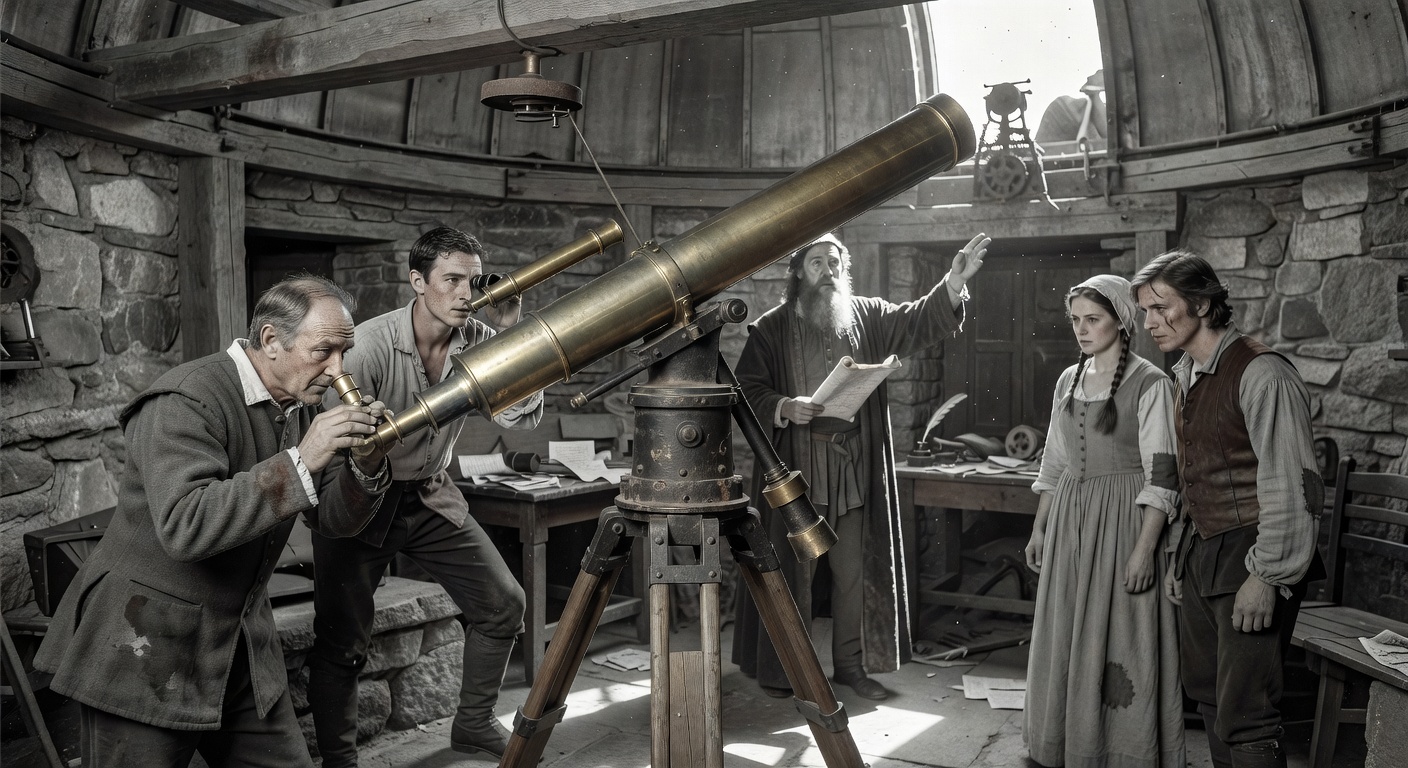
Then came Galileo, who is basically the first person to turn a telescope on the sky and write down what he actually saw — not what Aristotle said should be there. He found moons orbiting Jupiter. This was a catastrophic fact. If moons orbit Jupiter, then not everything in the universe orbits Earth. The old model said everything orbits Earth. The old model was wrong. Galileo published his findings. The Church put him under house arrest for the rest of his life. But you can't un-see the moons of Jupiter. The data existed now. Other people had telescopes. The argument had changed permanently — it was no longer 'what does the text say?' It was 'what do the observations show?'
Key Insight
This is the actual revolution: not a new answer, but a new method. Instead of asking 'what does the authority say?', scientists started asking 'what happens when we test it?' That shift — from inherited knowledge to earned knowledge — is the most important intellectual move in the last 500 years.
Francis Bacon formalized one side of this in the early 1600s: observe the world, collect data, find patterns. What we'd now call inductive reasoning — build up from evidence to conclusions. René Descartes was doing the opposite and the same simultaneously: start from first principles, use logic and mathematics, trust nothing you haven't reasoned through yourself. His famous line 'I think, therefore I am' is basically him hitting factory reset on all human knowledge and starting over from scratch. Between Bacon's obsession with evidence and Descartes' obsession with rigorous reasoning, you get the two pillars of the scientific method: empiricism and rationalism. Isaac Newton, arriving later in the 1600s, fused them. He observed the world, built mathematical models, and made predictions that turned out to be right. That combination — math plus experiment plus prediction — is still how science works today.
Key Insight
The real power of the scientific method isn't that it finds truth faster. It's that it has a built-in mechanism for being wrong. You make a prediction. You test it. If the test fails, your theory fails — no matter who you are or how long the theory has been around. Authority becomes irrelevant. The experiment is the judge.
By the time Newton published his laws of motion and gravity in 1687, something irreversible had happened. The universe had gone from being a mystery explained by God's will and ancient texts to being a system governed by laws you could write down, test, and use to make predictions. Engineers would eventually use Newton's equations to build bridges, cannons, and eventually spacecraft. The knowledge worked. And 'it works' turned out to be a much better test of truth than 'Aristotle said so' — which is exactly what those first observers who decided to actually look had wagered everything on. The Scientific Revolution didn't just change what people knew. It changed who got to decide what counted as knowing.
Sources
Images from Wikimedia Commons. Attribution required by license.
old astronomical telescope observatory
Generated by Grok Imagine (xAI), prompt: Generate a single 16:9 horizontal image for an educational lesson.
Lesson title: "Who Told You That Was True?" · How a handful of rebels replaced a thousand years of 'because we said so' with somethin…
This is a rare 1753 Homan Heirs chart of the Solar System. Features 23 diagrams including spheres, earth and celestial globes, planetary systems, temperature zones, and projection systems following the style of Schatz. There is a general emphasis on the astronomical work of Copernicus and Tycho Brahe. This map was drawn by Tob. Mayer for inclusion the 1752 Homann Heirs Maior Atlas Scholasticus ex Triginta Sex Generalibus et Specialibus…. Most early Homann atlases were “made to order” or compiled of individual maps at the request of the buyer. However, this rare atlas, composed of 37 maps and charts, was issued as a “suggested collection” of essential Homann Heirs maps. A fine copy of an important map.
http://www.geographicus.com/mm5/cartographers/homannheirs.txt · Public domain
Quiz yourself