History
·
The Plague That Accidentally Freed Europe
Medium
7 min
The Plague That Accidentally Freed Europe
How 50 million deaths gave the survivors more power than they'd ever had
Share
In less than five years, the Black Death killed somewhere between a third and half of Europe's entire population. But here's the part nobody tells you: for the people who survived, life got dramatically better. That's not a dark joke. That's economics.
By 1350, the Black Death had swept from Central Asia through the Middle East and across Europe, killing somewhere between 25 and 50 million people. Towns emptied overnight. Priests refused last rites. Entire villages were abandoned mid-harvest. The scale was so incomprehensible that many people genuinely believed the world was ending.
And in a way, it was. Just not the way they thought.
Before the plague, Europe ran on a system called feudalism. Here's how it worked: lords owned the land, peasants worked it, and in exchange for 'protection,' peasants handed over most of what they grew and had almost zero freedom to leave or negotiate. You were born into your place in the hierarchy and you died there.
It wasn't slavery in name, but it wasn't far off. Peasants — called serfs — were legally bound to the land. If a lord wanted to work you six days a week for barely enough food to survive, that was just... life. There was no quitting. There was no 'I'm going to work for the lord in the next village instead.'
Then one-third to one-half of the workforce died in about five years.
Analogy
Imagine your city's entire tech industry suddenly lost half its engineers overnight. Not laid off — gone. Every company still needs their software built, their servers maintained, their products shipped. But now there are half as many people who can do it.
What happens? Salaries explode. Engineers start getting signing bonuses, flexible hours, remote work, equity. Companies that used to lowball candidates are suddenly offering anything to get someone through the door.
That's exactly what happened to medieval peasants after the Black Death. The lords still needed their fields harvested. The crops didn't care that half the workers were dead. But suddenly, the workers who remained could walk to the next estate and demand better conditions — because that lord was desperate too. Labor became the scarcest resource in Europe overnight.
Make your call
The hook promised that surviving the Black Death made life dramatically better. Before we get to how, take a guess: what actually gave peasants more power after the plague?
A
Lords, shaken by the catastrophe, voluntarily offered peasants better conditions out of moral guilt
B
Labor became so scarce that lords had to compete for workers — giving peasants bargaining power for the first time
C
New laws passed across Europe protecting peasant rights and capping what lords could demand
Key Insight
When labor is abundant, employers hold all the power. When labor is scarce, workers do. The Black Death didn't just kill people — it flipped the entire power dynamic of medieval European society by making human labor suddenly, shockingly rare.
So wages rose. Dramatically. In England, agricultural wages roughly doubled in the decades after the plague. Peasants who had never in their lives been able to negotiate anything were suddenly being courted by competing lords. Some walked off their ancestral land entirely and moved to cities, where labor shortages meant anyone who showed up could find work.
Here's the twist: the lords panicked. Several European governments actually passed laws — called Sumptuary Laws and Statute of Laborers — trying to cap wages and force peasants back to pre-plague rates. England's Statute of Laborers in 1351 literally made it illegal to pay workers more than pre-plague wages.
It didn't work. When you have leverage, laws written by the people who want to take it away tend not to stick.
The cultural ripple effects were just as massive. Before the plague, the Catholic Church had an iron grip on European life. It explained everything, controlled everything, and promised that suffering in this life would be rewarded in the next. Then the plague hit — and the priests died just like everyone else. Churches that promised God's protection became mass graves.
People started asking uncomfortable questions. If God's representatives on earth couldn't be saved, what did that mean? If prayer didn't work, what did? This slow erosion of absolute faith in church authority planted seeds that would eventually grow into the Protestant Reformation, 150 years later. The Black Death didn't cause the Reformation directly — but it cracked the foundation.
Meanwhile, with labor scarce and wages rising, a new class of people started to emerge: skilled craftsmen, merchants, and tradespeople who weren't noble-born but had real money. The middle class — in its very earliest form — was being born from the rubble of the plague.
Key Insight
The Black Death is one of history's clearest examples of a brutal truth: catastrophic disruption doesn't just destroy the old order — it creates the conditions for a new one. The survivors of the plague didn't just inherit a emptier world. They inherited more power, more mobility, and more freedom than any generation of European peasants before them.
By the time the dust settled — and it took generations — Europe looked fundamentally different. Serfdom was dying in Western Europe. Cities were growing. Wages were higher. The Church's monopoly on meaning was cracking. And the economic logic of feudalism, which depended on an endless supply of desperate, landless laborers with nowhere else to go, had been permanently broken.
None of this was planned. No revolutionary led a movement. No manifesto was written. A bacterium called Yersinia pestis, carried by fleas on rats, accidentally dismantled a thousand-year social order in about five years.
That's the economics the hook promised: catastrophe cleared the ground, and the Renaissance — that explosion of art, science, and humanism that we still look back on as one of humanity's greatest eras — grew in it. It wasn't a coincidence.
Related threads
History
·
Who Actually Ran the World After Rome?
Who Actually Ran the World After Rome?
Sources
Images from Wikimedia Commons. Attribution required by license.
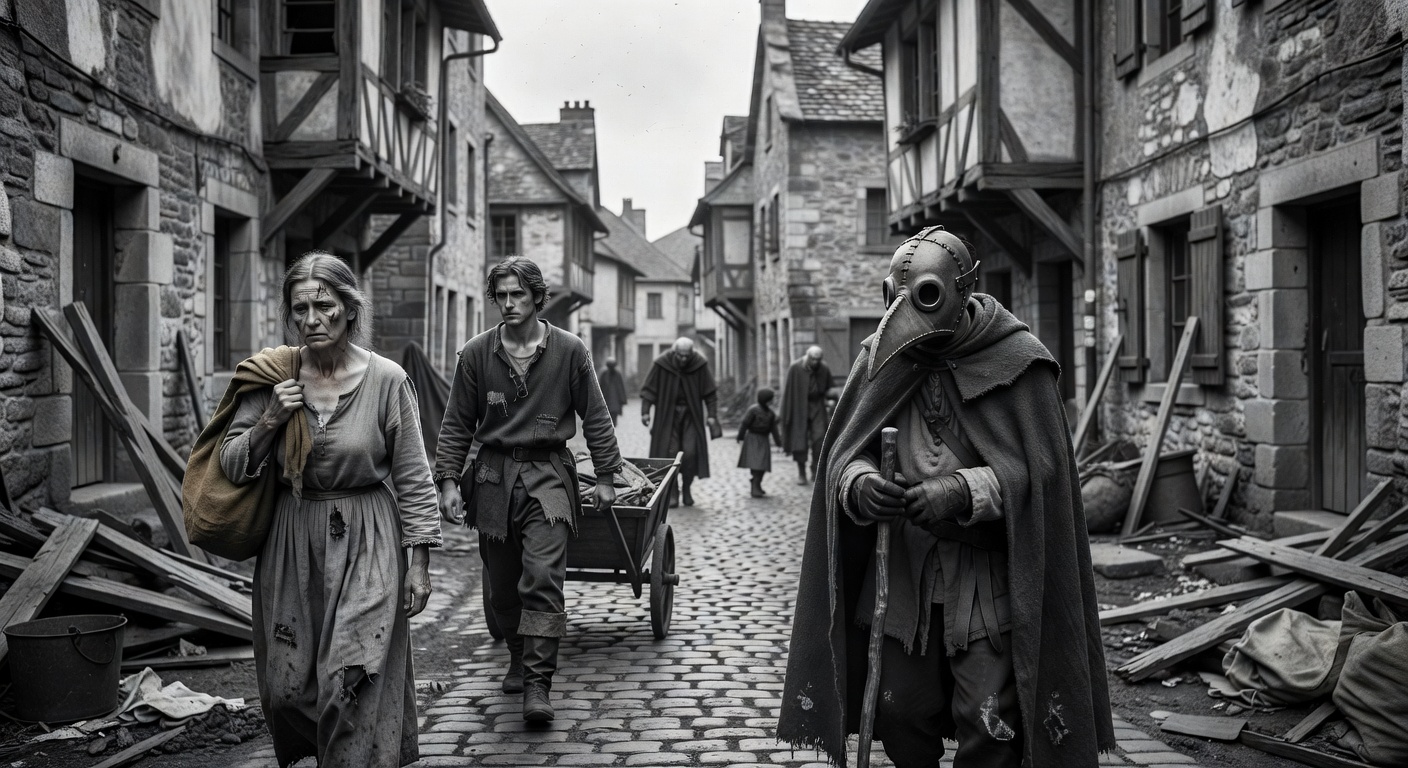
medieval plague doctor street
Generated by Grok Imagine (xAI), prompt: Generate a single 16:9 horizontal image for an educational lesson.
Lesson title: "The Plague That Accidentally Freed Europe" · How 50 million deaths gave the survivors more power than they'd ever had
…
Illustrated catalogue, collections of prints,
Library of Congress · Public Domain via Library of Congress
Quiz yourself