History
·
Who Actually Ran the World After Rome?
Medium
7 min
Who Actually Ran the World After Rome?
The Catholic Church filled the power vacuum Rome left behind.
Share
Imagine every government on Earth disappeared overnight. No police, no courts, no army. Who would you turn to? Your landlord, your local priest, or the warlord with the most guys carrying swords? That's not a hypothetical. That's exactly the situation 50 million Europeans woke up to after Rome fell — and how they answered it shaped the next thousand years.
When Rome collapsed in the West, it didn't just take the emperors with it. It took the roads, the courts, the currency, the postal system, the professional army — the entire operating system of civilization. What was left was a patchwork of scared communities, roving warlords, and crumbling cities nobody knew how to maintain. The question wasn't 'what political philosophy should we adopt?' It was 'how do we not get raided and starved to death this winter?'
Analogy
Feudalism is basically a protection racket — but one that everyone agreed to because the alternative was worse. Think about how a group chat works when someone needs help moving. You help your friend move, they owe you one. You call in the favor, they show up. Scale that up. A lord says to a knight: 'I'll give you land and protection. In exchange, you fight for me when I call.' The knight says yes, because land means income and the lord's walls mean survival. Then the knight turns to the peasants farming his land and says the same thing one level down. Everyone is trading service for security. That's feudalism. Not a grand political theory — a survival arrangement that hardened into tradition.
Here's the hierarchy you actually need to understand: at the top, a king — but a medieval king is nothing like a modern head of state. He's more like the most powerful warlord who convinced enough other warlords to back him. Below him, nobles and lords who swore loyalty in exchange for land grants called fiefs. Below them, knights who swore loyalty to lords in exchange for smaller land grants. And at the very bottom, serfs — peasants legally bound to the land, not quite slaves but not free either. They couldn't leave. They couldn't own property. They paid rent in labor. In exchange, they got the lord's protection and the right to not be immediately murdered.
Key Insight
The key insight: feudalism wasn't imposed from the top down. It grew from the bottom up, out of desperation. When people are terrified and there's no central authority, they trade freedom for safety. Every layer of the feudal pyramid made the same deal — I'll give you loyalty and service, you give me protection. The whole system is just that deal, repeated at every level of society.
Make your call
Think back to the hook: 50 million Europeans woke up with no government, no courts, no army. Which institution do you think actually stepped in to fill that void and hold civilization together?
A
The most powerful regional warlords — military strength was the only thing that mattered without Rome
B
The Catholic Church — it survived Rome's collapse and kept its bureaucracy, literacy, and authority intact
C
A new network of merchant cities — trade created the wealth and organization that replaced Roman order
Remember the question from the start — who do you turn to when every government disappears overnight? Here's the answer that surprised a thousand years of history: the Catholic Church. It was the one institution that survived Rome's collapse almost completely intact. While kingdoms rose and fell, while warlords carved up territory and lost it again, the Church kept its bishops, its bureaucracy, its Latin language, and — critically — its monopoly on literacy. If you could read in 800 AD, you were almost certainly a monk or a priest. That meant the Church ran the schools, wrote the laws, kept the records, and counseled the kings. The Pope could excommunicate a monarch — basically tell all of Christendom that this person was spiritually dead and nobody owed them loyalty. That's not just religious authority. That's political nuclear power.
Example
In 1076, Holy Roman Emperor Henry IV got into a fight with Pope Gregory VII over who had the right to appoint bishops — powerful positions that came with land and armies. Gregory excommunicated Henry. Overnight, Henry's own nobles started abandoning him, because why stay loyal to a king God had rejected? Henry had to walk barefoot through the snow to a castle in northern Italy and stand outside for three days in a hair shirt, begging the Pope's forgiveness. The most powerful ruler in Europe, humiliated in the cold, because one man in Rome said so. That's how much the Church actually mattered.
So what was life actually like for the 90% of people who weren't lords or clergy? Grinding, local, and surprisingly communal. Most people never traveled more than 30 miles from where they were born. Your entire world was your village, your parish church, the lord's castle on the hill, and the rhythm of planting and harvest. The Church calendar structured your year — feast days, fasting, saints' days — and gave meaning to the cycles of work and rest. It sounds bleak by modern standards, but medieval people weren't walking around thinking 'this is the Dark Ages.' They were living, loving, gossiping, celebrating, and occasionally dying of plague. The 'darkness' is mostly a Renaissance insult that stuck.
Key Insight
The medieval world ran on two operating systems simultaneously: feudalism handled physical security and land, the Church handled meaning, law, and legitimacy. When they cooperated, kingdoms were stable. When they clashed — like Henry IV in the snow — everything cracked. Understanding medieval Europe means understanding that tension, playing out for a thousand years.
Sources
Images from Wikimedia Commons. Attribution required by license.
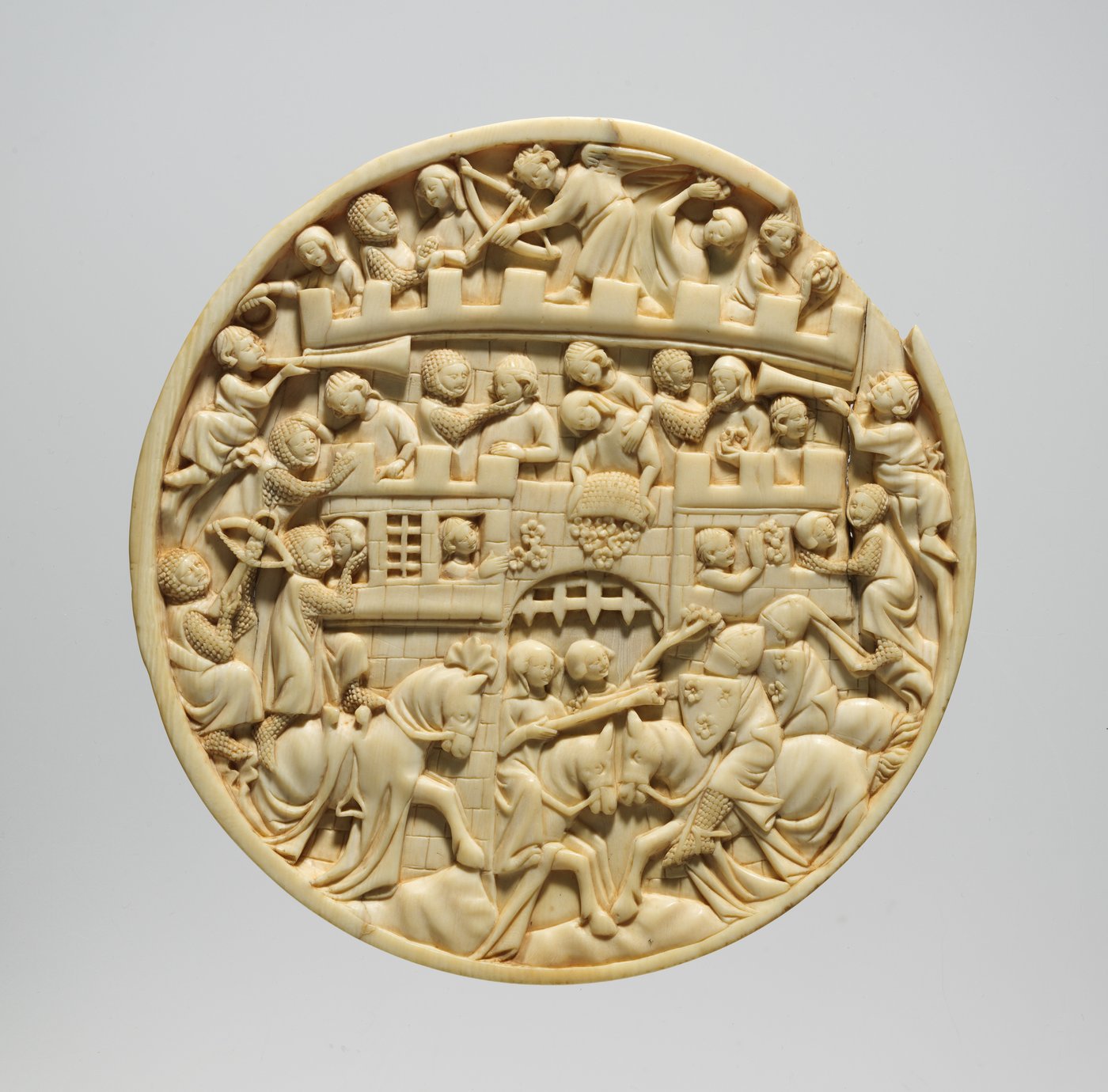
Roundel with Scenes of the Attack on the Castle of Love — ca. 1320–40 — French
French via The Metropolitan Museum of Art (Public Domain)
A trip to Mexico : being notes of a journey from Lake Erie to Lake Tezcuco and back, with an appendix containing and being a paper about the ancient nations and races who inhabited Mexico before and a
Library of Congress · Public Domain via Library of Congress
Quiz yourself