History
·
The Ancient Internet That Ran on Camels
Easy
5 min
The Ancient Internet That Ran on Camels
How a network of dusty roads quietly rewired the entire world
Share
A Roman emperor once banned silk because too much gold was flowing east to pay for it. The fabric was so addictive that it was destabilizing an empire — and most Romans had no idea where it even came from.
Picture a route stretching 4,000 miles — from the markets of Chang'an in China all the way to Constantinople, Rome, and the ports of the Persian Gulf. No single road, no single empire, no single person controlled it. It was a patchwork of paths, mountain passes, and desert crossings stitched together by one shared motive: profit. Merchants, nomads, monks, and diplomats all used it. And in doing so, they accidentally created the first global network of ideas, goods, and diseases the world had ever seen.
Nobody called it the 'Silk Road' while it was actually running. A 19th-century German geographer named Ferdinand von Richthofen coined the term in 1877, centuries after the routes had faded. The people using it just called it trading. The silk part is also a bit misleading. Yes, silk moved west. But so did paper, gunpowder, spices, glassware, horses, cotton, and gold. And moving the other direction: Buddhism, Islam, the Black Death, and the number zero.
Make your call
A Roman emperor bans silk to stop gold from draining east. Will it work? What's the real reason cutting off one product can't stop a trade network like this?
A
Romans could just manufacture their own silk substitute, making the ban irrelevant
B
The Silk Road was controlled by a single empire that could simply reroute goods around the ban
C
Silk passed through so many independent middlemen that there was no single supplier to cut off
Analogy
Think of the Silk Road less like a highway and more like the early internet — specifically, like how information spreads through social media. No one owns Twitter. No one controls what gets shared. But something posted in Seoul can reach São Paulo in seconds because millions of individual nodes are all connected. The Silk Road worked the same way. A merchant in Samarkand didn't know the Roman senator who'd eventually wear the silk he was trading. He just knew the guy in the next city. And that guy knew someone else. Goods and ideas hopped from node to node, mutating slightly at each stop, until they arrived somewhere unrecognizable from where they started — which is also why the emperor who banned silk was fighting a losing battle. There was no single node to shut down.
Example
Buddhism started in northern India around the 5th century BCE. For centuries it stayed regional. Then the Silk Road happened. Merchants and monks traveled the same routes — merchants needed protection and company, monks needed to spread their message. By the 1st century CE, Buddhist ideas had hitched a ride all the way to China, where they mixed with local Taoist and Confucian thought and became something new entirely. Today, more Buddhists live in East Asia than anywhere near where the religion was born. That's not missionary work. That's what happens when you build a network.
Key Insight
The Silk Road didn't just move goods between civilizations. It was the mechanism by which civilizations changed each other. Every empire that controlled a stretch of it didn't just collect tolls — it absorbed ideas, technologies, and beliefs it never went looking for.
And here's where it gets dark. The same network that carried silk and Buddhism also carried the Bubonic Plague. The Black Death that killed roughly a third of Europe's population in the 14th century almost certainly traveled west along Silk Road trade routes from Central Asia. Merchants moving through infected regions carried the bacteria in their cargo, their animals, and on their bodies. The network that connected the world was also the world's first pandemic highway. Connectivity has always had a shadow side.
The Silk Road didn't die in a war or get shut down by a government. It faded out because something better came along — ocean trade routes. When Portuguese sailors figured out how to navigate around Africa to reach Asia by sea in the late 1400s, the economics flipped overnight. Ships could carry vastly more cargo than camel caravans, with fewer middlemen taking a cut along the way. The cities that had thrived as Silk Road hubs — Samarkand, Kashgar, Dunhuang — slowly lost their relevance. The network rerouted itself to the coasts. Which means the Age of Exploration wasn't just about discovery. It was about who controlled the next version of the network.
Sources
Images from Wikimedia Commons. Attribution required by license.
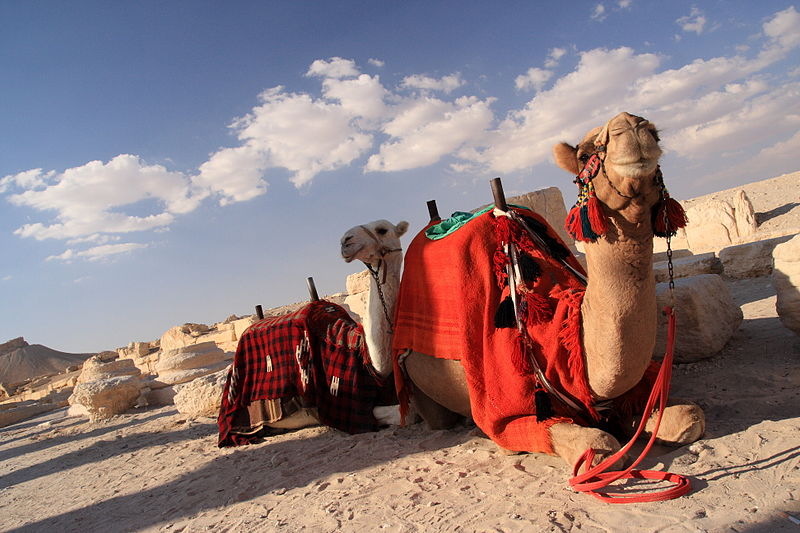
Camels at Palmyra (Tadmur), Syria — a crucial Silk Road caravan stop known in antiquity as the Bride of the Desert
James Gordon from Los Angeles, California, USA · CC BY 2.0 via Wikimedia Commons
The Greatly Merciful, Greatly Compassionate Rescuer from Suffering, Bodhisattva Guanyin — dated 947 — China
Lei Yanmei via The Metropolitan Museum of Art (Public Domain)
Quiz yourself