History
·
Why Do Empires Always Look the Same?
Medium
7 min
Why Do Empires Always Look the Same?
Rome, Persia, and China built power the same way without ever meeting.
Share
Three civilizations. Separated by thousands of miles. No internet, no shared language, no contact. Yet they all built empires using almost the exact same playbook. What did they know that everyone else didn't?
Empires don't start as empires. They start as one city, one tribe, one valley that's slightly better at something than its neighbors. Rome was a muddy river town. Persia was a minor kingdom under Median rule. The Qin state in China was considered a backwater by the sophisticated eastern kingdoms. None of them looked like world-beaters at the start. So what changed? The same thing, every time: they figured out how to turn military wins into permanent control — and they got really good at it really fast.
But military wins alone don't make an empire. History is full of great conquerors who built nothing lasting — Attila the Hun burned across Europe and left almost no institutional trace. What separated the empire-builders from the raiders was one thing: administration. Rome didn't just beat you. Rome built roads to your city, installed a governor, collected taxes, and offered your elites Roman citizenship if they played along. Persia under Cyrus the Great did something even smarter — he let conquered peoples keep their religion, their local rulers, and their customs, as long as tribute flowed to Persepolis. The Persian Empire was less an occupation and more a franchise model.
Make your call
Three civilizations, no contact, same result. What's the one thing that actually turned military victories into lasting empires — the thing Attila had that Rome, Persia, and Qin all shared with him, or the thing he was missing?
A
Overwhelming military dominance that made resistance impossible
B
Administration — roads, laws, and systems that made the empire feel inevitable
C
A charismatic ruler who inspired loyalty across conquered peoples
Key Insight
The pattern: Military force gets you in the door. Administration keeps you in the room. Empires that mastered both lasted centuries. Empires that only mastered one collapsed within a generation.
Example
China's Qin dynasty is the most dramatic case study. In just 15 years — 230 to 221 BCE — the Qin state conquered six rival kingdoms and unified China for the first time in history. How? The Qin had been quietly running a different operating system than everyone else. Under a philosophy called Legalism, they standardized everything: weights, measurements, axle widths on carts (so roads could be uniform), written script, law codes. When they conquered a new territory, they didn't negotiate — they just installed the Qin system wholesale. It was brutal and efficient. The First Emperor, Qin Shi Huang, didn't ask for loyalty. He built infrastructure that made loyalty the path of least resistance. The empire only lasted 15 years after unification, but the administrative template it created shaped China for the next 2,000 years.
Here's the twist — every successful empire also had to solve the same internal problem that killed most of its rivals: what do you do with your own elites? Powerful generals and aristocrats are great for conquering territory. They're terrible for stable governance, because they want power for themselves. Rome's solution was the Senate — a body that gave elites prestige and influence within the system, so rebelling against the system cost them something. Persia gave conquered nobles positions in the imperial court. The Han dynasty in China created a civil service exam — meaning you earned elite status through merit (in theory), not just birth. Each empire found a different way to co-opt the ambitious people who might otherwise tear it apart.
Key Insight
The real threat to every empire was never the enemy outside the walls. It was the ambitious general inside them. The empires that lasted longest were the ones that gave those generals somewhere to climb that wasn't the throne.
So what's the actual pattern? Step one: find an edge — military, geographic, technological, or organizational — and exploit it relentlessly. Step two: convert military wins into administrative control, not just tribute. Step three: make joining the empire more attractive than fighting it, at least for local elites. Step four: build infrastructure — roads, laws, currency, language — that makes the empire feel inevitable rather than imposed. None of this is accidental. And none of it is unique to the ancient world. The same playbook shows up in the British Empire, the Mongols, and — if you squint — in how platform companies absorb competitors today. That's the playbook three civilizations with no contact, no shared language, and no internet all independently discovered. The answer to what they knew that everyone else didn't: power compounds when you know how to institutionalize it.
Sources
Images from Wikimedia Commons. Attribution required by license.
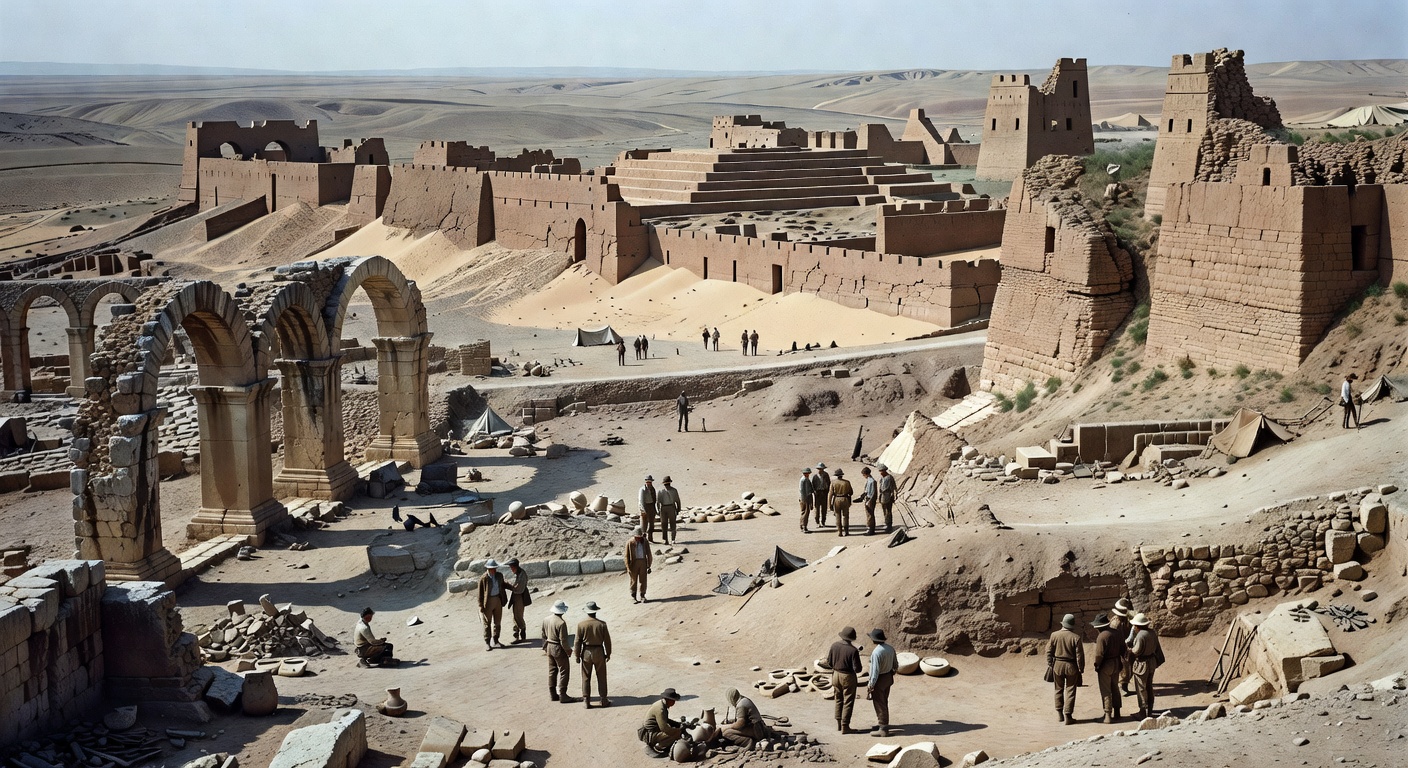
ancient empire ruins aerial
Generated by Grok Imagine (xAI), prompt: Generate a single 16:9 horizontal image for an educational lesson.
Lesson title: "Why Do Empires Always Look the Same?" · Rome, Persia, and China built power the same way without ever meeting.
Domain:…
A trip to Mexico : being notes of a journey from Lake Erie to Lake Tezcuco and back, with an appendix containing and being a paper about the ancient nations and races who inhabited Mexico before and a
Library of Congress · Public Domain via Library of Congress
Quiz yourself