History
·
Why Cities Were Born Next to Rivers
Easy
5 min
Why Cities Were Born Next to Rivers
The geography secret that explains where every ancient civilization appeared
Share
Every major ancient civilization — Mesopotamia, Egypt, the Indus Valley — appeared next to a river. All of them. That's not a coincidence. That's a pattern. And once you see why, you'll never look at a map the same way again.
For most of human history, people moved. They followed animals, tracked seasons, and never stayed anywhere long enough to build something worth protecting. Then, around 10,000 years ago, farming changed that. Suddenly you could grow more food than you needed. And when you have surplus food, something wild happens: you don't need everyone hunting. Some people can do other things. Build. Trade. Govern. That specialization is the seed of civilization — but it needs the right soil to grow in.
Not all farmland is equal. River floodplains are different. Every year, rivers like the Nile and the Tigris-Euphrates would flood — and when they receded, they left behind a fresh layer of rich, dark sediment. Free fertilizer. Automatically. You didn't have to rotate crops or rest the land. You could farm the same fields, year after year, and they'd keep producing. That's the kind of agricultural productivity that lets a population explode.
Analogy
Think about it like a group chat that keeps getting more active. At first it's five people, low stakes, easy to manage. But then more people join, more conversations happen at once, and suddenly someone has to pin the important messages, set the rules, and keep things from descending into chaos. Ancient river settlements worked the same way. More food meant more people. More people meant more coordination problems. Who owns which field? Who gets water first? Who stores the grain? You need systems. You need someone in charge. That's how you get governments, laws, and cities — not because someone planned it, but because the alternative was total chaos.
Make your call
Every major ancient civilization appeared next to a river. What's the real reason rivers were so essential — the factor that made civilization not just possible, but almost inevitable?
A
Rivers provided fresh water and transportation routes, making trade and communication easy
B
Rivers flooded annually, depositing fresh silt that created self-renewing farmland — generating the food surplus that freed people to specialize beyond farming
C
Rivers formed natural defensive barriers that protected early settlements from raiders
Key Insight
Geography didn't just influence where civilizations appeared. It determined which ones survived long enough to become civilizations in the first place. The river wasn't a backdrop. It was the engine.
Example
Take Mesopotamia, the land between the Tigris and Euphrates rivers in modern-day Iraq. The name literally means 'between the rivers.' By around 3500 BCE, the Sumerians had built cities like Uruk, which may have held 50,000 people, an almost incomprehensible number for the ancient world. They invented writing, not because they were more creative than anyone else, but because they had so much grain to track across so many transactions that human memory stopped being enough. The world's first writing wasn't poetry. It was accounting. Receipts for barley.
Meanwhile in Egypt, the Nile was so reliable, flooding at almost the exact same time every year, that Egyptians built their entire calendar around it. Predictability meant planning. Planning meant power. That's why Egyptian pharaohs could organize thousands of workers to build the pyramids. They had enough surplus food to feed a workforce that wasn't farming.
The Indus Valley civilization, centered around modern-day Pakistan, is the one most people forget, and it's arguably the most impressive. Cities like Mohenjo-daro had grid-planned streets, underground sewage systems, and standardized brick sizes across settlements hundreds of miles apart. They were coordinating at scale before most of the world had figured out how to write things down. And they were built on the floodplains of the Indus River. Same pattern, different continent.
But pay attention: all three civilizations, Mesopotamia, Egypt, and the Indus Valley, emerged within roughly the same thousand-year window, completely independently of each other. The same geographic conditions produced the same social solutions. That's the pattern the hook pointed to — and now you can see the mechanism behind it. Rivers didn't just feed people. They created the conditions that forced humans to invent civilization.
Key Insight
Civilization isn't something humans decided to build. It's something that happened to groups of humans when geography gave them enough surplus — and enough problems — that they had no other choice.
Sources
Images from Wikimedia Commons. Attribution required by license.
Tigris Euphrates river ancient Mesopotamia floodplain
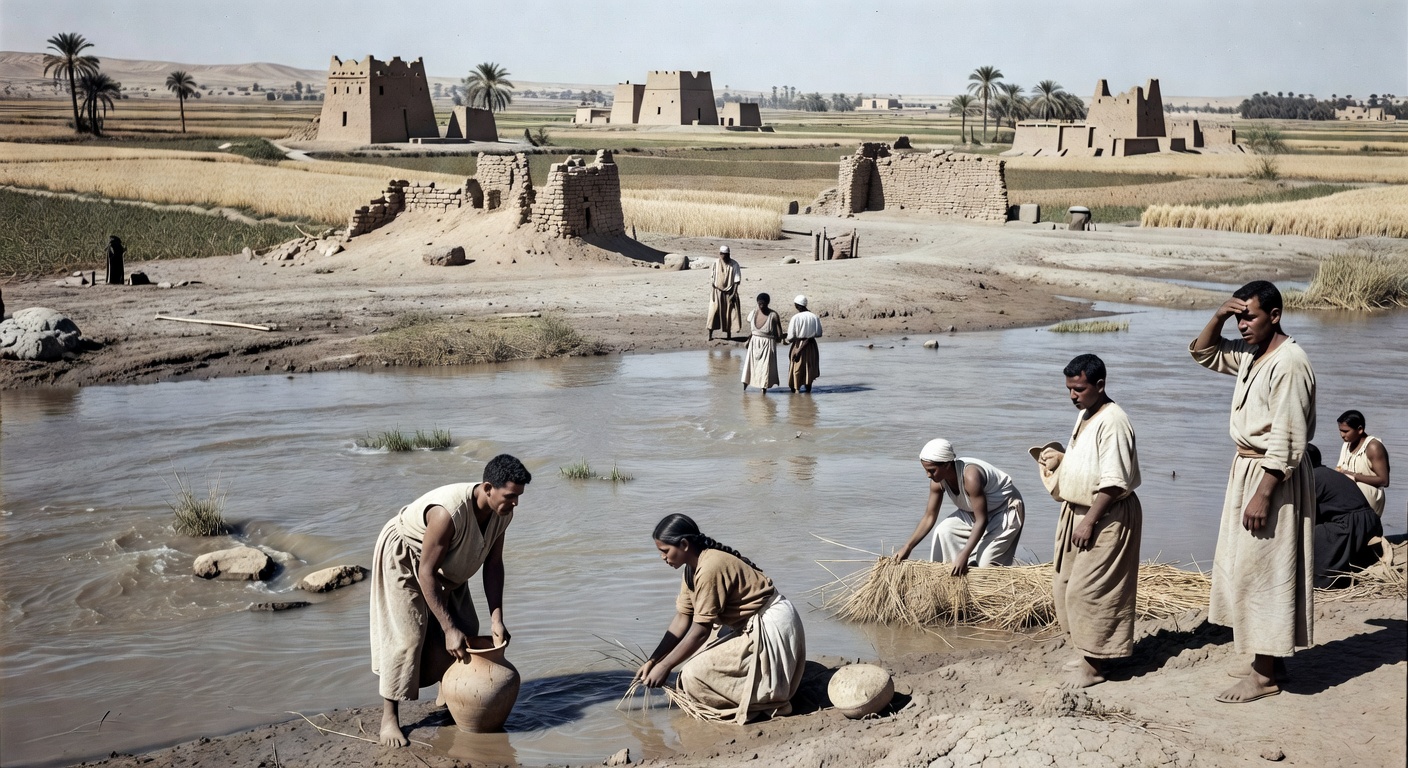
Generated by Grok Imagine (xAI), prompt: Generate a single 16:9 horizontal image for an educational lesson.
Lesson title: "Why Cities Were Born Next to Rivers" · The geography secret that explains where every ancient civilization appeared
Do…
Masonry remnant in the Colorado portion of Hovenweep National Monument, a widely dispersed example of architectural ruins from the Anasazi "ancient people's" period preceding the arrival of Puebloan I
Library of Congress · Public Domain via Library of Congress
Jeff Schmaltz, MODIS Rapid Response Team, NASA/GSFC — The lower Nile Valley — 2003-08-27
Jeff Schmaltz, MODIS Rapid Response Team, NASA/GSFC via Internet Archive (Internet Archive)
Quiz yourself