History
·
How Farming Created the Modern World
Easy
5 min
How Farming Created the Modern World
One weird decision 12,000 years ago explains why you have a boss, pay rent, and eat three times a day.
Share
What if the single worst decision in human history — longer working hours, worse nutrition, more disease, rigid social hierarchies — also accidentally created civilization? That's farming. And you're living in its aftermath.
For about 300,000 years, humans were hunter-gatherers. They worked maybe 4-5 hours a day finding food, then spent the rest of their time doing basically nothing productive. Anthropologists call this the 'original affluent society.' They were lean, varied their diet across dozens of species, and had no landlords. Then, around 10,000 BCE in the Fertile Crescent — modern-day Iraq and Syria — some groups started doing something strange. They stayed in one place and grew their own food. And everything, everything, changed.
Analogy
Think about the difference between freelancing and getting a full-time office job. Freelancing is unpredictable — some weeks are great, some weeks are rough — but you have flexibility, variety, and no one telling you what to do. A full-time job means a steady paycheck, but now you have a schedule, a manager, and you're doing one specific thing every single day. Early farming was exactly that trade-off. Hunter-gatherers were freelancing. Farmers clocked in. The hours got longer, the work got more repetitive, and suddenly there was someone in charge.
Make your call
The hook called farming 'the worst decision in human history' — longer hours, worse health, rigid hierarchies. So what actually made it stick? What did farming create that hunting never could?
A
Safety — settled communities could defend themselves from predators and rival groups far more effectively
B
Surplus — growing more food than you need right now, which made storage, ownership, and specialization possible
C
Population growth — more children survived infancy, which gave farming societies a numbers advantage over time
Here's what farming actually did that hunting never could: it created surplus. When you can grow more food than you need right now, you can store it. And the moment you can store it, everything gets complicated. Who owns the storage? Who decides how it gets distributed? Who gets to eat when the harvest is bad? You've just invented property, politics, and inequality — all from a grain silo.
Key Insight
Surplus is the engine of civilization. No surplus = everyone spends all day finding food. Surplus = some people can do other things — build, govern, fight, trade, think. Every specialist in human history, from priests to philosophers to the person writing this, exists because farmers grew more than they needed.
Here's the catch. Farming didn't just change what people ate — it changed who people became to each other. When you're nomadic, you can't accumulate much. You carry everything you own. Status is about skill and reputation. But once you settle down, you can own land. You can own the harvest. You can own the tools. And once ownership exists, inheritance exists. Which means for the first time in human history, you could be born into wealth or poverty before you ever made a single decision. Sound familiar?
Example
The city of Çatalhöyük in modern Turkey, around 7500 BCE, is one of the earliest known settled communities. Archaeologists found something striking: the earliest houses were basically identical in size and contents — no signs of wealth differences. But over centuries, as farming surpluses grew, the settlement shows clear signs of emerging hierarchy. Bigger houses. Storage rooms. Signs that some families controlled more resources than others. You can literally watch inequality being invented in the archaeological record, layer by layer.
Key Insight
The Agricultural Revolution didn't just feed more people. It invented the concept of 'more' — more ownership, more hierarchy, more specialization, more war over resources. Every economic and political system you've ever lived under — including the boss and the rent bill the hook mentioned — traces its roots to the moment someone decided to stay in one place and plant a seed.
Sources
Images from Wikimedia Commons. Attribution required by license.
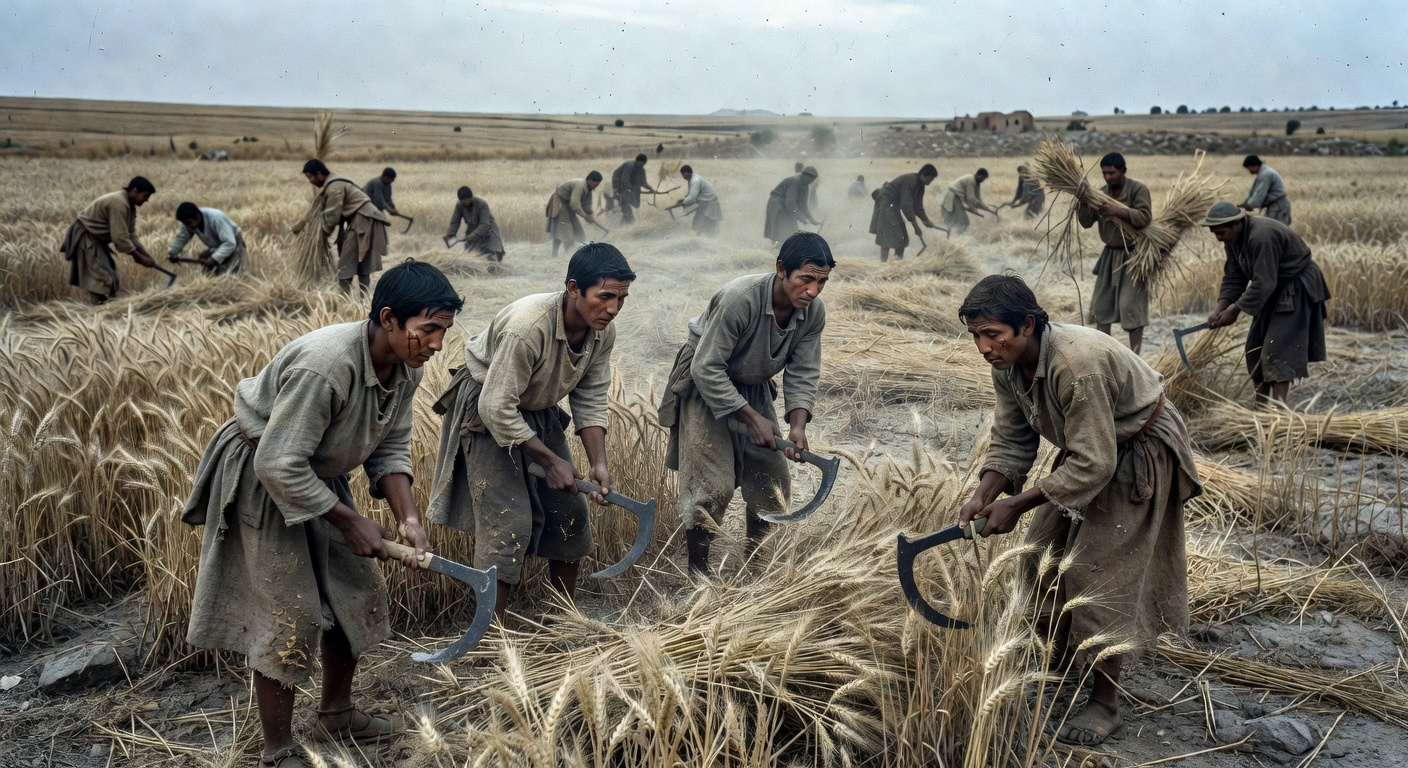
ancient wheat field harvest
Generated by Grok Imagine (xAI), prompt: Generate a single 16:9 horizontal image for an educational lesson.
Lesson title: "How Farming Created the Modern World" · One weird decision 12,000 years ago explains why you have a boss, pay rent, an…
Large Storage Jar (Ōtsubo) — late 15th century — Japan
Japan via The Metropolitan Museum of Art (Public Domain)
Pierced Bowl Signed by Hasan al-Qashani — late 11th–early 12th century
The Met via The Metropolitan Museum of Art (Public Domain)
Quiz yourself