Governance
·
Cross Cutting
·
the paper that predicted faction
Hard
7 min
Primary Source
The Man Who Predicted Political Chaos in 1787
Why one essay written before the Constitution still explains every gridlocked legislature on earth
Share
In 1787, James Madison sat down and wrote an essay predicting that democracy's biggest enemy wouldn't be tyrants or foreign invaders. It would be us — organized groups of citizens, each convinced they were right, tearing the republic apart from the inside. He called them factions. We call them political parties, lobbying groups, and Twitter mobs. He had no idea those things were coming. He described them anyway.
Every governance system faces the same core tension: how do you let people organize around their interests without letting those organized interests capture the whole machine? This is one of the deep tradeoffs that runs through constitutions, parliaments, and city councils alike. Some systems try to resolve it through strong executives. Others through proportional representation. Others through judicial review. Federalist No. 10 is the document that named the problem first — and proposed a structural solution that still shapes American governance today.
James Madison (1751–1836, Virginia) — fourth President of the United States and primary architect of the Constitution — wrote Federalist No. 10 as part of a newspaper campaign to convince New York to ratify the new Constitution. It wasn't a philosophical treatise written for posterity. It was a persuasion piece written on deadline. That's what makes it remarkable: the analysis is so precise that political scientists still assign it in graduate seminars.
Make your call
Madison believed the new Constitution could control factions — organized groups that put their own interests above the common good. What was his proposed solution?
A
Ban political parties and punish organized lobbying
B
Make the republic large enough that no single faction could dominate
C
Give the President veto power over any legislation backed by special interests
Key Insight
"By a faction, I understand a number of citizens, whether amounting to a majority or a minority of the whole, who are united and actuated by some common impulse of passion, or of interest, adverse to the rights of other citizens, or to the permanent and aggregate interests of the community.
The latent causes of faction are thus sown in the nature of man... The regulation of these various and interfering interests forms the principal task of modern legislation, and involves the spirit of party and faction in the necessary and ordinary operations of the government.
The smaller the society, the fewer probably will be the distinct parties and interests composing it; the fewer the distinct parties and interests, the more frequently will a majority be found of the same party... Extend the sphere, and you take in a greater variety of parties and interests; you make it less probable that a majority of the whole will have a common motive to invade the rights of other citizens."
— James Madison, Federalist No. 10, November 22, 1787
Look at the third sentence of the excerpt — "The latent causes of faction are thus sown in the nature of man." Madison isn't blaming bad politicians or corrupt institutions. He's saying faction is built into us. Wherever you have people with different property, different beliefs, different ambitions, you will have factions. You cannot educate them away or legislate them away. The only question is how to design a system that survives them.
Then look at his solution in the final sentence: "Extend the sphere." A small town is easy for one faction to capture — a single landlord, a single church, a single employer. A large republic? No faction is big enough to dominate everywhere at once. They have to negotiate. They have to form coalitions. The design of the Constitution — large, federal, with separated powers — was Madison's engineering response to a behavioral prediction.
This is the mechanism at work: a constitution doesn't just describe how government works today. It shapes what future leaders can do by structuring the incentives around them. Madison built faction-resistance into the architecture so that no future majority could simply seize control and run the table.
Whether it worked is a separate debate — and a live one. Critics point out that the Electoral College, Senate apportionment, and the filibuster have all been used by minority factions to block majority preferences, which is arguably the opposite problem Madison worried about. Defenders say the gridlock is the point: a system that can't move fast is a system that can't be captured fast.
What's not debatable is the prediction itself. Madison described, in 1787, the exact dynamics that produce lobbying, partisan polarization, and legislative deadlock. He didn't have a cure. He had a diagnosis — and he built the diagnosis into the founding document so that every future leader would have to operate inside it.
Related threads
Governance
·
Every Government Has to Choose: Fast or Fair
·
fast decisions, broad acceptance
Every Government Has to Choose: Fast or Fair
Governance
·
Why Democracies Keep Collapsing to Two Parties
·
Duverger's law
Why Democracies Keep Collapsing to Two Parties
Governance
·
Why Every Organization Eventually Fights Itself
·
principal-agent problems
Why Every Organization Eventually Fights Itself
Sources
Images from Wikimedia Commons. Attribution required by license.
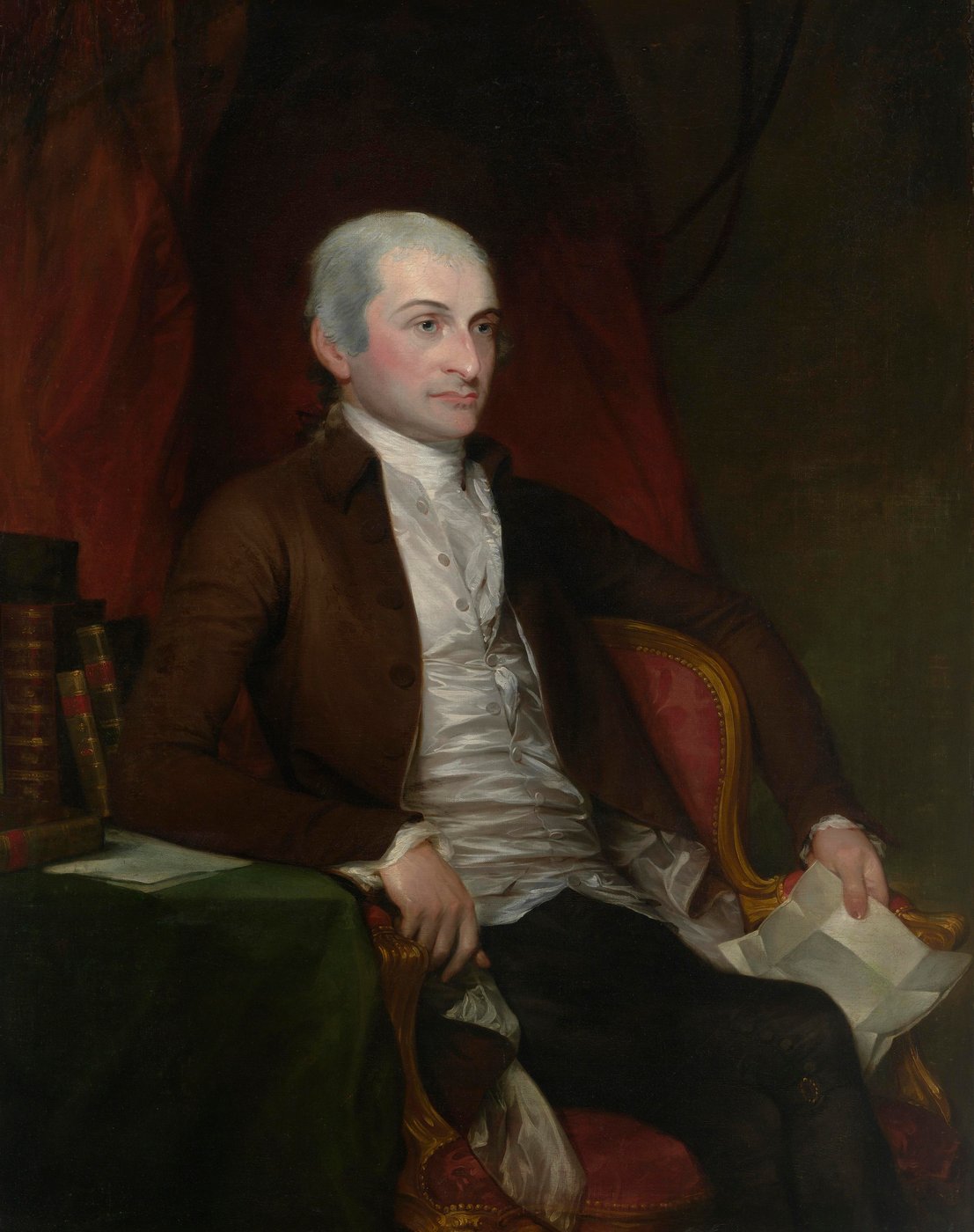
John Jay — begun 1784; completed by 1818
National Portrait Gallery, Smithsonian Institution via Smithsonian Open Access (CC0)
William Few — ca. 1787 — American
John Ramage via The Metropolitan Museum of Art (Public Domain)
Quiz yourself