Governance
·
Non State Organizations
·
why some trade unions last centuries…
Medium
6 min
Why Some Unions Last 200 Years and Others Die in a Decade
What separates a union that outlasts empires from one that dissolves after a single bad contract
Share
The Amalgamated Society of Engineers was founded in Britain in 1851. It still exists today — surviving two world wars, the collapse of British manufacturing, and the rise of automation. Meanwhile, most unions formed in the same era are gone without a trace. The difference isn't luck.
Power doesn't only live in governments and corporations. It also organizes in the spaces between them — in labor unions, international bodies, professional associations, standards committees, and NGOs. These are non-state organizations: groups that hold real influence without holding a government office or a stock price. Trade unions are one of the oldest and most studied examples. They exist to give workers collective bargaining power — the ability to negotiate wages and conditions as a bloc rather than as individuals who can be replaced one by one. Some have done this for generations. Others collapse almost immediately. The question of why is more interesting than it sounds.
The naive answer is that unions die when they lose fights — a failed strike, a hostile government, a plant closure. That's true sometimes. But the Amalgamated Society of Engineers lost plenty of fights in its first fifty years. The United Mine Workers of America survived the 1902 anthracite coal strike only partially, and the company never fully recognized them. Both organizations are still operating. Losing battles doesn't kill unions. Something else does.
Make your call
A union forms at a factory. The factory closes five years later. What's the most likely outcome for the union?
A
It collapses immediately — no factory, no members, no purpose
B
It survives by organizing workers at other employers in the same trade
C
It merges with a larger union and loses its identity
The key variable is what the union is organized around. Unions built around a single employer are fragile by design. When the employer shrinks, the union shrinks. When the employer closes, the union has nothing to represent. But unions organized around a trade or craft — carpenters, printers, electrical workers — have a membership base that moves with the work. The trade persists even when individual companies don't. The Amalgamated Society of Engineers wasn't tied to any one factory. It represented engineers as a category of skilled worker, which meant it could recruit from new industries as old ones died. That structural choice, made in 1851, is a big reason the organization is still here.
There's a second factor that matters just as much: whether the union controls something the employer can't easily replace. Craft unions in the nineteenth century often controlled apprenticeship programs — the only pathway into a skilled trade. If you wanted trained boilermakers or compositors, you went through the union. That's leverage that survives individual contract negotiations. When unions lose control of entry into their trade — through employer training programs, technology that deskills the work, or deregulation — they lose the structural power that made them durable.
Key Insight
The unions that last aren't the ones that win the most fights. They're the ones that control something the employer can't get elsewhere — a skilled workforce, a certification pathway, a professional standard. Take that away, and the union is just a negotiating club with no leverage.
The third factor is internal: whether the union can hold its own members together when the incentives pull toward defection. This is where a lot of unions die quietly, without any external cause. The logic is simple: if the union wins a pay raise, every worker at that employer gets it — whether they paid dues or not. That's called the free-rider problem, and it's structurally corrosive. Members start asking why they're paying for something everyone gets for free. Dues fall. Staff get cut. The union's capacity to fight future battles shrinks. Eventually it can't mount a credible threat, and employers stop taking it seriously.
Unions that survive this typically do one of two things. They negotiate closed-shop agreements — where union membership is a condition of employment, eliminating the free-rider problem by force. Or they provide services that non-members genuinely can't access: legal representation, pension funds, training programs, job placement networks. The Amalgamated Society of Engineers ran one of the most comprehensive mutual aid systems in Victorian Britain — unemployment benefits, sick pay, retirement support. Members had concrete reasons to stay that had nothing to do with the next contract negotiation. The union was also a welfare state in miniature, at a time when the actual state provided almost nothing.
Related threads
Governance
·
Who Actually Decides How the Internet Works?
·
rough consensus and running code
Who Actually Decides How the Internet Works?
Governance
·
When the Donor Becomes the Boss
·
the NGO that forgot its mission…
When the Donor Becomes the Boss
Governance
·
The World's Most Powerful Institutions Have No Army
·
the UN, WTO, and EU decide without the…
The World's Most Powerful Institutions Have No Army
Sources
Images from Wikimedia Commons. Attribution required by license.
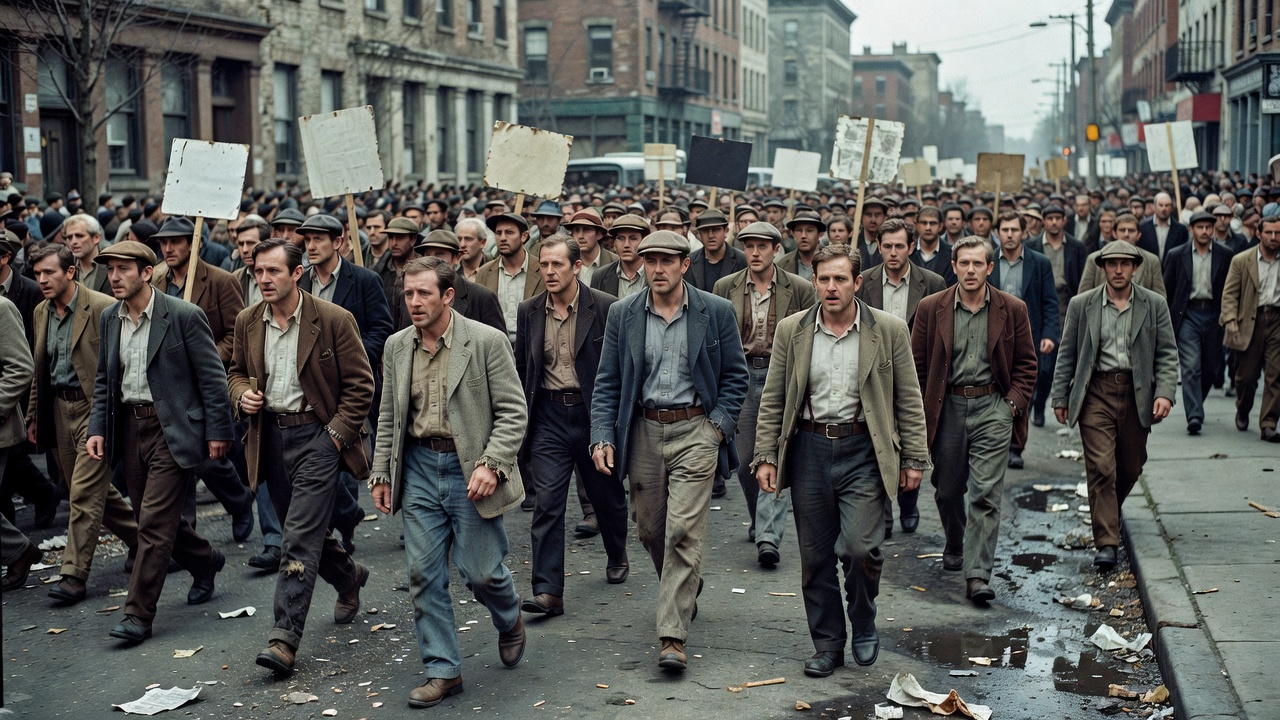
trade union march historical
Generated by Grok Imagine (xAI), prompt: Generate a single 16:9 horizontal image for an educational lesson.
Lesson title: "Why Some Unions Last 200 Years and Others Die in a Decade" · What separates a union that outlasts empires from one tha…
Anthracite Coal Strike Commission appointed 1902 by President Roosevelt
Library of Congress · Public Domain via Library of Congress
Quiz yourself