Governance
·
Religious Organization Governance
·
why religious organizations outlast…
Medium
6 min
Why Churches Outlive Empires
What makes religious institutions the most durable organizations humans have ever built
Share
The Roman Empire collapsed in 476 CE. The institution that administered its eastern provinces — the Catholic Church — is still holding staff meetings.
Most governance lessons focus on states — parliaments, constitutions, courts. But religious organizations are a different kind of governance puzzle entirely. They're not backed by armies or tax revenue. They can't throw you in jail. And yet some of them have been running continuously for over a thousand years, coordinating millions of people across dozens of countries, surviving wars, schisms, plagues, and the collapse of every secular power around them. That's not faith. That's engineering. The question is: what kind?
Most institutions die one of three deaths. The founder dies and no one agrees on who's next. The organization's property gets seized, sold, or inherited into irrelevance. Or the members stop identifying with the institution and drift away. Governments collapse this way. Companies collapse this way. Dynasties definitely collapse this way. Religious organizations have, over centuries, built specific structural solutions to each of these failure modes — and that's what makes them so unusually durable.
Make your call
A company's founder dies. The company has no named successor, no written succession plan, and the founder owned all the key assets personally. What usually happens?
A
The senior employees vote on a replacement and the company continues normally
B
The company fractures, stalls, or collapses within a few years
C
Ownership automatically transfers to the longest-serving employee
The succession problem is the most dangerous. When a leader dies, every organization faces a legitimacy vacuum — who has the right to take over? Most institutions answer this badly, either through chaos or through whoever happens to be strongest at the moment. Religious organizations solved it by making succession a ritual rather than a contest. The Catholic Church elects a pope through a conclave — a sealed, structured process with centuries of precedent behind it. The Dalai Lama tradition uses a search committee and physical signs to identify a reincarnation, removing individual ambition from the equation entirely. The LDS Church simply promotes the longest-serving apostle, automatically, no campaign required. These aren't identical solutions, but they share a design principle: the process itself holds authority, not the person. When the leader dies, the process doesn't. So the institution doesn't either.
Property is the second piece. A church that rents its building can be evicted. A monastery that holds land in a single abbot's name loses everything when he dies. Medieval religious institutions figured out a structural fix: the organization itself owns the property, not any individual. The Catholic Church holds assets through a legal entity — the Holy See — that has existed continuously since the 4th century. Individual bishops come and go; the property doesn't move. This is so effective that secular law eventually copied it. The modern corporation — where a company can own assets independent of any individual shareholder — is, structurally, a descendant of how monasteries held land. Religious organizations invented institutional property rights because they needed to survive their own members.
Key Insight
Identity is the third and most underrated factor. A bank survives because it holds your money. A government survives because it controls territory. A religious organization survives because members actively want it to survive — and teach their children to want the same thing. That's a self-renewing membership base that no corporation can buy and no state can legislate. The institution becomes part of how people understand themselves, which means losing the institution feels like losing yourself. That's not manipulation. It's the most powerful continuity mechanism ever designed.
Put the three together and you get something no secular institution has consistently matched: a clear succession process that doesn't depend on any individual, property that outlives every member, and an identity so embedded in daily life that members recruit the next generation automatically. The Roman Senate had none of these. The East India Company had the first two but not the third. Most modern corporations have weak versions of all three. The Catholic Church has been running all three for sixteen centuries. That's not an accident of faith — it's the output of structural decisions made by people who were, whatever else you think of them, very serious about not dying.
Related threads
Governance
·
The Oldest Org Chart Still Running
·
an organization built in the 4th…
The Oldest Org Chart Still Running
Governance
·
The 2,500-Year-Old Rulebook That Still Works
·
how a Buddhist sangha actually runs…
The 2,500-Year-Old Rulebook That Still Works
Governance
·
The Room That Decides Without Voting
·
Quaker consensus
The Room That Decides Without Voting
Sources
Images from Wikimedia Commons. Attribution required by license.
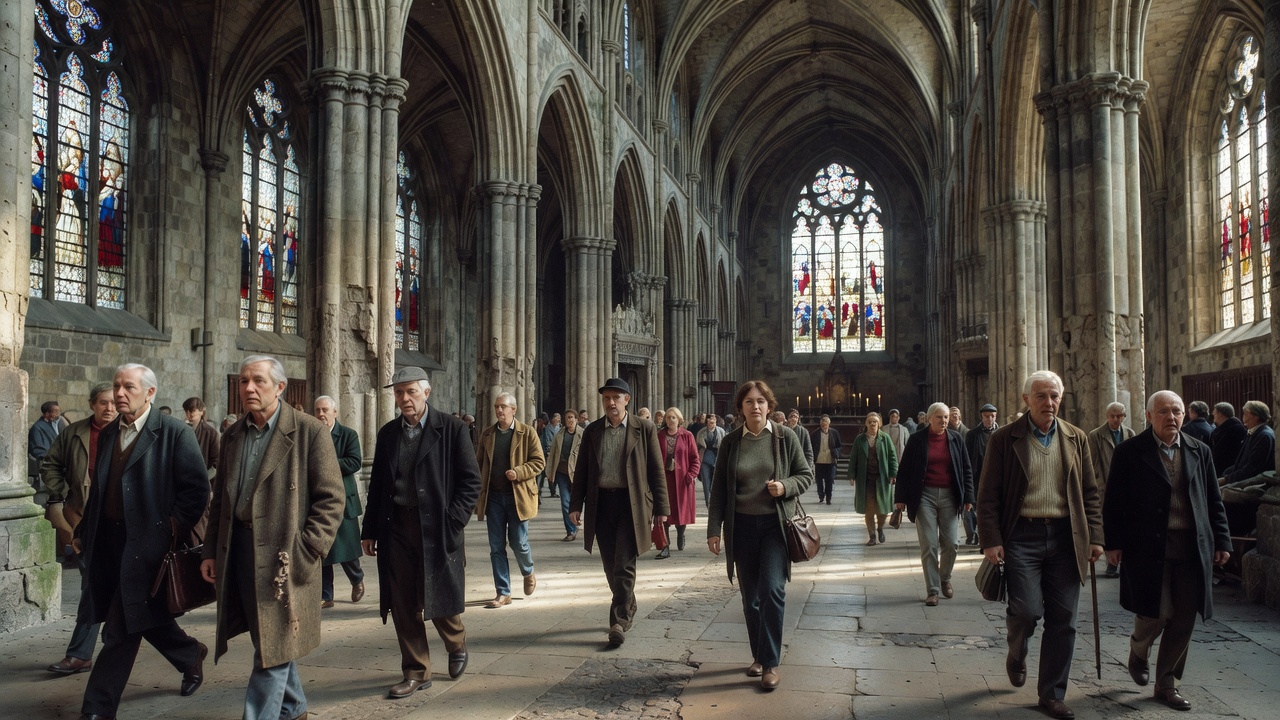
ancient cathedral interior
Generated by Grok Imagine (xAI), prompt: Generate a single 16:9 horizontal image for an educational lesson.
Lesson title: "Why Churches Outlive Empires" · What makes religious institutions the most durable organizations humans have ever buil…
Mahasiddha Jnanatapa — ca. 1350 — Eastern Tibet, Kham, Riwoche monastery
Eastern Tibet, Kham, Riwoche monastery via The Metropolitan Museum of Art (Public Domain)
Quiz yourself