Governance
·
Religious Organization Governance
·
three ways Protestants decide things…
Medium
5 min
Three Ways Protestants Decide Who's in Charge
Why churches that split from the same source ended up with totally different power structures
Share
Two churches, same theology, same hymns, same Bible. One can fire its pastor with a congregational vote on a Sunday afternoon. The other needs a bishop in another city to sign off. Why do they work so differently — and which one actually lasts longer?
When historians study governance — how organizations make decisions, distribute power, and survive over time — religious institutions turn out to be some of the most interesting cases. They've been engineering solutions to the same problems governments face for centuries: who has authority, how do you replace leaders, and what happens when people disagree?
Protestantism is a particularly rich case because it started as a single break from Catholic authority in the 16th century and then immediately fractured into dozens of movements — each of which had to answer the same structural question from scratch: who gets to decide? Three distinct answers emerged. They're still the dominant templates today.
The first answer is congregational governance. Power lives entirely at the local level. The congregation — the people sitting in the pews — hires the pastor, sets the budget, votes on major decisions, and can remove leadership by majority vote. Baptists, most independent evangelical churches, and the United Church of Christ use this model.
It's radically democratic. No outside authority can tell a congregational church what to do. If the members want to leave their denomination, they vote and leave. If they want to hire a 24-year-old with no seminary degree, they can. The tradeoff is that the congregation is also the only check on itself. A charismatic pastor who wins the room can consolidate enormous informal power — because there's no bishop above them to intervene.
Make your call
Here's the structural question that splits the other two models: if a local congregation can't govern itself well — if it's captured by one faction, or the pastor goes rogue — who steps in? What do you think most Protestant traditions chose?
A
A council of local pastors who vote together on disputes
B
A bishop with authority over multiple congregations
C
A national assembly that reviews appeals case by case
The second answer is episcopal governance — from the Greek episkopos, meaning overseer. Power flows downward from bishops, who oversee multiple congregations in a geographic region. Bishops appoint or approve clergy, resolve disputes, and hold authority that individual congregations can't override. Anglicans (Episcopalians in the US), Methodists, and Lutherans in many countries use this structure.
This is closer to how a franchise works than a democracy. The local outlet has day-to-day autonomy, but headquarters sets standards and can intervene. A bishop can remove a pastor. A congregation can't just declare itself independent and keep the building — the property often belongs to the diocese. That last detail matters enormously for long-term institutional stability, which is why episcopal churches have tended to hold assets and survive schisms better than congregational ones.
The third answer — presbyterian governance — is the most structurally inventive. Power lives neither with the congregation alone nor with a single bishop, but with a layered system of elected councils. At the local level, a congregation elects a session of ruling elders. Those elders send representatives to a regional body called a presbytery. Presbyteries send representatives to a national assembly. Presbyterians, Reformed churches, and some Congregationalists who added regional accountability use this model.
It's representative democracy, built into church structure. No single person holds decisive authority. Decisions bubble up through councils, get debated, and come back down as policy. The upside: it's hard for any one leader to hijack the institution. The downside: it's slow, and getting anything done requires navigating multiple layers of elected bodies who all have real power. Sound familiar? It should — the framers of the US Constitution were heavily influenced by Presbyterian church governance when they designed Congress.
Key Insight
The three models map onto three different theories of where legitimate authority comes from: the people (congregational), the office (episcopal), or the representative council (presbyterian). Every Protestant denomination picks one — and that choice determines everything from who owns the church building to how fast the institution can respond to a crisis.
Related threads
Governance
·
The Oldest Org Chart Still Running
·
an organization built in the 4th…
The Oldest Org Chart Still Running
Governance
·
The 2,500-Year-Old Rulebook That Still Works
·
how a Buddhist sangha actually runs…
The 2,500-Year-Old Rulebook That Still Works
Governance
·
The Room That Decides Without Voting
·
Quaker consensus
The Room That Decides Without Voting
Sources
Images from Wikimedia Commons. Attribution required by license.
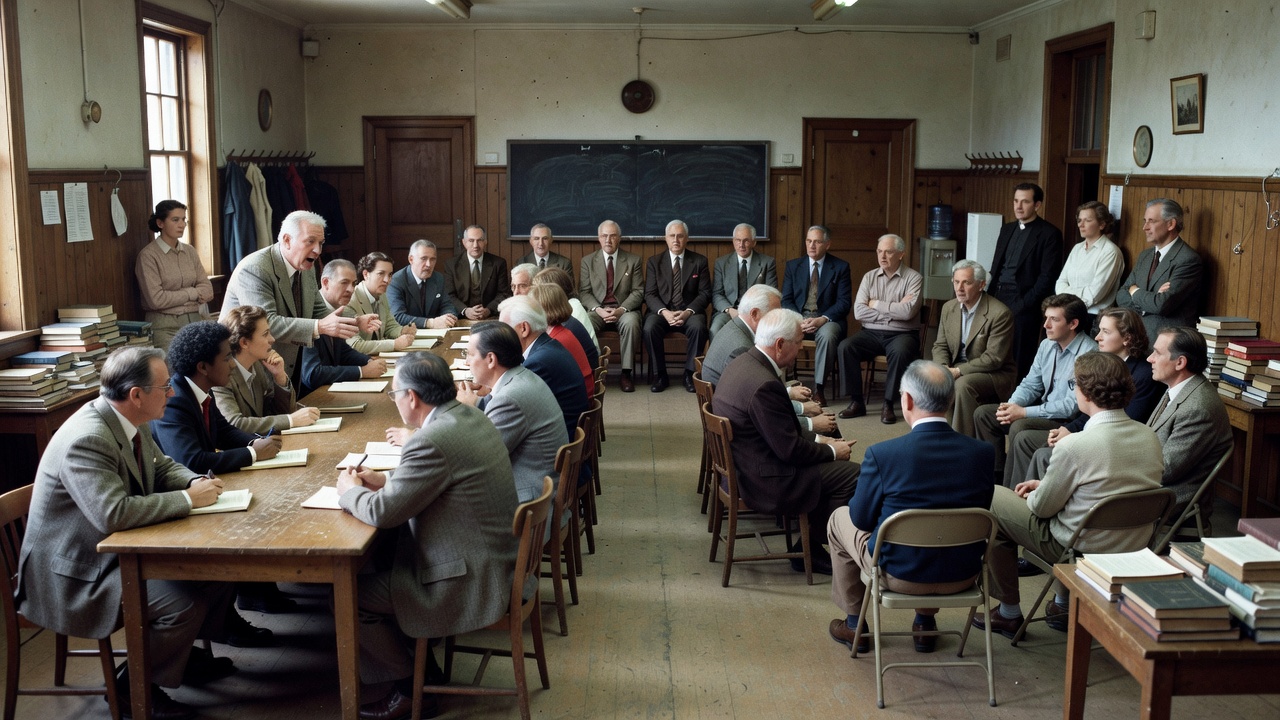
Protestant church council meeting
Generated by Grok Imagine (xAI), prompt: Generate a single 16:9 horizontal image for an educational lesson.
Lesson title: "Three Ways Protestants Decide Who's in Charge" · Why churches that split from the same source ended up with totally di…
Quiz yourself