Governance
·
Religious Organization Governance
·
an organization built in the 4th…
Medium
6 min
The Oldest Org Chart Still Running
How a 4th-century institution outlasted every empire that tried to replace it
Share
The Roman Empire is gone. The Han Dynasty is gone. The Byzantine Empire — the one that actually ran the Roman bureaucracy for another thousand years after Rome fell — is gone. The Catholic Church, which was officially organized while the Roman Empire was still alive, is still filing paperwork.
Most people think of religious institutions as belief systems — collections of doctrines, rituals, and communities. That's true. But underneath the theology, every major religious organization is also a governance structure: a set of rules about who makes decisions, who controls resources, who can join, who gets promoted, and what happens when the person at the top dies. Study those rules as engineering, and some remarkable things become visible. The Catholic Church, in particular, looks less like a spiritual community and more like the most durable organizational design in recorded history.
The structure was formalized at the Council of Nicaea in 325 CE — convened by the Roman Emperor Constantine (c. 272–337 CE, Naissus, modern Serbia), who wanted a unified church to help stabilize a fracturing empire. What came out of that council wasn't just a creed. It was a clear chain of command: bishops overseeing geographic territories called dioceses, priests operating within those dioceses, deacons below them. At the top, the Bishop of Rome — the Pope — held primacy. The org chart was explicit, and it mapped onto Roman provincial administration almost exactly. Constantine knew how to run a large territory. The Church borrowed the blueprint.
Make your call
Here's the question that makes this interesting: the Roman Empire that created this structure collapsed within 150 years. Its army disbanded. Its currency failed. Its roads stopped being maintained. Why did the Church survive when everything else built by Rome didn't?
A
It survived because religion gives people something to believe in, so people kept it alive voluntarily
B
It survived because the hierarchy was designed to function independently of any single emperor, army, or political patron
C
It survived because the Pope had enough military power to defend Church territory
The key design feature is what engineers would call redundancy without dependency. Each bishop controls his own diocese — its land, its finances, its clergy appointments. The Pope sets doctrine and holds ultimate authority, but he doesn't micromanage every parish in Bavaria or Lagos. When a political crisis wipes out one region, the other dioceses keep running. When a Pope dies, the College of Cardinals elects another one through a defined process — no army required, no dynasty to negotiate with, no vacuum of succession. The mechanism that killed most ancient institutions — a single point of failure at the top — was specifically engineered out of the Catholic structure. Compare that to the Roman Empire itself, where the death of an emperor routinely triggered civil war.
Key Insight
Whatever else explains 1,700 years of survival — and believers and historians weigh that differently — the governance structure contributed something concrete: no single point of failure. Bishops are autonomous enough to outlast political collapse. The papacy is elected, not inherited. Property is held institutionally, not personally. Every one of those features is an engineering choice.
There's one more feature worth naming: identity as infrastructure. The Church controls who can perform sacraments — baptisms, marriages, last rites. In medieval Europe, that meant it was embedded in every major life event for every person on the continent. You couldn't be born, married, or buried without the Church. That's not theology — that's a distribution network. It made the Church indispensable to ordinary life in a way that no political empire managed to replicate. Empires tax you. The Church was present at your birth. The result is an institution that communities actively maintained and protected, because losing it meant losing the rituals that structured their lives. The Roman legions didn't have that. The Byzantine tax collectors didn't have that. The Church did — and it's why the structure that Constantine's council built in 325 CE is still processing appointments, managing property, and electing leaders today.
Related threads
Governance
·
The 2,500-Year-Old Rulebook That Still Works
·
how a Buddhist sangha actually runs…
The 2,500-Year-Old Rulebook That Still Works
Governance
·
The Room That Decides Without Voting
·
Quaker consensus
The Room That Decides Without Voting
Governance
·
The Church That Never Has a Leadership Crisis
·
the LDS Church
The Church That Never Has a Leadership Crisis
Sources
Images from Wikimedia Commons. Attribution required by license.
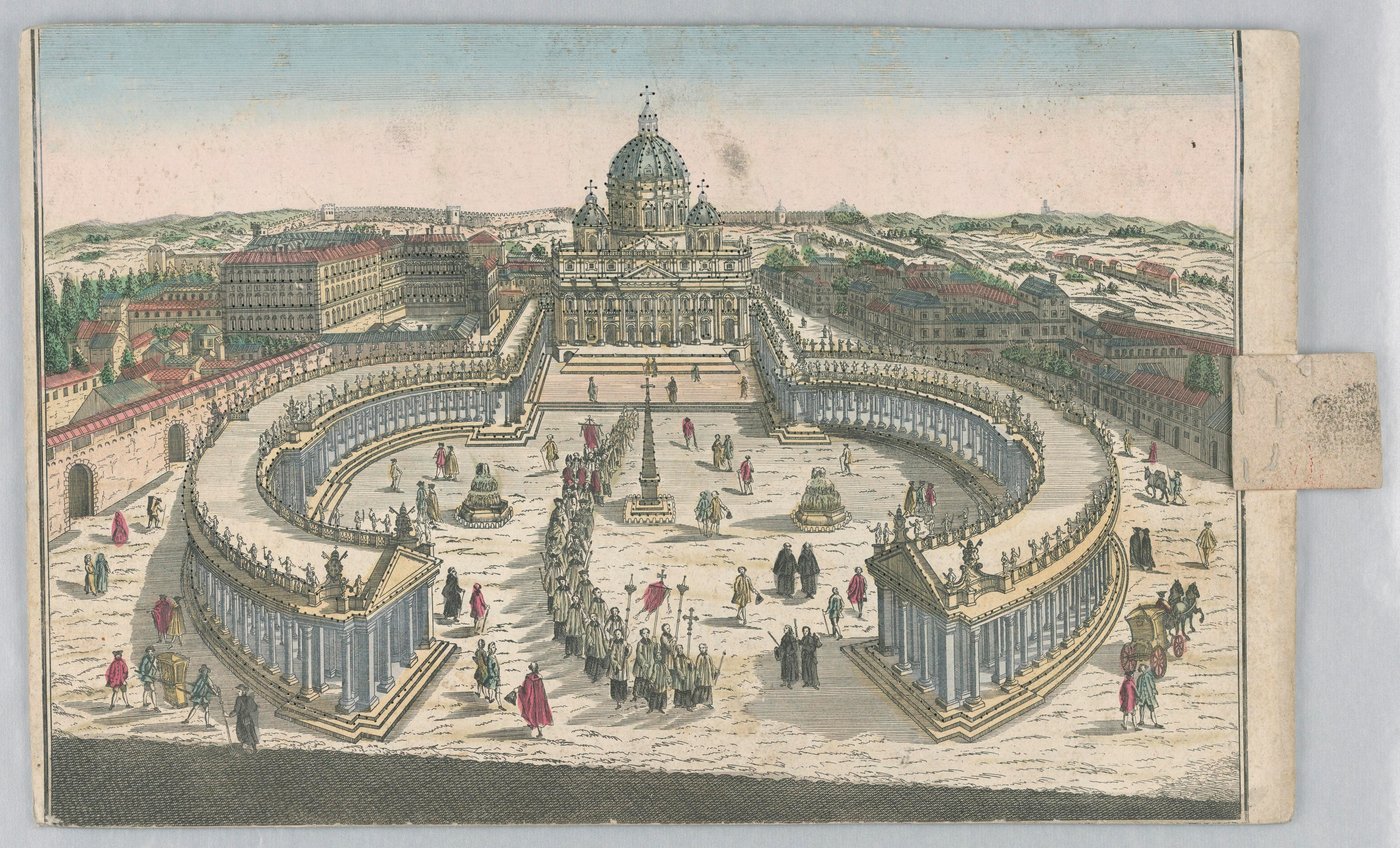
Peep-Show Print: St. Peter's Basilica, Rome — mid- 18th century
Gift of Eleanor and Sarah Hewitt via Smithsonian Open Access (CC0)
The Hours of Jeanne d'Evreux, Queen of France — ca. 1324–28 — French
Jean Pucelle via The Metropolitan Museum of Art (Public Domain)
Quiz yourself