Governance
·
Corporate Governance
·
Mondragon
Medium
6 min
What Happens When the Workers Own the Company?
How Mondragon built a global corporation without shareholders calling the shots
Share
Imagine showing up to work knowing you can vote out your boss. Not just complain to HR — actually vote. That's Monday morning at Mondragon, a company with 80,000 employees and no outside shareholders.
Most companies have a split at the center: the people who own the company (shareholders) and the people who work in it (employees). The owners hire managers to protect their investment. The workers follow orders to keep their jobs. Everyone's interests point in slightly different directions, and keeping those tensions from blowing up is what corporate governance is about — the rules, structures, and people that decide who gets to make what decisions.
Mondragon is a stress test of what happens when you collapse that split entirely.
In 1956, a Catholic priest named José María Arizmendiarrieta (1915–1976, Basque Country, Spain) — who had spent years teaching technical skills to poor young men in the town of Mondragón — helped five of his former students start a small workshop making paraffin heaters. They structured it as a cooperative: every worker was also an owner. One person, one vote on major decisions. Profits shared among members. No outside shareholders to answer to.
Arizmendiarrieta's conviction was that ownership changes how people work, not just how they're paid. He was right, though not in the ways you'd expect.
Make your call
Mondragon grew from five workers to 80,000 across dozens of countries. What do you think is the hardest governance problem that scale created?
A
Paying workers fairly when some cooperatives are more profitable than others
B
Keeping democratic decision-making meaningful when there are 80,000 voters
C
Convincing customers to trust a company without traditional shareholders
Mondragon's answer was to build governance in layers. Individual cooperatives — a machine shop, a supermarket chain, a university — each run their own one-member-one-vote elections for a governing council. Those councils send representatives to a Congress that sets policy for the whole group. Workers elect their own managers and can remove them. A Social Council handles wages and working conditions separately from the Governing Council, which handles strategy.
It sounds like a lot of meetings. It is. But it also means that when Mondragon's leadership decided in the 1990s to expand internationally, the workforce had actual input — not a survey, not a town hall where the decision was already made, but a vote that could have gone the other way.
That's genuinely unusual. In most large corporations, workers find out about major strategic shifts in a press release.
Key Insight
The ratio that defines Mondragon: the highest-paid worker earns at most 6x the lowest-paid. At most large corporations, that ratio runs 300x or higher. This isn't charity — it's a governance rule, enforced by the workers who would otherwise be on the low end of the gap.
Mondragon isn't a utopia, and the honest version of this story requires saying so. When the 2008 financial crisis hit, the cooperative's manufacturing arm — Fagor, which made home appliances — collapsed. 5,500 workers lost their jobs. The cooperative tried to redeploy them to other divisions, and succeeded with many, but not all. Some workers ended up unemployed.
More pointed: Mondragon's international subsidiaries, factories in places like China and Brazil, are not cooperatives. Those workers are regular employees with no ownership stake and no vote. The cooperative structure that protects workers in the Basque Country doesn't extend to the people assembling products elsewhere. Critics call this a contradiction the organization has never resolved.
What Mondragon proves is that worker ownership at scale is possible — 80,000 people, billions in revenue, globally competitive. What it doesn't prove is that it's easy, or that the model exports cleanly everywhere it goes. The governance structure that works in a Basque machine shop requires real adaptation — and sometimes compromise — when you're running a supermarket chain across Spain or a factory in another country with different labor laws and no cooperative tradition.
The five workers who started with paraffin heaters in 1956 built something that no business school predicted could survive past a few hundred people. It's still there. That's the part worth sitting with.
Related threads
Governance
·
How Founders Stay in Charge After Selling the Company
·
dual-class shares
How Founders Stay in Charge After Selling the Company
Governance
·
Who's Actually Running the Company?
·
public companies and founder-led…
Who's Actually Running the Company?
Governance
·
When Your Boss Gets Paid in Stock, Whose Side Are They On?
·
stock-based pay
When Your Boss Gets Paid in Stock, Whose Side Are They On?
Sources
Images from Wikimedia Commons. Attribution required by license.
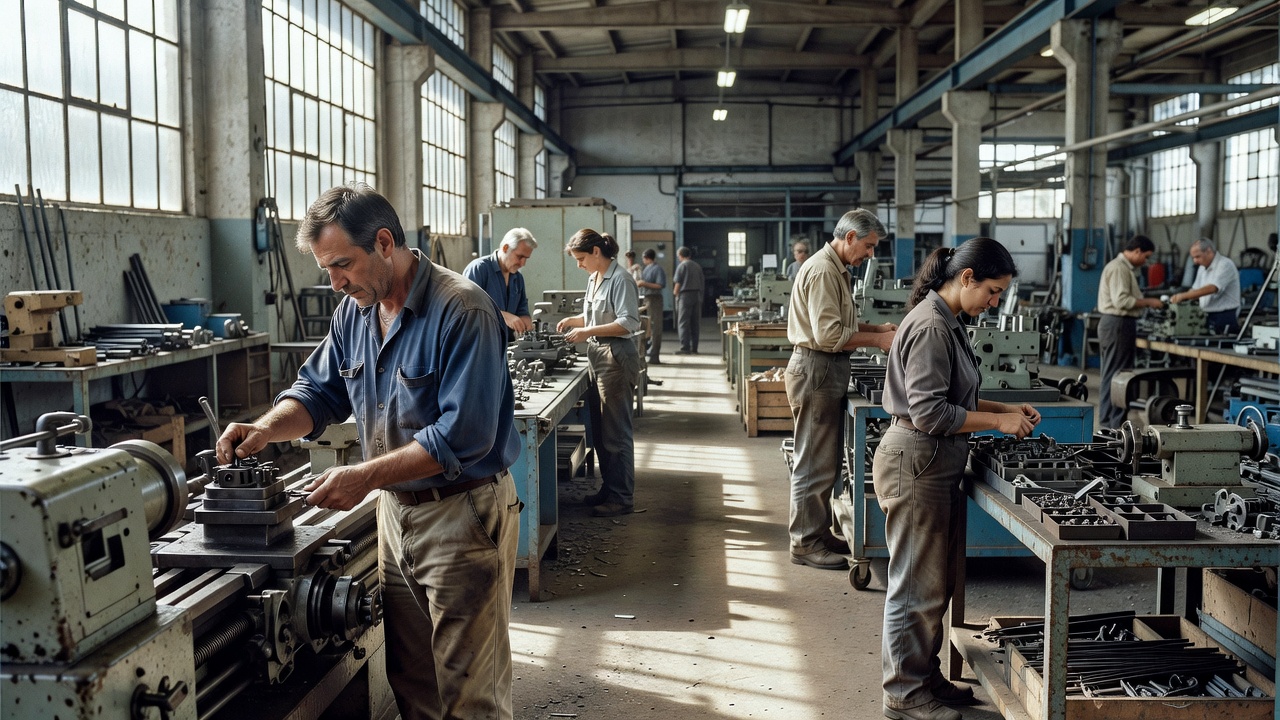
Mondragon cooperative factory
Generated by Grok Imagine (xAI), prompt: Generate a single 16:9 horizontal image for an educational lesson.
Lesson title: "What Happens When the Workers Own the Company?" · How Mondragon built a global corporation without shareholders callin…
Jose Maria Arizmendiarrieta portrait
Generated by Grok Imagine (xAI), prompt: Generate a single 4:3 horizontal image for an educational lesson.
Lesson title: "What Happens When the Workers Own the Company?" · How Mondragon built a global corporation without shareholders calling…
Quiz yourself