Governance
·
Corporate Governance
·
dual-class shares
Medium
5 min
How Founders Stay in Charge After Selling the Company
Why owning most of a company doesn't mean controlling it
Share
When Meta went public in 2012, Mark Zuckerberg owned about 28% of the company. But he controlled over 56% of the votes. Somehow, selling half his stake made him more powerful.
Who actually controls a company — not who works there, but who makes the big calls? In most public companies, that question has a simple answer: whoever owns the most stock. One share, one vote. But some of the most powerful companies on earth are built on a different answer entirely.
When a company goes public — meaning it sells shares to outside investors for the first time — the founders typically give up a chunk of ownership in exchange for cash. Enough rounds of this, and a founder can end up owning a minority of their own company. Under normal rules, that means they can be outvoted. Outvoted means fired. Larry Page and Sergey Brin watched that happen to Steve Jobs at Apple in 1985 and decided they weren't going to let it happen to them.
Make your call
So how do you raise billions from investors while making sure those investors can never outvote you? What do you think founders do?
A
They keep a majority of shares and never sell below 51%
B
They create two classes of stock — one with far more voting power than the other
C
They write contracts that limit how investors can vote
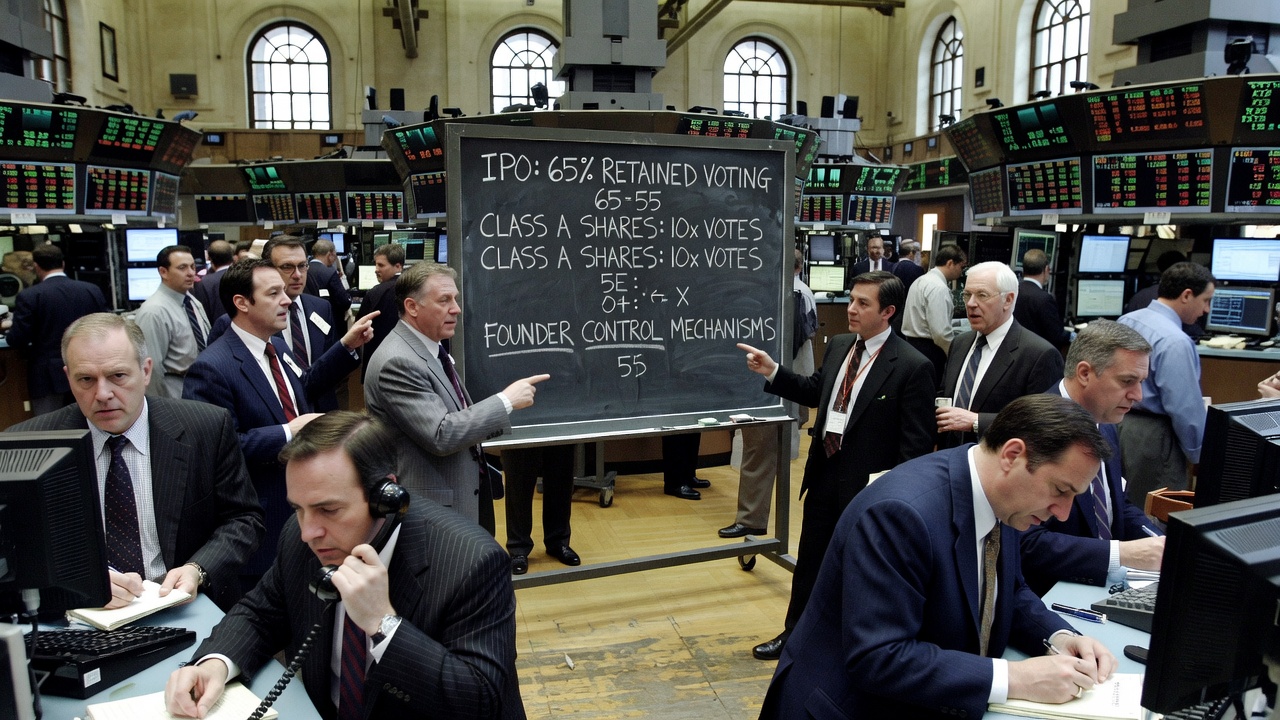
The mechanism is called dual-class shares. Before going public, a company creates two categories of stock. Class A shares go to outside investors: one share, one vote, normal. Class B shares stay with the founders: one share, ten votes. Sometimes twenty. When Google went public in 2004, Page and Brin (and later Eric Schmidt) held Class B shares worth ten votes each. Investors who bought in at IPO got Class A — one vote each. The public owned most of the company's economic value. The founders owned most of the control. Those are different things, and keeping them separate is the whole game.
Key Insight
Ownership and control are not the same thing. Dual-class shares split them apart on purpose. You can own 70% of a company's value and have no say in how it's run. You can own 10% and be impossible to remove.
The argument for this structure is straightforward: founders think long-term, markets don't. If Zuckerberg had to answer to a shareholder vote every time he made an unpopular bet, Facebook might never have bought Instagram for $1 billion in 2012 — a deal that looked insane at the time and turned out to be one of the best acquisitions in tech history. Dual-class shares insulate founders from short-term pressure. The argument against is just as straightforward: it insulates them from accountability entirely. When things go wrong — and sometimes they do — there's no mechanism to remove the person responsible. WeWork's Adam Neumann held supervoting shares that let him steer a company into near-collapse while remaining unchallengeable. He eventually left, but only because his own investors convinced him to — not because shareholders could force him out. That's the tradeoff baked into the structure: you get visionary leadership when the founder is right, and you get no recourse when they're not.
Related threads
Governance
·
What Happens When the Workers Own the Company?
·
Mondragon
What Happens When the Workers Own the Company?
Governance
·
Who's Actually Running the Company?
·
public companies and founder-led…
Who's Actually Running the Company?
Governance
·
When Your Boss Gets Paid in Stock, Whose Side Are They On?
·
stock-based pay
When Your Boss Gets Paid in Stock, Whose Side Are They On?
Sources
Images from Wikimedia Commons. Attribution required by license.
stock market IPO listing
Generated by Grok Imagine (xAI), prompt: Generate a single 16:9 horizontal image for an educational lesson.
Lesson title: "How Founders Stay in Charge After Selling the Company" · Why owning most of a company doesn't mean controlling it
Doma…
Quiz yourself