Governance
·
Power Transfers
·
why federations dissolve (USSR,…
Medium
7 min
Why Federations Fall Apart From the Inside
What the Soviet Union, Yugoslavia, and Brexit have in common
Share
The Soviet Union had nuclear weapons, the world's largest army, and 70 years of institutional inertia. Yugoslavia had held together through two world wars. The UK had been a union for over 300 years. All three came apart — not by conquest, not by revolution, but because the people inside them stopped agreeing on one basic question: who does this thing actually serve?
Power doesn't only transfer through elections or coups. Sometimes it transfers through disintegration — a federation splits, a union fractures, and what was one political entity becomes several. This lesson is about that specific mechanism: why federations dissolve. Not how they're conquered, not how they're reformed. How they pull themselves apart from the inside, and why the shape of that process looks eerily similar across wildly different cases.
A federation is a deal. Several distinct groups — nations, regions, republics — agree to pool sovereignty in exchange for something: security, trade access, a shared currency, a bigger seat at the global table. The deal holds as long as every member believes they're getting more out than they're putting in. The moment that calculation flips, the federation is already dying. The formal dissolution is just the paperwork.
Make your call
The USSR, Yugoslavia, and the UK's relationship with the EU all collapsed under pressure. What do you think was the core trigger in each case?
A
A dominant external enemy disappeared, removing the original reason to stay together
B
Economic stress made the weaker members feel they were subsidizing the stronger ones
C
A single charismatic leader's death removed the glue holding the federation together
In the USSR, the Baltic republics — Estonia, Latvia, Lithuania — had been forcibly incorporated in 1940 and never stopped keeping score. By the 1980s, they were producing more per capita than the Russian core was redistributing back to them. When Mikhail Gorbachev (b. 1931, Russia) loosened central control through glasnost and perestroika, he didn't expect the republics to sprint for the exit. They did, because the economic grievance had been there for decades, waiting for the door to open. The formal dissolution in December 1991 wasn't a surprise to anyone paying attention — it was the moment the paperwork caught up with reality.
Yugoslavia ran the same script. After Josip Broz Tito (1892–1980, Croatia/Yugoslavia) — the strongman who'd personally held the federation together through force of personality and selective repression — died, the underlying math became visible. Slovenia and Croatia, the wealthiest republics, were transferring resources to Serbia and the poorer south. When the federal center tried to maintain that transfer through increasingly Serbian-dominated institutions, Slovenia and Croatia concluded the deal had been renegotiated without their consent. They left in 1991. War followed, but the dissolution preceded the war — the violence was a consequence, not a cause.
Brexit is the same shape in a different costume. The UK's Leave campaign ran on a single economic claim: the UK sends £350 million a week to Brussels and gets less back than it gives. The number was contested — economists called it misleading — but the underlying feeling it captured was real to millions of voters. England, particularly outside London, felt the EU was a deal that served cosmopolitan elites and continental manufacturers more than it served them. When the referendum came in 2016, enough people decided the cost-benefit calculation had flipped.
Key Insight
The pattern: federations don't dissolve because of ideology or identity alone. Identity is the language people use to describe the grievance. The grievance is almost always about who is subsidizing whom — and whether that transfer still feels worth it.
There's a second condition that runs alongside the economic one: the center has to lose its monopoly on the story. Every federation maintains itself partly through a shared narrative — we are stronger together, we share a history, the union is what makes us safe. When that narrative starts competing with a counter-narrative (we are being exploited, our culture is being erased, the center doesn't represent us), the federation is vulnerable. In the USSR, state media's collapse let 70 years of suppressed national histories resurface overnight. In Yugoslavia, Serbian state television in the late 1980s ran a relentless campaign reframing the federation as Serbian sacrifice for ungrateful neighbors. In Brexit Britain, a decades-long tabloid drumbeat about EU bureaucratic overreach had already done the narrative work before the referendum was called.
Once the economic grievance and the counter-narrative align, dissolution becomes a coordination problem, not a values problem. Enough people have to believe enough other people are ready to leave — and then someone has to move first. In the USSR, Lithuania declared independence in March 1990. In Yugoslavia, Slovenia held an independence referendum in December 1990. In Brexit, Nigel Farage (b. 1964, UK) and the UKIP movement spent a decade making 'leave' feel like a realistic option rather than a fringe fantasy. The first mover changes what's imaginable for everyone else.
Related threads
Governance
·
The Coup That Forgot to Cut the Phone Lines
·
anatomy of a coup that failed (which…
The Coup That Forgot to Cut the Phone Lines
Governance
·
Who Actually Keeps a Dictator in Power
·
how one-party states maintain internal…
Who Actually Keeps a Dictator in Power
Governance
·
Why Some Leaders Actually Leave
·
what makes a peaceful transition of…
Why Some Leaders Actually Leave
Sources
Images from Wikimedia Commons. Attribution required by license.
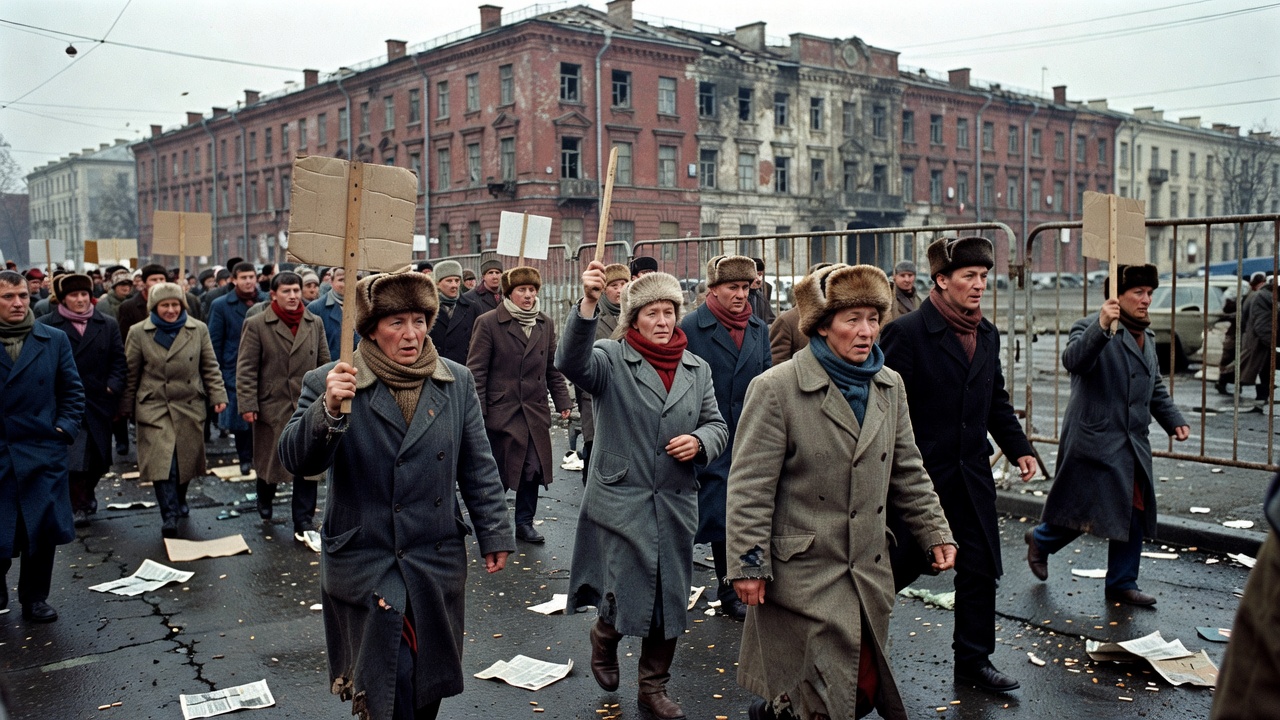
USSR dissolution 1991
Generated by Grok Imagine (xAI), prompt: Generate a single 16:9 horizontal image for an educational lesson.
Lesson title: "Why Federations Fall Apart From the Inside" · What the Soviet Union, Yugoslavia, and Brexit have in common
Domain: gov…
Soviet republics map 1991
Generated by Grok Imagine (xAI), prompt: Generate a single 4:3 horizontal image for an educational lesson.
Lesson title: "Why Federations Fall Apart From the Inside" · What the Soviet Union, Yugoslavia, and Brexit have in common
Domain: gove…
Quiz yourself